
Students renew protest against education bill


Play
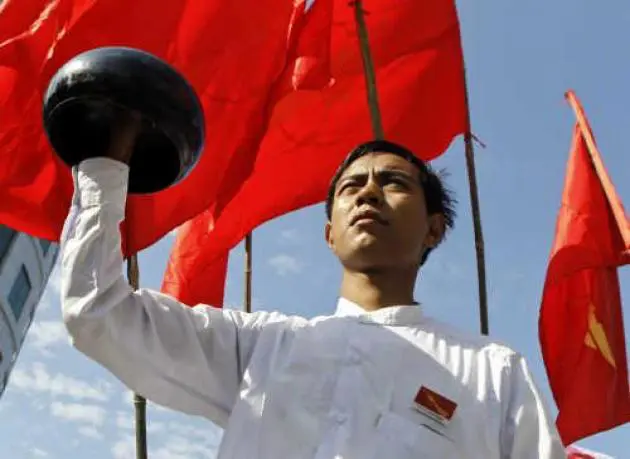
Mandalay - Students nationwide today renewed their protests against the National Education Bill, saying the government has failed to solve the problem after the 60-day deadline.
The students launched a mass protest in Yangon on November 14, which continued for four days and was attended by hundreds of students. They demanded the government step in and amend the bill within 60 days.
This time, they will march from Eintawyar Pagoda in Mandalay towards Yangon, which is 575km away.
Nan Lin, a student, said that the march would last about 15 days. They will pass Myingyan, Pakkoku, Magway and Pyay before reaching Yangon.
“If necessary, we will use cars,” the student said.
“Recently, some face beating by angry mob. To avoid these incidents, we will stop at night for the sake of students,” added Nanda Sit Aung, a member of Democracy Education Initiate Committee.
They anticipate participation of students from various organisations. Along the route, they will chant slogans like “We desire democracy education”, “We don’t need education not supported by students”, and “Freedom to organise student unions”.
They also plan talks along the route, to draw public participation to the protest.
In December, Mandalay hosted a protest.
“We have been protesting National Education Law since its drafting stage,” Swe Lin Htun, Chairperson of Mandalay District Students’ Union, said then. “Because this law puts the education under the control of the central government, it cannot guarantee the democratic education system that we want. I don’t believe it gives us academic freedom. The main thing we need is to remove restrictions on forming student unions.”
The law has met public backlash since its drafting stage, but the parliament approved it nonetheless in July.
Opposing the law is the National Network for Educational Reform (NNER), which brands the law “substandard” and “centralised”. In August, the network also announced the plan to form a national education commission and higher education coordination committee. This is despite the fact the two institutions are branded “unnecessary” in the law.
The network also called for more inclusive education, with special clauses taking into account children with disabilities.
The coalition, which cover school teachers, students and law experts, has criticised the Ministry of Education’s 2014 reform proposals as “propaganda of the government” created without enough input from the public. Importantly, it attacked on the centralisation of the plan. Under the bill, students’ unions remain illegal. All schools and universities, except defence academies, must be supervised by the ministry.
