
Public education campaign launched


Play
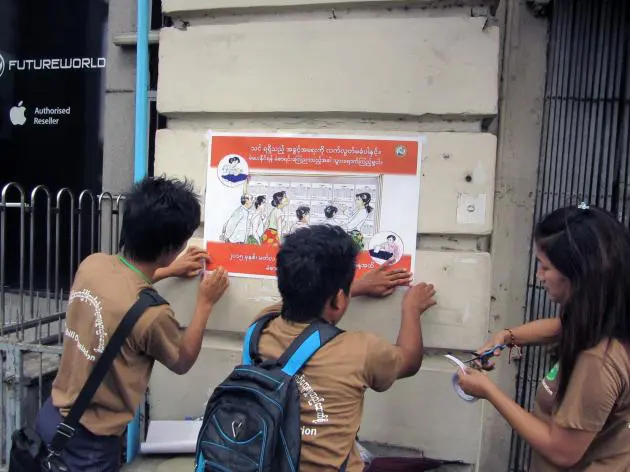
Civic social organisations (CSOs) in 10 townships in Yangon are going door-to-door in an effort to get all eligible residents on the voters' list ahead of this year's election.
The Horn Bill, a CSO, is working to educate residents in Kyauktada and Botataung townships by handing out leaflets, making announcements in newspapers and explaining the voting system to households throughout the area.
"It is tiresome going door-to-door as the heat is intense these days," said Chan Lyun from Horn Bill. "Distributing leaflets doesn’t reach the majority of people. Some don’t like it and some have no interest when we go house-to-house."
Even if representatives from the Union Election Commission introduce his organisation's members, "we don't (always) get a warm welcome," Chan Lyun added.
The CSOs could be more effective if they work more closely with the commission, which has a greater ability to reach the public through the media. CSOs have until March 29 to get residents on the voters' list.
In Latha Township and several other townships, the work is being carried out by a network of seven CSOs, said Khin Lay Nge of Phanteeyar Network.
Apart from Kyauktada, Botataung and Latha townships, CSOs are talking to potential voters in seven other townships: Seikan, Dagaon, Seikgyi-Khanaungto, Lanmadaw, Pazuntaung, Dawbon and Kamayut.
Myanmar is expected to hold the 2015 elections in October or November. It is considered the most important milestone in the country that just ended the military ruling and embraced democracy.
Apparently in the effort to ensure transparency, members of the US-based Carter Centre and the European Union will be invited to monitor a general election later this year, according to Reuters.
Reuters quoted Soe Thein, a senior minister at the president's Office, as saying at a forum on Monday "We'll allow the Carter foundation and EU to observe the upcoming general election independently to ensure the election takes place free and fair," Soe Thein, a senior minister at the president's Office, said at a forum on Monday.
"It will be the first general election held under a democratically elected government in many years," he said.
It would be the first time in at least 65 years that the country will call in Western poll observers. Foreign observers were not allowed in the 2010 general elections that ushered in Myanmar's first semi-civilian government after almost half a century of military rule. Only observers from Southeast Asian nations were invited to the 2012 by-elections, which brought democracy icon Aung San Suu Kyi to parliament.
Before 2010, the last general election in Myanmar, then Burma, was held in 1990, but the military did not allow parliament to convene. At the election before that in 1960, it was not clear if foreign observers were invited.
The Assembly of the Union is made up of two houses – a 224-seat upper house and a 440-seat lower house including the military quota.
The NLD expects to win 80 per cent of the lower and upper house seats and plans to field more than 1000 candidates in the election, Han Tha Myint , a member of the NLD’s Central Executive Committee, told Thai journalists recently.
