
Pre-election contentious issues
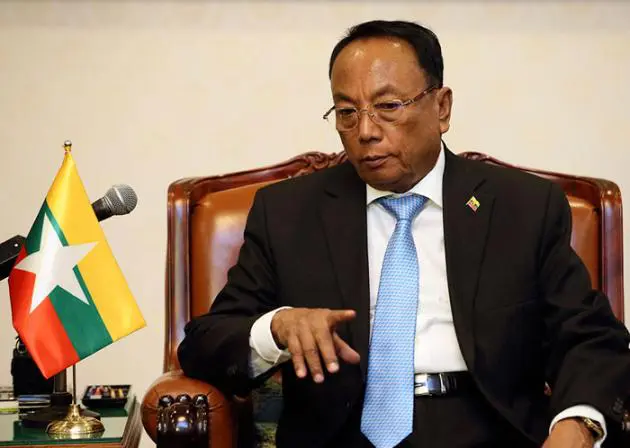


Upper House speaker Khin Aung Myint said on Wednesday that Myanmar should consider a presidential bid from opposition leader Aung San Suu Kyi, South Korea's Yonhap News Agency reported.
The speaker told Yonhap that a presidential bid from the country's opposition leader Aung San Suu Kyi should be considered from a point of national interest, not individual.
"We should look at this problem not from the point of one individual, but from the point of the national interest of the country as a whole," said the speaker. "In the process of transforming democracy, there should not be an emphasis on one or another person over the process of deciding the fate of the country as a whole."
Khin Aung Myint was in Seoul this week to meet with Chung Eui-hwa, the speaker of the unicameral National Assembly and other officials to discuss bilateral cooperation.
The speaker is one of the six negotiators involved in the amendment discussion convened ahead of the country's landmark general elections set for late 2015.
"In my personal opinion, everybody should participate (in political leadership). Of course, Aung San Suu Kyi is an intellectual and because she has a political image inside the country, I would like her to participate in the leadership of the country as well."
"This upcoming election will be the second in our democratic reform process so therefore it is very important for the country, for the elections and post-election period to be conducted calmly and fairly," he said.
Khin Aung Myint said no matter who becomes the next president, everybody must work toward the betterment of Myanmar with goodwill.
International community has all eyes on the election, calling for free and fair election.
In an assurance, a Myanmar delegation led by the Minister of the President's Office Aung Min sent a letter from President Thein Sein to Japanese Prime Minister Shinzo Abe during a four-day visit to Japan, according to sources.
In the letter, the president promised to continue with the national peace process and democratic reform, and guaranteed a free and fair election later this year.
The delegation visited Japan to mark the signing of the nationwide ceasefire draft with ethnic armed groups in March in the hope of securing Japan's continuing support.
Japan is among the largest donor countries providing humanitarian assistance to Myanmar. It halted aid to Myanmar in 1988 when the military took power.
Japan resumed its assistance in 2011 under Thein Sein's administration. Shinzo Abe later made a historic visit to Myanmar, the first by a Japanese prime minister in 36 years.
United Nations Secretary-General Ban Ki-moon last week also urged Myanmar to address the citizenship status of Rohingya Muslims in the country's western Rakhine state ahead of the election.
Almost 140,000 of Myanmar's 1.1 million Rohingya, most of whom are stateless, remain displaced after deadly clashes with Buddhists in Rakhine in 2012.
"The international community is still deeply concerned about the situation in Rakhine," Ban told a gathering of countries called the "Partnership Group on Myanmar."
"Long-term stability in Rakhine will remain unattainable without comprehensively addressing the issue of status and citizenship of the Muslim populations," he said.
"The communal situation in Rakhine and elsewhere remains fragile," Ban said. "There are already troubling signs of ethnic and religious differences being exploited in the run-up to the elections. The reform process could be jeopardized if the underlying causes of these tensions are left unaddressed."
Ban said he expressed "concern that continuing controversies on the race and religious bills as well as absence of swift action to regularize the status of white card holders will be seen as institutionalised discrimination."
"With general elections looming, the government must take urgent and practical measures to address these issues and their underlying causes," he added.
Ban raised the treatment of white card holders with President Thein Sein, saying that failure to permanently resolve the citizenship status of Rohingyas will leave the country open to constant criticism.
"The clashes in Kokang (Shan state) are also deeply disturbing in terms of the toll of lives and destruction," he said. "Humanitarian actors will need unimpeded access to providemuch needed aid in a timely fashion. The tensions arising from these clashes must not jeopardise the larger peace process."
