
Politics heat up on military move


Myanmar's political scene is aliveafter Union Parliament last week voted down the proposed changes to Section 436(a) and (b), which designates how the 2008 Constitution can be altered.
That military MPs strongly defended the Constitution to retain the veto power left elected politicians in dismay.
Aung San Suu Kyi, the leader of National League for Democracy which has not yet officially announced its decision whether to run in the upcoming election, said after the voting that the result was not a surprise. Yet, the voting would not influence the party’s decision-making process, she said.
“Our participation does not depend on the amendment of the Constitution. The NLD will consider other matters. We have not moved backward because of this. I believe the people will decide [rightly] now they know who wants change,” she said.
The parliament approved an amendment to Section 59(d) but rejected amendments to sections 59(f), 60(c), 418(b), 436(a) and 436(b). Section 59(f) blocks Aung San Suu Kyi from being elected president, while Section 436(a) gives the military an effective veto to any proposed change.
There was a proposal to trim the share of house votes required to amend the Constitution from over 75 per cent to 65-70 per cent, essentially removing the military's veto.
This drew strong defence from military MPs.
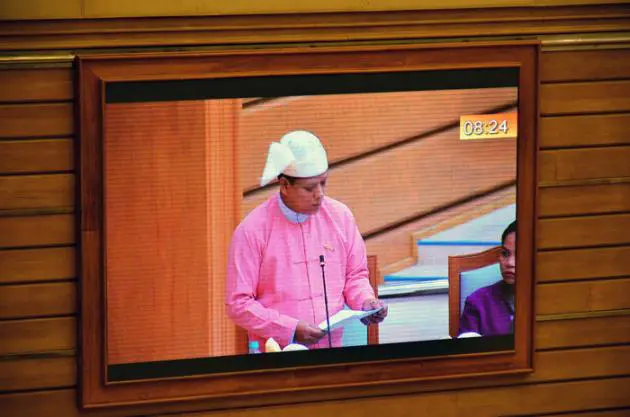
"Myanmar is still in a democratic transition ... stability and reconciliation are very important in this period and democratic practices are not mature enough yet," Brigadier General Tin San Naing, one of 166 officers hand-picked by the military to serve as lawmakers, told the house as debate opened on Tuesday.
"This is not the right time," he said, referring to the proposed change to Section 436(a).
He said it took six years and four months to draft the 2008 Constitution, taking into consideration different views on politics, security, administration and social and legal affairs. He also mentioned that 92.48 per cent of voters supported it. Objecting to changes, he said the United States amended its constitution only 27 times in more than 200 years. He also said lessons from
France and Egypt showed violence is possible when countries changed their constitutions. He noted that chaos could take place in Myanmar where is home to more than 100 ethnic groups. He said that in this scenario, the Tatmadaw (armed forces) can contribute more towards democracy, while safeguarding the Constitution.
Brigadier-General Tin Soe, another military representative, also argued against changing Section 59(f). He said foreigners, including “Bangalis” and Indians, had settled in Myanmar and intermarried with indigenous people since 1824. He blamed this for sparking numerous “Bangali” crises in the country.
He said historically, foreigners had stirred up domestic trouble and tried to control the country’s economy and security matters. Myanmar needed to be aware of the danger of being colonised, he said. The relationship with foreign powers should always be transparent, Tin Soe said, so the president and their spouse and children should be clear of influence from other countries, he added.
Elected MPs’ voice
Upper House MP Paw Shan Lwin from the Chin National Democratic Party proposed that Section 436(a) should be amended with the approval of two thirds instead of 75 per cent.
MP Aye Maung said: “Any presidential candidate representing the military should also be elected by the people. We need to amend Section 436(a). Otherwise, it is like the people are being held in custody.”
MP Nan Say Awa from the Phalon-Sawaw Democratic Party pointed out that under the previous constitutions adopted in 1947 and 1974, only elected MPs had the power to amend Section 436.
“According to democratic practices, any constitution can be amended with approval of over 50 per cent of all MPs,” she said.
The Union Parliament comprises 489 elected representatives and 166 military appointees numbering 664. Only 633 hold the seats as 31 seats are vacant. The charter amendment bill required votes from 475 MPs. However, on the voting day, only 583 MPs were present.
During the debate, Kyun Khae, the MP for Chin State, mentioned that the amendments would be possible only with the approval from Senior General Than Shwe, the last junta leader. He supported the end of military veto power and change to Section 59(f).
Suu Kyi’s displeasure
Suu Kyi said military MPs tried to block the amendment process.
“They objected to the charter change and they did it again. The people will now clearly understand their objective which is against the wish of elected MPs,” she said, adding that five million people signed a petition to support the charter change.
The amendment bill was proposed by an MP from the party. Durign the debate, Thein Tun Oo, an MP from the ruling Union Solidarity and Development Party, showed his support to the changes to Section 436, because circumstances had changed since it was drafted.
“If the country is said to be on the path to democracy, we should not forget democratic standards. Fixing the extent of democratic norms is of great importance,” Thein Tun Oo said.
Nevertheless, Suu Kyi attacked the ruling party for its inadequate efforts.
"It doesn't even want to support an inadequate amendment. It means no change is wanted. Representatives who didn't support it want no change,” Suu Kyi said.
Suu Kyi said she didn't expect to be able to run for the presidency as the Section 59(f) is amended.
"I don't see ourselves as losers on constitutional amendments. We expected it. The people too anticipated this result,” she concluded.
Asked if the result dashed all political hopes for the country, NLD MP Aung Moe Nyo said it showed the hopes of the people are ignored but such hopes would not wither away.
