
US to seek cooperation in illegal fishing battle


Play
Will not impose sanctions but work with developed nations on action plan
The United States will seek international cooperation, rather than impose sanctions, on
various countries in the battle against illegal fishing, senior officials said.
Under President Barack Obama’s executive action, the US has launched and been implementing since March an action plan to prevent seafood products from illegal fishing or harvesting from entering the US market, said US Deputy Assistant Secretary for Ocean and Fisheries David Balton.
“Some 80-90 per cent of sea food consumed in the US is imported. The goal is to ensure US consumers are confident that the seafood they buy in stores and restaurants is both sustainably harvested and legally harvested,” he said. “It is important to impose the ‘traceability requirement’ on all seafood sold in the US. We are going to do this in steps. Some species of fish have been at risk of being harvested illegally.”
While the European Union is issuing “yellow cards” as a warning and “red cards” for banning illegal fishery products from entering its market, “we have a kind of outreach or assistance programme to help developing countries that sell a lot of seafood in the US to keep up with whatever new requirements are in place”, Balton said.
By September, the action plan will implement a strategy to optimise the collection, sharing, and analysis of information and resources to prevent illegal, unreported and unregulated fishing or fraudulently labelled seafood from entering the US market.
By December, it will implement recommended adjustments to US tariff codes to properly identify seafood products.
By October next year, the first part of the traceability system will be in place to allow authorities to trace how and where fish has been harvested and produced before entry into the US market.
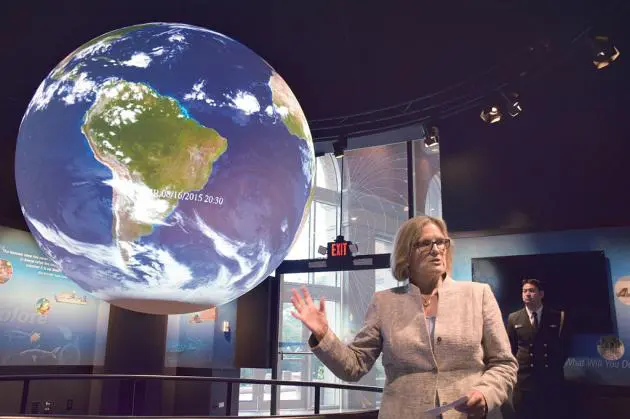
This would then allow the US to know the source of fishery products, said Under Secretary of Commerce for Oceans and Atmosphere Kathryn Sullivan.
Technology, notably satellite as well as international cooperation would help the tracing system work efficiently and effectively, said prominent American scientist Sullivan, who headed the taskforce to map out the action plan.
The US will also encourage countries to also ratify the
Food and Agriculture Organisa-tion’s (FAO) 2009 Port State Measures Agreement to prevent, deter and eliminate illegal, unreported and unregulated fishing.
Under the agreement, which cannot come into force until ratification by 25 countries, the parties will apply rules of the pact to foreign vessels when these seek entry to any port or while they are in port. “If we know you are illegal, you cannot come to our port, you cannot have gasoline,” said Sullivan matter-of-factly.
Michele Kuruc, vice president of oceans policy at WWF, said illegal fishing occurs in every country. Such fishing has caused economic loses at the global level of $23 billion (Bt820 billion) annually, she revealed.
Illegal fishing poses economic instability and impacts ecology, she said.
Southeast Asia has a large number of fishing vessels and a lot of “open fishing” that put pressure on near-shore areas and push fishermen to continue aiming for profit by going farther off-shore, leading to unsafe conditions which contribute to illegal fishing.
One of the primary issues for the global community now is something called “trans-shipment”, in which trawlers transfer their fish into cargo ships, Kuruc said.
While admitting that trans-shipment poses a difficulty in tracing where the fish come from, Russell Smith, Deputy Assistant Secretary for International Fisheries at the National Oceans and Atmospheric Association, said advanced technology and international cooperation could tackle the problem.
“We do have ways to check and distinguish between illegal and legal trans-shipments,” he said. “Regional fishery management organisations have developed rules for trans-shipments. Some were banned, while some were allowed with requirements such as recording when the trans-shipment occurred.”
