
A year in review: Myanmar


Play
A lot happened in Myanmar in 2015. Some brought hope to its citizens, others caused anxiety. Here are our top 10 news to capture the past year.
1. Election
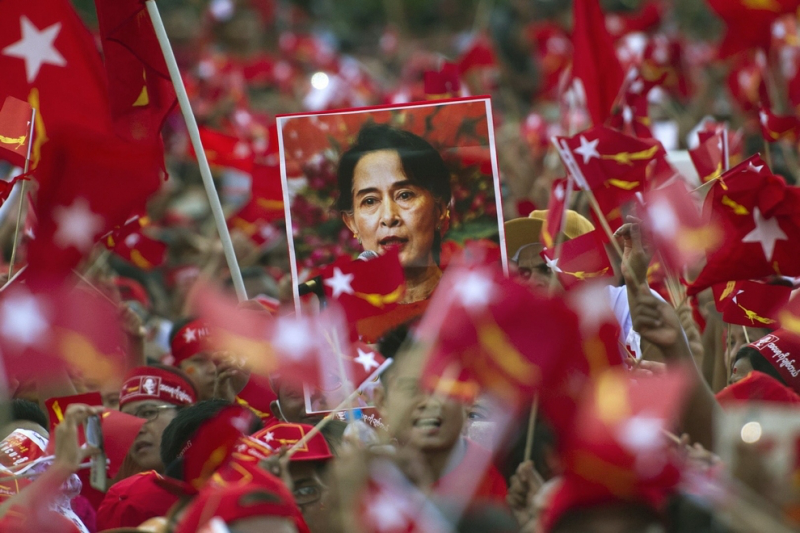
The country’s first fair election was held in more than two decades; 91 parties contested in the November 8 election and 69 per cent of registered voters cast votes. Aung San Suu Kyi’s National League for Democracy unexpectedly emerged as the landslide winner, sweeping 887 seats, or 77.1 per cent of all the 1,150 seats. This was despite the surprising reshuffle at the ruling Union Solidarity and Development Party.
Myanmar citizens anxiously awaited the election, hoping it would open a new chapter for the country which had been under military rule for decades and suffered from severe insufficiencies in basic public services. Ahead of the formation of the first civilian government in April, hopes are high that a true ceasefire agreement would be achieved; the 2008 Constitution would be amended; and economic and social hardships would be addressed.
2. Disastrous flooding
Monsoon rains caused floods and landslides in several parts of Myanmar in June and the situation was worsened by Cyclone Komen. Twelve of 12 states and regions experienced widespread flooding in July and August, leading to 125 fatalities and the temporary displacement of some 1.7 million people.
According to the Ministry of Agriculture and Irrigation, over 1.1 million acres of farmlands have been inundated, with more than 872,000 acres destroyed.
According to UN Office for the Coordination of Humanitarian Affairs data released on December 14, from over 1 million people in need of ongoing humanitarian assistance, 460,000 were flood victims. They will require ongoing support, particularly in the food security sector for about 6 months.
In Kachin and Shan states, up to 4,000 of these people remain displaced. In Rakhine State, one of the worst-hit parts, the damage to crops and people’s livelihoods will be felt by communities well into 2016.
3. World Cup Debut
The national football team’s performance at the World Cup U-20 in New Zealand brought loud cheers to all fans. The footballers showed their skills and fighting spirits. Qualified for the World Cup, the team brought back the good memories to the whole country.
During a ten-year span between 1961 and 1970, Myanmar, then Burma, dominated the U-19/U-20 Asian Cup. But for decades, the team lagged behind. It was ranked as 158 out of 204 countries according to FIFA. Among Asean nations, it was ranked the fifth after Thailand, the Philippines, Vietnam and Singapore.
But the team yielded unexpected results in the AFC U-19 tournament to ensure its place in the 2015 World Cup U-20, making itself the first team to represent Asean in one of the World Cup tournaments.
4 Student crackdown
On March 10, 2015, following a weeklong standoff in the town of Letpadan in Bago Region, police officers violently cracked down on a group of approximately 200 protesters demonstrating against the National Education Law.
Police arrested 127 protesters, journalists, and bystanders in Letpadan. Over 70 face charges that carry sentences of up to nine years and six months imprisonment, and the trial goes on along with commitment to amend the law.
With criticisms against excessive use of force by police officers, it reminded Myanmar people and international community of existing human rights violation in the country.
There are excessive calls for the release of the arrested along with other political prisoners who include farmers and activists.
5 NCA signing
On October 15, eight of 15 invited ethnic armed groups signed the nationwide ceasefire agreement (NCA) with the government.
To some, it was a historic moment as fighting with several ethnic armies, since Myanmar gained independence from the British in 1948, was considered a major hurdle hindering economic development in the impoverished country. Ethnic groups represent around 40 per cent of Myanmar’s 52 million people.
To others, it was the Thein Sein government’s ploy to boost popularity before the November 8 election, as 17 more armed groups particularly those based in Kachin and Shan states were not included.
To the international community, it is a good beginning. There is positive development as NLD becomes part of the peace process.
6 Thilawa SEZ
The first phase of Thilawa Special Economic Zone was officially opened on September 23, being one of the most significant economic successes of the Thein Sein government. Forty eight companies from 12 countries including Thailand are committed to invest more than US$500 million.
Located about 20km southeast of Yangon, the SEZ will comprise a total of 1,096 acres including the second phase, expected to house modern factories that would employ up to 40,000 workers.
The first-phase opening convinced Myanmar and international community that industrial modernisation progresses well in the country. Thilawa’s success brings hope that the development of other two SEZs planned by the government – Dawei and Kyaukphyu - would be completed soon.
Work on Dawei project could proceed fast as it has involved Japan.
Meanwhile, the government is in the middle of allocation of 4,289 acres of land for the implementation of Kyuakphyu SEZ.
President Thein Sein said this month that the implementation of Dawei SEZ and its related projects would benefit not only Thailand and Myanmar but also countries in the region. He urged government officials to double their efforts to finish implementation of the three SEZs on time.
7 Jade mining
The landslide in Kachin State’s Hpakant region on November 21 was one of the most heartbreaking stories. The accident killed over 100 miners. Fears are this would not be the last in the region where jade mining goes on in a rather unregulated manner.
Statistics showed that the heaps of dumped soil have fallen down more than 36 times this year and all claimed lives. In the region where there are only 33,128 households with 312,528 members, more than 800 private jade mining firms exist, operating on 15,638 blocks. Each block measures one acre. Aside, there are 222 joint-venture businesses engaging in jade mining on 302 blocks.
Jade mining proliferated fast during the junta era. Until 1994, only manual kits were used. Now, trucks and new tools are brought in. According to UK-based Global Witness, jade is a significant driver of armed conflicts between the government and the Kachin Independence Army (KIA) as the industry generates funds for both sides. It report showed that Myanmar’s jade production was valued as high as $31 billion in 2014, but the majority of benefits go to former military leaders, drug lords, and crony companies. Former dictator Than Shwe, Minister for Livestock, Fisheries and Rural Development Ohn Myint, former general secretary of the Union Solidarity and Development Party Maung Maung Thein, and US-sanctioned drug lord Wei Hsueh Kang are highlighted as major players in jade.
The Than Shwe, Maung Maung Thein and Ohn Myint families hold multiple concessions which between them generated pre-tax sales of US$220 million at the 2014 jade emporium (the official government jade sale), and US$67 million at the 2013 emporium, according to the report.
8 Minimum wage
The dream of labour groups and workers for minimum wage became true. On September 1, the minimum wage for standard eight-hour day work of Ks3,600 ($2.7) was enforced on companies with 15 employees or more.
The minimum wage was set after two years of fierce negotiation. The tri-partite committee agreed to the rate, weighing in pressure from workers who asked for more and employers who tried to keep it low to maintain cost competitiveness.
It was a tough fight. Before the minimum wage was officially announced, labour groups suggested Ks5,000 ($ 3.83) but employers complained that the business was not good enough for salary increment. Most of whom insisted that they could pay only Ks2,500 ($ 1.91) a day. This led to labour protests in many industrial zones. Many leading workers were detained by the authorities and sued by their respective employers. In July, about 30 garment factories, mainly from China and South Korea, threatened to close down should the minimum wage take effect.
After the Ks3,600 rate came into effect, hundreds of workers lost jobs as their factories were shut down.
The wage leads a worker with 6 working days a week to getting about $70 on a monthly basis. It is more than what some workers, mostly those in garment factories earned before, though it remains the lowest in Asean.
According to a research by the Philippines’ National Wages and Productivity Commission, all the neighbouring countries have set minimum wages and all are higher than Myanmar’s: Thailand, Bt300 or $8.32; Laos, 30,000 kip ($3.7); Cambodia 17,066.67 riel ($4.14), and Bangladesh 176.67 Taka ($2.25). The rate in Malaysia - where thousands of Myanmar migrant workers are working - ranges from 26.67 -30 ringgit ($6.2 - $6.97).
9 Rohingya issue
When the boats carrying thousands of Rohingya Muslims were intercepted in the Indian Ocean, Myanmar once again suffered from criticisms from international community.
Several of the boat people claimed they flee atrocities in Myanmar. This again stirred displeasure among Buddhist Myanmar nationals, forcing the government to address the issue with other Asean nations.
The issue of Rohingya Muslims seems to remain as a difficult thing to tackle in the new government’s term. The word Rohingya itself caused fierce controversy between the government and the international community, as Myanmar insists on using the word Bengali rather than Rohingya.
The minorities still keep on saying that they have been living in Myanmar for long whereas Myanmar people hold their belief that Bengali (Rohingya) is not included in Myanmar’s 135 national races.
United Nations Secretary-General Ban Ki-moon frequently said in 2015 that Myanmar should address the issue of citizenship for Rohingya Muslims. The UN and the United States keep on using the word Rohingya.
Senior officials from both the government and the Parliament_ including House Speaker Shwe Mann, Information Minister Ye Htut, and Rakhine State chief minister Maung Maung Ohn - officially criticised Ban Ki-moon for using the word Rohingya.
Aung San Suu Kyi, chairperson of the National League for Democracy, is also against the citizenship of Rohingya, responding to a question raised at a press conference on November 5 that they are boat people from Bangladesh.
In late November, Myanmar arrested a Muslim publisher and four for printing a calendar that used quotes to support Rohingya Muslims. The calendar used some of former Prime Minister U Nu’s words to debunk the official view that the Rohingya are not an ethnic minority.
It has angered Myanmar Buddhists who believe that such activity threatens the law and order of the country. Myanmar’s Printing and Publishing Law bans publishing materials that could damage national security and law and order. The court charged the arrested people one million Kyat (about US$ 765).
The international community still expresses its concerns over religious tensions between Rakhine Buddhists and Rohingya Muslims in Rakhine State. It is really interesting to keep an eye on how the NLD will address the issue after it takes office in 2016.
10 YSX opening
Yangon Stock Exchange was inaugurated on December 9, injecting optimism to those in the financial market and the entire economy. YSX is a jigsaw in modernising the financial market, to be another source of fund for local companies.
In Asean, there is only Brunei that has no stock exchange.
YSX is new but it aims high. The authorities said YSX has good prospects and could catch up with Vietnam's bourse within three years.
Six companies will be listed. Work is on the way to issue securities licenses. Trading will start in March, primarily restricted to the locals.
