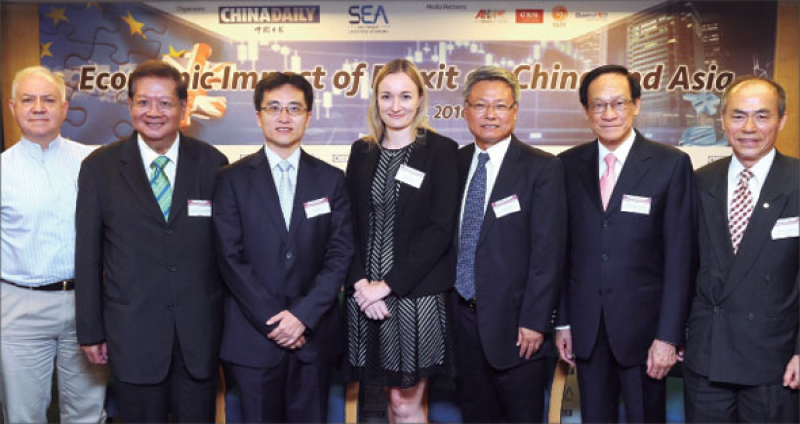
HONG KONG - Britain’s exit from the European Union (EU), known as Brexit, though raising uncertainties across the world, also signals a “new beginning” that will bring more investment opportunities and closer ties with Hong Kong, the Chinese mainland and
Brexit, which triggered a sharp depreciation of the British pound against major currencies including the renminbi, will reduce risks for Chinese companies to do business in the UK, said Jo Hawley, director of trade and investment of British Consulate General Hong Kong.
Jo Hawley, director of trade and investment of British Consulate General Hong Kong. (Photo by Edmond Tang / China Daily)
Buyers from China will find it cheaper to invest in UK properties, she said, adding that Chinese tourists and students will spend less when visiting and studying in the Western country.
“The depreciation of the British pound after Brexit is already providing opportunities for investment in Britain,” Hawley told the forum themed “Economic Impact of Brexit to China and Asia”, organized by China Daily Asia Pacific.
By July 3, 10 days after Britain’s referendum on whether to leave the EU, the British pound had dipped more than 10 percent, from 9.84 yuan ($1.48) per pound to 8.83 yuan.
“In the long term, leaving the EU means that the UK will be free to sign its own trade deals with other countries, such as a free trade agreement with China,” Hawley added.
Tse Kwok-leung, head of policy and economic research at Bank of China (Hong Kong) Ltd, believes Brexit will be beneficial to Hong Kong, as relations between the two sides will become closer.
“Brexit’s impact on Hong Kong is rather insignificant because direct contact between the two places is limited. I believe that after Brexit, Britain will not be alienated from Hong Kong, but they will become closer, for Britain will be free to sign its own trade deals,” Tse said.
The roundtable has the attention of Elsie Leung Oi-sie (second right, front row), deputy director of the HKSAR Basic Law Committee and former secretary for justice. (Photo by Edmond Tang / China Daily)
N.R. Liu, deputy director (business and China) at HKU SPACE and head of HKU SPACE Executive Academy. (Photo by Edmond Tang/ China Daily)
David Dodwell, executive director of Hong Kong-APEC Trade Policy Study Group, however, doubts whether a bilateral trade agreement between the UK and another country or area works effectively at a time of globalization.
“Large companies have supply chains that span 10 to 15 countries (and regions). If trade arrangements don’t embrace all these countries, it is not helpful. Most of the trade agreements in Asia now embrace regional agreements.”
Instead of being optimistic toward Brexit, he pointed out that job opportunities and economic development may also be affected.
“The outcome of Brexit will be catastrophic and the price paid will be substantial for a very long time, because to negotiate how to exit the EU is a very long process, which may cause job uncertainties, career uncertainties, economic stagnation and so on,” Dodwell said.
Michael Yeoh, co-founder and chief executive officer of the Asian Strategy and Leadership Institute, meanwhile, warned that the uncertainties arising from Brexit and the drop in the pound may weaken UK companies’ investment in Asia.
Michael Yeoh, co-founder and chief executive officer at Asian Strategy and Leadership Institute. (Photo by Edmond Tang / China Daily)
Maximizing benefits
The UK is China’s second largest trading partner in the European Union and China is also the UK’s second largest outside the EU. Bilateral trade between the two countries amounted to US$91.03 billion last year, according to the Ministry of Commerce.
Edward K.Y. Chen, president of Qianhai Institute for Innovative Research, said while there would be a long transition period following Brexit, the most important thing in the process is to “minimize short-term cost and maximize long-term benefits”.
“To minimize short-term cost, the first thing for Britain to do is to stabilize its economy. That means to stabilize the exchange rate of the pound in order to restore confidence and trust for investors. The second thing for Britain is to assure the world that London will stay as the No 1 financial center in the world. Meanwhile, the third thing is how Britain will manage its trade with the EU in the post-Brexit era,” Chen noted.
Edward K. Y. Chen, president of Qianhai Institute for Innovative Research. (Photo by Edmond Tang / China Daily)
In the long term, he added, how much benefits the UK will reap from the decision depends on how the country manages its relationship with the international world.
Chen said he is not concerned about that as the Belt and Road Initiative, proposed by President Xi Jinping in 2013 to strengthen international trade and economic cooperation by improving connectivity, provides a new channel for Britain to build relations with all the economies along the route.
“Brexit will not end economic globalization,” Chen said. Instead, it is “a new beginning that will bring new economic opportunities”.
Panelist Edward K. Y. Chen (second right) said the first thing for Britain to do is to stabilize its currency as well as its economy. (Photo by Edmond Tang / China Daily)