
The biggest little Buddha


Play
Hewn from a massive emerald, a tribute to the lost Buddhas of Bamiyan reminds the world about tolerance
An enormous emerald, unearthed in Africa after perhaps two million years and reincarnated in Thailand as an image of the Lord Buddha, has been given the mission of promoting global peace and begun what its admirers liken to a spiritual journey.
The sheer scale of the Abhaya Emerald Buddha – 15.4 centimetres in height and nearly 2,621 carats – appears certain to secure it a place among the world’s great gems. Its closest known rival is the Emerald Unguentarium, part of the Habsburg-Lorraine Household Treasury kept in Vienna, which is 400 carats lighter.
Four centuries ago Emperor Ferdinand III turned down fortunes in gold and pearls that were offered for his Unguentarium, and the owner of the Abhaya Emerald Buddha is today similarly waiving off head-spinning bids, determined that it belongs to the ages and to all of humanity. At any rate, given the altruism invested in its creation, any talk of value is brushed aside as merely callous.
Instead, the statuette will tour the world, going on public display in the hope that it will convey a message of tolerance. It was the religious intolerance of Afghanistan’s fundamentalist Taleban government that led in 2001 to the dynamiting of the towering twin Buddhas carved centuries ago in the Bamiyan cliff-side.
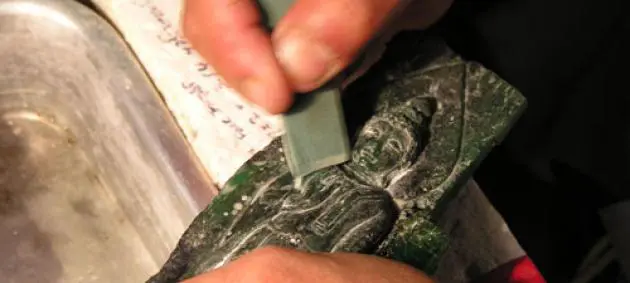
That despicable crime against culture was foremost in the mind of the American who bought the gigantic Zambian emerald. He then commissioned a Myanmarese artisan to sculpt the image of a standing Buddha into it. The abhaya pose (baang haarm yaard in Thai) was deliberately chosen – the Buddha raises a hand to implore families to stop quarrelling.
Paving the way for the Abhaya Emerald Buddha’s introduction to the world, Cameron Cooper and Pascal Butel have written a book about it titled “An Emerald Encryption”, on which they gave a presentation last month at the Foreign Correspondents Club in Bangkok. The book is now in its second edition – the first run was just 99 copies, but those went to such well-regarded international figures as Aung San Suu Kyi.
Cooper has worked as an editor at GemKey magazine, Dow Jones, the Japanese newspaper Yomiuri Shimbun and, briefly, The Nation. Butel inherited a significant collection of ancient Asian art and became an authority on Buddhist iconography.
The man who hired them to write the book – the same American who brought the emerald to Thailand to be sculpted in 2004 – remains anonymous due to security concerns. They refer to him only as “the commissioner”.
Shocked by the loss of the Bamiyan Buddhas, he resolved in a sense to “replace” them with an icon far smaller in scale yet equally dazzling, and much more accessible. To sculpt the stone, a risky job given emerald’s brittleness, he hired Aung Nyein, who had long before fled Myanmar for Mae Sot, where he’s renowned as a jade carver.
It soon became apparent that the 3,900-carat emerald would lose fully a third of its weight as it was pared down to the desired form. The owner shrugged off the considerable reduction in monetary value, says Cooper. “He was motivated by the knowledge that in other hands it was most certainly going to be cut up into pieces and sold off, ending up as somewhat anonymous items of jewellery. He felt that something so rare must be preserved.”
On December 5, 2005, an “auspicious day”, Aung Nyein began his work, drawing inspiration from the subtle features of the mammoth 15th-century Buddha in Sukhothai and a recent Lanna-style bronze installed alongside the Mekong River in Chiang Saen. Two months later he was finished.
Butel waxes poetic in the book, ascribing words to the newly reborn Buddha: “My eyes look swollen. You may understand that if I were not a Buddha I would have cried ... I am simply showing you how to reveal your own saintliness without any cult to follow. I am global and approachable by all faiths.
“I am the largest emerald-carving healing instrument in the history of humanity for all nations. Those who take care of me will be blessed above all ... People who see me once will never forget me.”
Appraisals and certification were obtained from gemology institutes in Thailand and the US and a lab in Switzerland. Barbara Wheat of the International Colored Stone Association found that the icon’s “calming” green “radiated a sense of power and peace”.
“This is the largest single emerald crystal I have ever held,” said Omri Hartavi of Perfect Emerald Co, lauding the owner. “Most dealers would have sliced it up and gone for maximum yield, resulting in many large cut emeralds rather than one huge historic carving. Without a doubt, this decision took a lot of courage and contributes to the intrinsic value of the piece.”
Just how much might the Abhaya Emerald Buddha be worth? It’s a question Cooper and evidently the owner would rather avoid, regarding such evaluations as “vulgar”. A press release issued by the organisers of the 2007 Dubai International Art and Antique Fair – where the statuette was displayed for the first time – claimed it was for sale at US$5 million (Bt157 million). It also named the owner as Bangkok’s Sidhartha Gallery. Cooper says that’s completely incorrect.
“The gallery was representing it, but I don’t recall them claiming ownership. I believe they had the better connections to this particular fair and that was why they were fronting it. More importantly, the Abhaya Emerald Buddha was not for sale and certainly not at a particular price. There has never been a public price put on it – that would be stupid for anyone selling such a piece.”
While in Dubai the statue was examined for the British TV show “Antique Roadshow”, Cooper notes, “and they just said it was ‘priceless’ – as in they didn’t know what sort of value to put on it because they had never seen anything remotely like it.”
He stresses that the statuette will not be offered for sale in the foreseeable future, so the word “priceless” applies literally. And if, in the distant future, the owner decides to “pass it on to another caretaker” – as regional terminology for the sale of Buddha images would have it – “it’s pretty unlikely he’d let it go to someone who was going to keep it in their house to themselves. He’s more concerned about its legacy, now that he sees the possibilities for the impact it can have.” More than likely it will end up in a public shrine or a major museum.
Museums around the world are on the proposed itinerary for the Abhaya Emerald Buddha. Media presentations are being planned for New York and other cities.
“This sculpture is at the beginning of a long and amazing journey that will take it around the world to many places, to be de-encrypted by many people – long after we have all shuffled off the mortal coil,” Cooper and Butel write. “It demands to be shared.”
