
Built for the pro


Play
Fujifilm's big sensor camera raises the curtain on excellence
The new flagship mirrorless interchange lens camera from Fujifilm, the X-Pro1 has been designed with the seasoned photographer in mind. It’s an improvement on the already very good Fujifilm mirrorless X100, which comes with a fixed lens.
The key to X-Pro1’s excellent image quality is the large APS-C 16 megapixel X-Trans CMOS sensor, which is designed to minimise moire and false colours without the need for an optical low-pass filter enabling the sensor to capture the full “unfiltered” resolution and descriptive quality of the XF lens.
The X-Trans CMOS works in combination with Fujinon lens, especially the stellar XF 35mm F1.4 R lens, to capture excellent image files.
X-Pro1 has 3-inch LCD monitor and a hybrid optical and electronic view finder. The camera supports sensitivity of up to ISO 25600.
However, you do need to know how to adjust various parameters to control exposure, for example whether to compensate the exposure value by using over or under value, for example.
There is no intelligent auto mode to assist new comers. The only auto mode is the Program Automatic Exposure, which is achieved by dialling both shutter speed dial and aperture ring to auto option.
X-Pro1 provides intuitive and traditional control layout with a separate aperture ring, and shutter speed dial and Exposure Compensation dial.
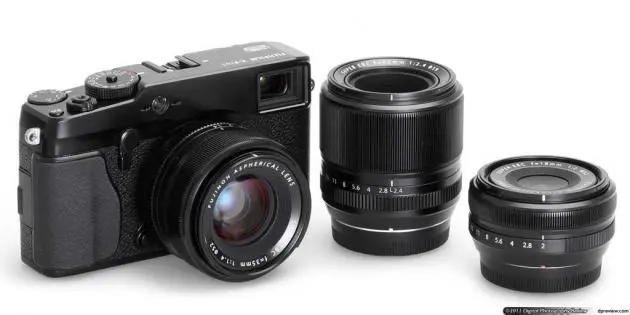
We tested the X-Pro1 at The Nation newsroom with three XF lens – XF 18mm F2, XF 35mm F1.4, and XF 60 mm F2.4 which are equivalent to 27mm, 53mm and 91mm in 35mm photography respectively.
We found during the test that the XF 18mm lens captured beautiful landscape photos while the XF 35mm and XF 60mm lens captured beautiful portraits.
The XF 35mm lens produced sharp and clean portraits with a professionally blurred background and beautiful skin tones.
X-Pro1 uses the approach of film simulation to capture photos. The X-Pro1 can simulate the colour and tonal qualities of acclaimed film brands including the true-to-scene natural look of Provia, the vibrant tonality and saturated colours of Velvia and the silky soft look and beautiful skin tones of Astia. There are also some simulation modes of monochrome films. Before shooting, you must select which film mode you want to use.
I particularly enjoyed shooting with Velvia when capturing golden sunlight of the setting sun. The photos looked very vivid in this mode.
The X-Pro1 can be mounted with an M Mount adapter so that the camera can be used with M Mount Leica lens.
And it’s good that the camera provides a Q (Quick Menu) button. The Q button lets you skip directly to frequently used shooting menus, such as ISO sensitivity setting, White Balance and Film Simulation. You can use the 4-way controller to select the item and the command dial to change settings for speedy operation while shooting.
The X-Pro1 package with XF 35mm lens retails for Bt75,900. The body alone sells for Bt57,900 and comes with a free M Mount adapter. The M Mount adapter sells for Bt6,500. The XF 18mm lens, XF 35mm lens and XF60mm lens retail for Bt19,990, Bt19,990 and Bt21,990 respectively.
Key specs
_ Number of effective pixels: 16.3 million pixels
_ Image sensor: 23.6 mm x 15.6 mm (APS-C) X-Trans CMOS with primary colour filter
_ Storage media: SD memory card / SDHC memory card / SDXC (UHS-I) memory card
_ Lens mount: FUJIFILM X mount
_ Sensitivity: ISO 200 - 6400 (standard); Extended output sensitivity: ISO 100, 12800 and 25600
_ Exposure control: TTL 256-zones metering, Multi / Spot / Average
_ Exposure mode: Programmed AE, Shutter priority AE, Aperture priority AE, Manual exposure
_ Shutter speed: 30 sec. to 1/4000 sec, Bulb (max. 60 min.)
_ LCD monitor: 3.0-inch RGBW (White) LCD monitor, approx. 1,230,000 dots, (Approx. 100% coverage)
_ Movie recording: 1920 x 1080 pixels, 1280 x 720 pixels (24 frames/sec.)
_ Power supply: NP-W126 Li-ion battery
_ Dimensions: 139.5 (W) x 81.8 (H) x 42.5 (D) mm
_ Weight: Approx. 450 g (including battery and memory card)
