
The intimacy of uplift


Play
Businessman Koichi Tsukamoto parlayed Japan's first brassiere into a global lingerie business in just 65 years
It’s rare that a man who pretends to understand women actually has any idea what the fairer sex is all about. The late Japanese businessman Koichi Tsukamoto might not have known women in terms of their emotional complexity, but he certainly had an excellent understanding of their physical features.
Tsukamoto was a pioneer in introducing brassieres to Japanese women. Founder of the Wacoal brand, he designed his first bra to fit his wife’s bust and now, 66 years later, his company is providing support to women all over the world through more than 50 type of bras.
He started the company in Kyoto in 1946, a year after returning home from World War II and at a time when few women had heard of bras.
“Tsukamoto said that with the country at peace, women would be more concerned about beauty,” says public relations officer Katsuyuki Ishida. “Though many were still wearing the traditional style wrap-around garments, he believed Japanese women would quickly became more conscious of Western fashions and Western-style innerwear would become integral. His wife acted as his model for making a prototype of product, which at the beginning was only available in small, medium and large sizes.”
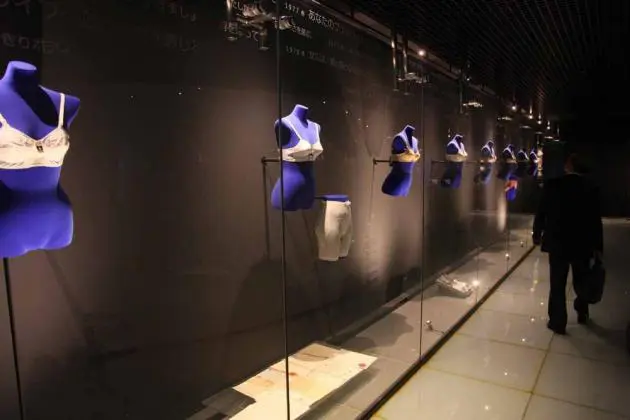
A visit to the company’s head office in Kyoto reveals the extent of the efforts made by Tsukamoto and his team to become closer to women of all ages. The Museum of Beauty showcases the revolutionary creations in the company’s intimate apparel, going from its first bra pad in 1949 and the 1951 Clover broadcloth brassiere complete with pockets for pads to 1965’s bell-flower like stitch bra, which used three-dimensional cutting. Also on show are the 1972 seamless cup bra with front hook and the 1992 ultra soft bra with a bust-enhancing function.
“The company has been conducting research on the female body for more than 40 years. In the beginning, we measured 160 points of a female body by hand to get the accurate line and shape. Today, we employ infrared equipment that is capable of displaying three-dimensional images of the body on a computer in a 360-degree field of vision,” says Ishida.
The complexity of the female body is clearly shown in a glass case displaying the 40 parts required to form a single bra. These parts account for approximately 25 different components and materials. Each brassiere goes through roughly 20 processes with more than 6,000 stitches, which take a single team of 20 personnel about 25 minutes to complete.
The adjacent room serves as a display area of Wacoal products for females from the cradle to the rocking chair. In addition to the 140 patterns of bras in various shades and styles on display along the wall, there’s innerwear for babies and kids, bras for girls as their breasts are developing, as well as a collection of lingerie for a bride to wear under her wedding dress.
Wacoal also designs maternity wear to support a mother’s body before and after childbirth and to help her recover her bodyline, as well as comfy innerwear for older people that is easy to don and take off. Highly functional sportswear for both men and women that promotes greater efficiency of movement is displayed alongside a collection of pumps for businesswomen with comfortable heels and pads to support stable walking.
“Annual sales of Wacoal products worldwide is about US$2.8 billion (Bt85.7 billion). In Asia alone – excluding Japan – it’s about 40 billion yen (Bt15.4 billion),” says Yuzo Ide, general manager of International Operations, adding that about 40 million Wacoal brassieres are sold every year both in and outside Japan.
In 1964, Wacoal established the Human Science Research Centre to carry out scientific research on women’s physiques and develop technology based on its findings. It measures approximately 1,000 Japanese females between the ages of four and 69 every year and has accumulated data on more than 40,000 women and girls.
“To study the body changes associated with ageing, we’ve collected data on an individual’s shape measurement over a 30-year period from the age of 20 to 50. We have 300 examples of body changes from this research, which is very beneficial in developing our products,” explains the centre’s manager Taizou Kishimoto.
Kishimoto shows us three silicon torsos representing women in three age groups: 10-20, 30-40 and 40 up. The chest texture of each torso is made in such a way that it is identical to that of a female in each age group.
“The young one has an ideal rounded bust shape. A sign of physical ageing is the looseness of decolletage skin and firmness and a sagging bust. The breasts will later move downwards and outwards. From the triangle-shaped, firm and rounded hip, firmness is lost and the shape becomes more square. The waistline expands by at least 10 centimetres. The stomach area as a whole starts to protrude,” explains Kishimoto.
“The breast contains no muscles, but fats and milk glands. So you can’t exercise to bring back the firmness of your breasts. You need to wear innerwear that fits correctly in keeping with changes in body size and shape. Don’t just remember the size of your bra. Every time you purchase a new one, you must try it on first. Women should get a bra fitting every three months,” he adds.
Thai Wacoal – now in its 42nd years and under the umbrella of ICC International – is working with the National Electronics and Computer Technology Centre (NECTEC) in studying Thai people’s physical features through three dimensional, body-scanning technology. The data is beneficial in developing products compatible with Thai women’s physiques.
“We receive some data from Wacoal Japan and we are conducting our own research too. We have found that Thai women’s breasts have increased in size over the last 18 years and the average bra cup size is B, while two decades ago, it was A. The number of women wearing cup C is also increasing,” says Thamarat Chokwatana, director and executive vice president of ICC.
Thai Wacoal is free to develop its own patterns to meet Thai women’s lifestyles and trends. But while a wide range of sizes is available, they don’t cater to all body shapes. To rectify this problem, Wacoal offers a personal consultation, measurement and fitting service to meet customers’ specifications at prices not significantly higher than those of ready-made products.
And just as Japan’s Remamma project, which assist women who have undergone mastectomies, there are also made-to-order bras that fit their needs and make them look good and feel confident.
“Most women want a bra that helps their bust look firm and young, Thai women in general prefer comfortable bras with a simple design. Teenagers want adjustable-length bras with spaghetti-like shoulder straps that tie behind the neck. We are making products that are very close to women so we must always try hard to understand what women want,” says Thamarat.
