
Best friends with Budapest


Thailand and Hungary are building a bond that extends to sport, food and even politics
The friendship that Thailand and Hungary enjoy reaches all the way back to King Chulalongkorn’s European tours at the turn of the last century to bolster support for Siam against aggressive colonial expansion. On the first of his two excursions, in 1897, lasting nine months, Rama V – the first Siamese monarch to see Europe – visited Budapest, Kisber, Babolna and Godollo in Hungary.
The friendship matured with a follow-up trip to Budapest in 1902 by Crown Prince Vajiravudh, the future King Rama VI, and blossomed anew when King Prajadhipok (Rama VII) and his queen travelled to the capital and Mezokovesd in August 1934.
Our countries formally established diplomatic relations on October 24, 1973. Hungary opened an embassy in Bangkok five years later, and Thailand had a mission in Budapest by 1989, along with a commercial office to bolster trade.
Ambassador Sompong Sanguanbun and Istvan Simicsko, Minister of State for Sports and Youth Affairs at Hungary’s Natural Resources Ministry, are making plans to celebrate the 40th anniversary of our diplomatic relations, including forging closer relations between our parliaments.
Simicsko, who chairs a Hungary-Southeast Asia Parliamentary Friendship Group, says this summer’s celebratory events will include demonstrations of Thai boxing.
“Muay thai is very popular in Hungary,” he says. “Even my daughter is learning it!
“Children’s personalities shine when they play sports,” he adds. “They become calmer as they concentrate on the game. It’s a good way to teach them to be responsible, to understand the concepts of fair play and sportsmanship. And all these things are taught in the playful way.
“There is definitely an opportunity to use sports to tighten relations between Thailand and Hungary. That’s why we are cooperating with the ambassador to realise the opportunity and put it to practice.”
Sompong points out that Hungary is at the top in several international sports.
“When Singapore wanted to learn more about techniques in world-class-gymnastics, Hungary sent 10 teachers,” the ambassador says. “So if the Thai side is interested in any such cooperation, like asking for gymnastics or fencing coaches from Hungary, things could be managed.”
Hungarian athletes always do well in fencing, gymnastics, kayaking, swimming and judo and other martial arts, Simicsko says, “so there are some opportunities that we can put to use. Many of our fencing coaches are working abroad, and there are many fencing schools in Hungary, so there’s an opportunity where we can do something.”
After a good muay thai workout, a lot of Hungarians head out to get a relaxing Thai massage and then dine at Thai-food restaurants, both readily found in Budapest and elsewhere in the country. Thailand’s rubs and rice are our unofficial cultural ambassadors to Hungary.
It’s a land that gets quite cold in the winter, but Hungarians relish hot food. In fact, the country is famous for the chilli peppers grown there.
“Hungarians love spicy food, so they have no problem with hot and spicy Thai dishes,” says entrepreneur Monta Kontonsep, who helps her younger sister run the restaurant Kaeng Som Tom Yum in Budapest. “Sometimes they even ask for more chillies!”
Apart from the chilli, though, getting authentic ingredients to fill the restaurant’s needs isn’t easy. A lot of vegetables and herbs imported from Thailand fall short of European Union standards. What does reach the local market is expensive.
“I have to drive a truck to Austria to buy fresh vegetables, herbs and other ingredients – it’s cheaper than buying them here,” says Monta.
Monta arrived in Hungary almost 15 years ago to work in a spa offering Thai massage. Eventually she set up her own business.
“I really wanted to have my own place, and now we have Chichaya Spa and Thai Massage. All our therapists have certificates. We were determined to set a good standard for Thai spas.”
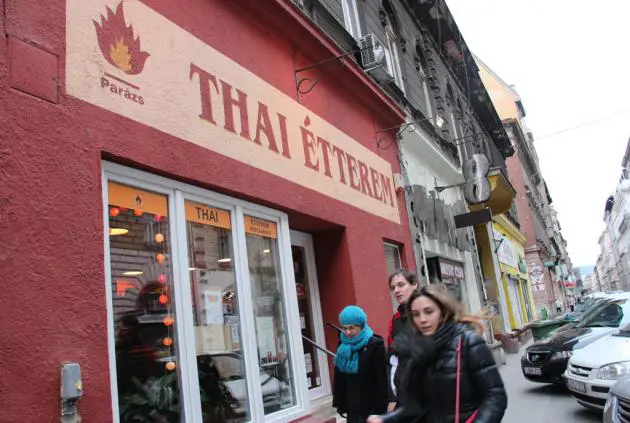
The locals also flock to Parazs Presszo Thai-Hungarian Restaurant and Cafe, which has consistently enjoyed good reviews.
“This was the first Thai restaurant in Hungary owned by a Thai,” says Sompratana Torat, the boss-receptionist-and-chef known to her customers as Ole. “We opened in 2007 and we have both Thai and Hungarian employees, since we serve both kinds of food.
“My husband should get some credit for our success. He’s Hungarian, though we met in Thailand. He wasn’t working at the time, but when he came back to Hungary he got a job in a bar and then decided he’d love to have his own business.
“At first we planned to open a massage spa, but after we both took a course in Thailand to get certified, we felt it wasn’t what we really wanted to do. So then, after having two kids, my husband thought it was time to start our own business. He worked really hard to find a good location and get a loan from the bank to start this restaurant.”
Ole says she doesn’t alter her Thai recipes to suit the European palate.
“Every dish tastes just like it does in Thailand. We focus on the real taste of Thai food, offered at an affordable price, and in a nice place to sit and talk. It’s always busy in the kitchen, but we’ve still managed to expand – now we have three restaurants, and one of them recently won an award!”
