
Tiny, perfect, expensive sculptures
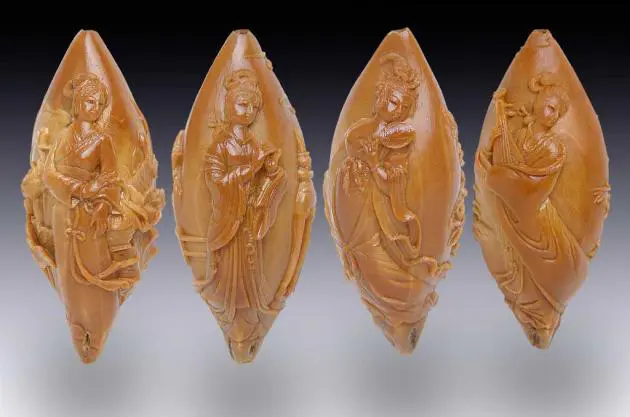


The Chinese art of carving kernels has rebounded, but artisans are leery of their machine rivals
In a refined kernel-carving shop at China Artwork City in Guangfu, Xu Zhongying is receiving customers from home and abroad. Some would like to pay hundreds of thousands of US dollars for her work, but few of them know that Xu almost gave up the skills in her 20s.
“When I became a worker in a local kernel-carving factory I could barely made a living with the meagre salary – few people would buy such an ‘entertaining thing’ in the 1970s,” recalls Xu, now 57.
Carving olive, peach or walnut kernels, known as hediao in Chinese, is a traditional micro-sculpture, and Guangfu in Suzhou, in East China’s Jiangsu province, is famous for it.
“I was always confident with my skills. Fortunately, more and more people have begun to appreciate this folk art,” Xu says.
The earliest recorded date for turning tiny kernels into art is during the Song Dynasty (960-1279) and it prospered in the Ming Dynasty (1368-1644). The ancient craftsmen displayed their consummate skills on kernels less than five centimetres long, etching human figures, animals, landscapes and even lines of poetry.
Kernel carving regained its popularity around 2008, when it was added to the National Intangible Cultural Heritage list. Artists now mull innovations in the art and how to keep the town’s speciality from disappearing.
Lu Xiaoqin, 37, another kernel carver in Guangfu, is famous for expanding the subjects of the art beyond traditional Buddhist figures such as Arhats. “Customers’ tastes are increasingly varied and some of them are tired of Arhats’ usually simple and sometimes rough lines. They want to see something different,” she says.
Lu spent around two months carving her latest work, depicting China’s Romeo and Juliet – Liang Shanbo and Zhu Yingtat. It won a national prize. The two household lovers had never appeared on a kernel carving before, but Lu believes “it presents a folk story on a work of folk art”.
For Lu, the carving is difficult because each kernel is different in texture and rigidity. She once majored in painting and often draws a blueprint on a kernel’s surface first. She says the process constantly requires reconsideration and creativity and there is no established pattern to follow.
The mother of a 15-year-old hopes young people can boost the art form with their “solid cultural knowledge and colourful imagination”. She’s teaching a class at the Suzhou Tourism and Finance Institute and expects to draw more students in the future.
“I’m glad to see some of them, including my own child, take an interest and show talent. For instance, if they can use their three-dimensional design skills in carving, there may be more surprising innovations.”
But Gu Xiaodong, an owner of a kernel-carving shop at China Artwork City, worries about computer technology’s impact on the folk handicraft, saying “computers can’t replace human beings regarding to the genuine handcraft skills”. Machines on an assembly line now churn out more than 50 per cent of the carvings.
“I think the country and people should have a natural consciousness to protect and support traditional folk art,” Gu says.
