
Beauty in the Touch
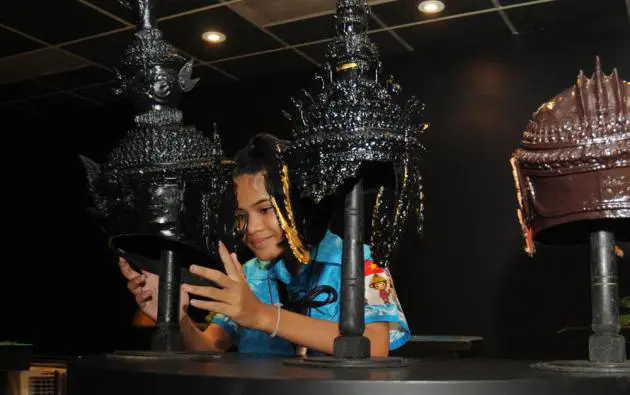


A new museum for the blind offers new experiences to the visually impaired.
SIRIRAJ HOSPITAL last week celebrated the birthday of Her Majesty the Queen by offering visually impaired children an experience they’ll remember all their lives through its new Museum for the Blind.
Located on the second floor of the Adulyadejvikrom Building, the museum – a first for Thailand – invites “finger viewing” of the objects with the assistance of audio and guide rails. Much thought has gone into the new facility, with the hospital’s medical faculty joining with Rajasuda College at Mahidol University, the Bangkok School for the Blind and the Foundation for the Blind Under Royal Patronage to make it a truly exciting experience.
Wanchana Pradapsri, 14, a student at the Bangkok School for the Blind, was thrilled with the tactile exhibition.
“It’s very exciting to be able to touch the objects while the audio guide explains what it’s all about. Some of the objects are very strange, like the silk cocoons and the saxophone,” he says.
The first temporary exhibition at the museum brings together items from Her Majesty the Queen’s seven royal projects and His Majesty the King’s favourite music instrument.
Visitors follow the guide rail and listen to the audio guide as they take the 50-minute tour of the newly built room, which awakens the senses through detailed descriptions, touch and other activities.
The collection has been designed to inspire the non-seeing and help them appreciate the royal projects implemented over several decades for the well being of the Thai people. While sighted visitors are welcome, they will be asked to wear blindfolds and the lights will be switched off, thus enabling them to experience the objects in the same way as the non-sighted.
At the entrance to the museum is a small hall displaying a large model of the Ceres Medal presented to Her Majesty the Queen by the United Nations Food and Agriculture Organisation in May 1979. The objects are described in both Braille and Thai language. Blind visitors are invited to examine Her Majesty’s portrait on the back of medal and then take a seat as the audio guide relates the story of Her Majesty’s royal initiatives.
The next exhibition room comprises eight zones, all of them focusing on the Queen’s initiatives.
The first and the second zones explain the Support Foundation’s work in the preservation and development of mudmee silk and the Liphao weaving heritage. The audio guide explains both the objectives and the achievements of the projects before inviting visitors to touch the silk cocoon, the silk thread, and the finished fabric, all the while explaining each process. Rattan and basketwork weaving is explained and finger-viewed in the second zone.
The third zone has khon mask models of the characters Phra, Nang and Hanuman, while the next three zones zoom in on Her Majesty’s projects for the conservation of natural resources.
The “Bring Elephant Home Conservation Project” invites the blind to touch and learn from elephant models. “Project Pa Rak Nam (Forest Love Water)” creates a rush of excitement by using real water to awaken the senses. Water also features in the explanation of the Queen’s Coastal Natural Resource project in Pattani and Narathiwat, with visitors invited to put their hands in a bucket to discover the objects inside.
The seventh zone is dedicated to the Royal Botanical conservation project and features the best known and most widely illustrated of
all flowering plants, the lady’s slipper orchid.
The last zone offers a jazzy experience with a saxophone model for finger viewing as His Majesty the King’s composition “Yimsu” is played in the background.
Senator Montien Boonton, who is visually impaired, was impressed by both the content and the finger-viewing experience with audio soundtrack. He said it should promote better understanding between the sighted and the non-sighted.
“I don’t think that the sighted people who visit this museum will be totally able to comprehend what the blind go through every day – that would be impossible. But it does offer a solid experience of how we access knowledge and information. Sighted people should take care to examine each item by touching it thoroughly and really feeling it, as that is the way we learn about and link the objects to our imaginations,” he says.
Having visited other museums for the blind of the US and China, Montien also suggests that the museum add more Braille guide books so that blind visitors can further study the projects.
Professor Udom Kachintorn, chairperson of the museum, says that it has taken about a year to put together the facility and that it is anticipated that the exhibitions will be changed every three months. The next one, timed to coincide with the celebration of the King’s birthday in December, will focus on His Majesty’s initiatives and projects while the current showcase will travel to other provinces, allowing the visually impaired outside the capital to benefit from the experience.
“Next year we are planning a medical museum experience that will highlight ophthalmology issues,” he says.
Surveys put the number of blind in Thailand at about 0.3 per cent of the population, though with medical advances, the number is decreasing.
“Today, we can carry out tests that inform us about the risk of blindness in newborns. This is very helpful in taking preventive measures that will help those infants lead a normal life,’ Dr Udom says.
“Right now we are doing the testing in Bangkok only but we plan to expand this examination to medical centres in other provinces such as Chiang Mai and Nakhon Sri Thammarat.”
A LIFETIME
OF MEMORIES
- The Museum for the Blind at the Siriraj Medical Museum is openfrom 9am to 4pm daily except Sunday.
- Admission is Bt40. For more information, (02) 419 7000 extensions 6363 or 6440.
