
The gates of Chinese history
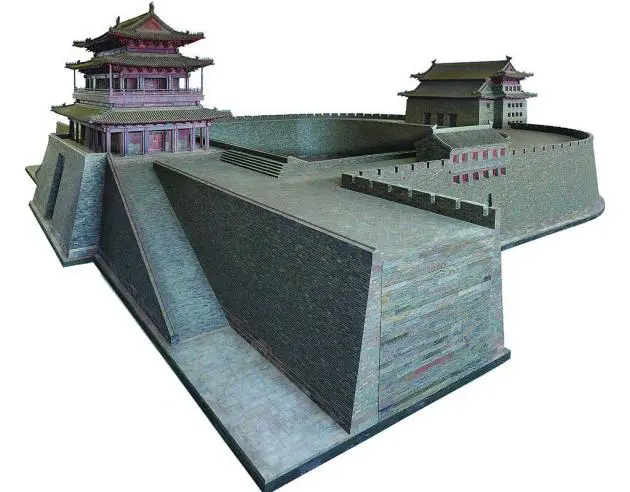


A Beijing exhibition recalls the city's ancient entryways, recreated in red sandalwood that can last for thousands of years
For people who never had the chance to see Beijing in bygone days, there is now a way to travel back in time. “Sculpture and Memory”, an exhibition of sandalwood models of Beijing’s old city walls and gates, opened in the National Museum of China on October 30.
The models of the Temple of Heaven and Andingmen are the second and the third instalment in a series of models of the capital’s ancient architecture initiated by the China Red Sandalwood Museum. The first model, of Yongdingmen, the Gate of Everlasting Stability, was finished in December.
“When I was a kid I saw many of these city gates with my own eyes,” says Chen Lihua, founder of the Sandalwood Museum and chairwoman of the Fuwah International Group, a major commercial-property developer in Beijing. “But how about our descendants – how can they know what the old Beijing was like?”
The model of the Temple of Heaven, where Taoist emperors prayed for good harvests, is made entirely of precious sandalwood, a heavy and fine-grained wood. It is one-eighth the size of the original. Weighing nearly 12 tonnes, it is the largest piece of sandalwood artwork created by the Sandalwood Museum.
The model of Andingmen, the north gate in the former city wall, is one-tenth the size of the original. It features city walls, a barbican entrance, a gate tower and an embrasured watchtower. All the painted parts are represented by red sandalwood, which has a gentle glow. The city walls are made of ebony, a wood with variations in colour much like the bricks on the old walls. The model weighs about 6.5 tonnes.
Andingmen, the Gate of Stability, was where the armies once returned from wars. The museum has also finished a model of Deshengmen, the Gate of Triumph, where the troops embarked. Deng-shengmen is not on display this time because of limited space.
All the models are made with mortise-and-tenon work, an essential technique of traditional Chinese architecture, Chen says. Woodworkers around the world have used this simple but strong method to join pieces of wood, particularly when the adjoining pieces connect at an angle of 90 degrees.
Born into a noble Manchu family in Beijing, Chen saw the ancient city walls and gates vanish in the latter half of the 20th century. She has always wanted to restore them to the public consciousness. “We have to leave our memory about old Beijing for the later generations,” she says.
Chen chose to re-create these buildings in miniature with red sandalwood because they can last for thousands of years. It took 10 years to complete the blueprint for the models, a process that involved professional assistance from the Palace Museum and the Beijing Municipal Administration of Cultural Heritage.
The capital city of both the Ming (1368-1644) and Qing (1644-1911) dynasties, Beijing had 20 gates in the walls of the outer city, the inner city and the imperial city. In the 1950s a debate raged among academics, politicians and historians as to whether these city walls and gates should be kept.
Liang Sicheng, “the Father of Modern Chinese Architecture”, was outspoken about saving them, but he and his colleagues failed to persuade the authorities. The structures were torn down to make way for urban construction.
Yan Chongnian, a historian and director of the Beijing Manchu Institute, says the models are more than reminders of the old city. “Because of the special quality of sandalwood and ebony, these models can survive for a very long time, so later generations will have the chance to get a glimpse of the old Beijing,” he says. This is also the first cooperation between the National Museum of China and the China Red Sandalwood Museum.
"The moulding, the materials and the proportions are all impeccable,” says Lu Zhangshen, director of the National Museum. And the models display “the beauty of Chinese wooden architecture craftsmanship”.
Chen says she plans to finish the rest of the city gates in five years. “If time allows, I will continue to make the 72 memorial archways of the old Beijing. And I would then love to be the doorman for the old city of Beijing.”
