
The Book on Thai Film


Play
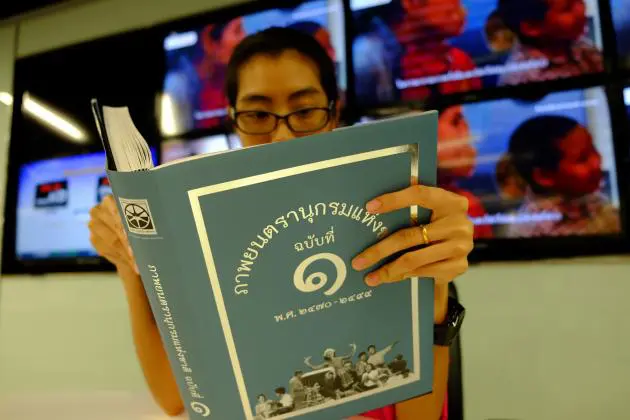
Celebrating 30 years, The Thai Film Archive proudly launches its first ever filmography
Long before the advent of the Internet and the launch of an international movie database courtesy of Imbd.com, film fans let their fingers do the walking, flicking through pages in movie guides and filmographies to find such essential information as director, actor, film crew, release date, synopses and juicy tidbits.
But Thai film fans not familiar with English were often left frustrated in their search for local movies. Today, 87 years after the first Thai film, “Choke Song Chan” (“Double Luck”), was released, Thai cinema now boasts its very own filmography volume.
Weighing in at a hefty 1.9 kilograms, the 637-page book “Phabphayontranukrom Hang Chat Chabab Thee 1” or “First National Filmography”, has been compiled by three generations of cinephiles and brings together information on more than 500 Thai movies released between 1927 and 1956.
Chalida Uabumrungjit, the deputy director of the Thai Film Archive, says this important tome was vital even with the mass of information available in cyberspace. She points out that film archives around the world continue to regularly put out filmographies, adding that the Hong Kong Film Archive, which was founded just a few years after Thai Film Archive, is about to launch its eighth volume.
“The book is like the spine for film research and study. In Thailand, the movie information, especially the stuff that dates back several decades, has never been verified and corrected. We tended to put our faith in interviews with people who were working in the industry at the time and of course it varied a lot, as everyone had a different recollection,” she says.
Information on everything from the title to the synopsis has been collected from different reliable sources for the book, the fruit of 30 years of labour.
Work started unofficially back in the 1980s when Thai Film Archive director Dome Sukwong was a guest lecturer for the film class at the Bangkok Technical College (now the Rajamangala Institute of Technology: Bangkok Technical Campus). Dome assigned students to work on the project by going to interview filmmakers as well as checking details in newspaper archives that give the release date and brief information.
“The book is the real thing but the e-book is just an illusion. Reading it provides a clear map of Thai film during the first 30 years of the industry,” says Dome, who believes in hard material.
Dome is the only person still alive today who was able to gain access to primary sources when he started his research on Thai movies as a young man with the archive. He also met many of the filmmakers and was able to find information in books, magazines and newspapers that had been maintained in good condition.
However, with only a tiny budget allocated to the archive from government, the filmography project could only be undertaken on a piecemeal basis.
The movie database project came back to life in the 1995 when the Thai Film Foundation stepped in to help. Chalida and fellow Foundation volunteers Panu Aree and Wimonrat Aroonrojsuriya went to the National Library and spent more than a year filtering through the information in its attic to find details of films released before 1957. They checked the newspapers and wrote down any details they could find on a special form created by the archive for that purpose. Just as in today’s press, newspapers back then carried advertising that gave the release date and a few details. The three volunteers were thorough and checked every page of the old newspapers and magazines.
It was far from plain-sailing. While the newspapers were the most reliable source, they were not always able to locate every edition, with up to three months worth of papers missing for some years. In addition, information was sometimes written in different formats, lacked detail and came without photographs.
“There were some mentions of films where we couldn’t be sure if they were Thai productions or not. We skipped some where we were not sure,” says Chalida.
“It would helped if we had smartphones or better Internet access back then because the newspapers were old and the library wouldn’t let us copy them,” says Panu.
“It’s sad that in order to find information about Thai films we have to go to the National Library instead of the Film Archive. We have only around 10 movies plus footage from another 10 films out of the 500 or so films that were released during that period,” says Tippawan Prayoonsuk, the Archive’s Head of Library and Information and the editor of the book.
Panu adds the basic movie details illustrate many cultural and social aspects of Thai life,
“Thai history from the 1930s to the 1960s was dominated by politics while the social aspects came more through literature than film. But we can see how society evolved through the historical movies made during that time ,” says Panu.
“We found that before the glorious Mitr-Petchara (Mitr Chaibancha and Petchara Chaowarat, the most popular actor/actress of the 1960s), the female character dominated over male characters in Thai films. Unlike the perception that the female character should be courteous and well-mannered, they were strong. An example is the leading woman in one film who turns to prostitution to get money to take care of her children,” Chalida adds.
“One thing that became clear during our work on the filmography is the lack of any study of Thai film history. I guess Thais just aren’t interested in the big picture. They only focus on their favourite actors.”
BETWEEN THE LINES
- One thousand copies of the book have been published and are for sale at Archive on Buddha Monthon Sai 5 in Salaya, Nakhon Pathom, and at its branch at the Bangkok Art and Culture Centre. It’s priced at Bt1,000.
- A second volume is planned, and the information will eventually be uploaded to the archive’s website and available through its search system.
- Find out more at www.Fapot.org.
