
Love is in the air


Play
Fourteen vocalists spread over three generations lend their voices to a Valentine's concert
SOME OF THAILAND’S best-known and most-loved singers of three generations are joining up to mark Valentine’s Day’ in the concert “Thesakarn Waan Pleng Rak” being staged at the Thailand Cultural Centre on February 20 and 21.
“This concert is about preserving Thai music,” says Jirawut Kanjanaplin, founder of the Kanjanaplin big band and the concert’s musical director, speaking at the recent press conference in the Devaraja Sabharamaya Hall and Throne Hall of Phyathai Palace.
“Each of the numbers being performed is a staple in the memories of Thais from all walks of life. The 14 vocalists contributing to this concert represent three generations and will be singing solo as well as in groups, duos and trios to present songs that speak not just of love between man and a woman but also for the nation, the religion and the King. We are also performing ‘Love’, a song by Her Royal Highness Princess Maha Chakri Sirindhorn on occasion of her birthday in April as well as a repertoire by King Rama VI’.”
The 14 contributors are Suthep Wongkamhaeng, Sawalee Pakapan, Chairat Thiebthiem, Pornpimol Thammasarn, Sumet Ong-art, Rawiwan Chinda, Opas Thosaporn, Pimpayom Ruangroj, Suchart Chawangkoon, Nareekrajang Kantamas, Wasu Sangsingkaew, Jaruwan Boonyaruk, Polkrit Thomya and Pijika Jittaputta. They’ll be performing such timeless compositions as “Jong Rak”, “Tae Pang Korn”, “Ther Thi Rak”, “Rak Chan Nan Nan”, “Ror Ther”, “Rak Chan Wan La Nid”, “Joob Yoei Chan”, “Yad Petch” and “Jib Ror Dor.” The Kanjanaplin big band will be responsible for the whole show and be under the baton of Jirawut Kanjanaplin.
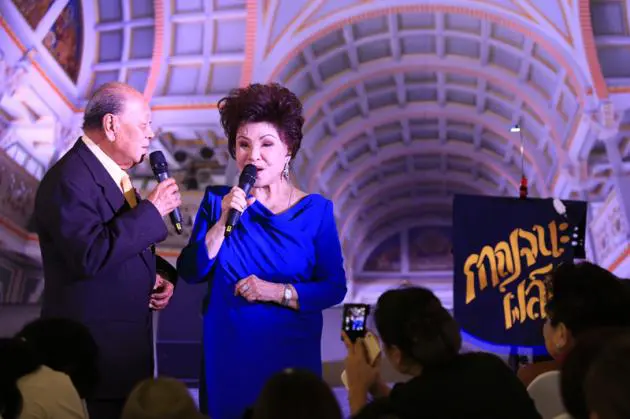
Sumet and Sawalee performed “Khwam Rak” during the press conference. Suthep and Sawalee then sang“Tae Pang Korn” and “Sanya Rak”, while Chairat and Pornpimol covered “Phor Ngae Mae Ngon”.
Phyathai Palace is located on the banks of the Samsen Canal on Rajwithi Road. It was built in 1909 at King Rama V’s behest so that he might stay there and look out over the farms, plantations and livestock in the area. King Rama VI ordered the construction of several new halls and King Rama VII instructed that the palace be converted into an international hotel. The Phyathai Palace then became the location of the first Thai radio broadcast station before being turned into a clinic for the army and changing its name to Phramongkutklao Hospital.
