
Making London Safe


Play
The English capital proposes superhighways for bicycles
You need nerves of steel to cycle through London. Red double decker buses, black taxi cabs and white delivery vans crowd the roads.
Cycle paths come to an abrupt end for no apparent reason. Car drivers stubbornly refuse to acknowledge the space set aside for cyclists in front of traffic lights.
And the air is so polluted that breathing masks for cyclists have become common. London is far from being a “cycle city” like Copenhagen or Amsterdam, even though the mayor has done his best to change that.
Boris Johnson has long portrayed himself as the bicycling politician. He never lets an opportunity pass to let himself be photographed on two wheels. He even presented one-year-old Prince George with a tricycle.
The hire bikes to be found across London, in a scheme similar to those found in Paris, Berlin, New York and other cities, were immediately nicknamed Boris Bikes when they were introduced in 2010.
Johnson regards them as one of his greatest successes – even though it was actually his leftist predecessor, Ken Livingstone, who initiated the scheme.
In early 2013, Johnson announced investment of 913 million pounds (Bt44.9 billion) into London cycling, including a network of cycle paths.
There are currently four “cycle superhighways” linking the outskirts of London with the centre. Despite the pretentious name, these are simply reserved lanes for cyclists on roads. Cars cross the lanes, and sometimes park on them.
London cycling can be lethal. There were around 23,000 motor vehicle-cyclist accidents in London between 2009 and 2013, 80 of which were fatal, according to insurers Aviva. Several more cyclists have been killed this year.
The congestion charge introduced in 2003 in central London has reportedly reduced traffic by 10 per cent. But despite, that there are often traffic jams in the morning and evening rush hours.
The Copenhagenize Index ranks the world’s top 20 bicycle friendly cities. London does not make an appearance.
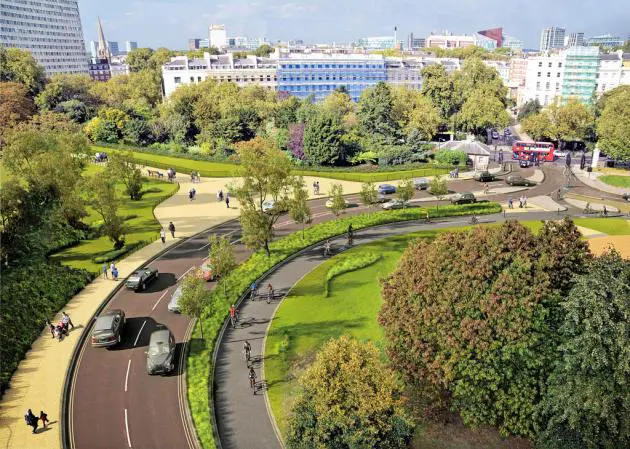
It is no wonder that plans to build two segregated, two-lane cycle paths, through central London have attracted a lot of attention. They have been nicknamed “Crossrail for the Bike,” because they would speed movement just like the express railway line Crossrail does.
The longest of the two cycle paths is planned to run for 29 kilometres linking east and west London. It would pass through Hyde Park, and go past Buckingham Palace, Westminster and Big Ben.
As was only to be expected from the flamboyant Johnson, he opened the first construction job himself, climbing into a digger to be photographed.
Certain areas are getting extra investment to be made into “Mini Hollands.”
Infrastructure and transport safety have also become topics in the May 7 general election campaign with politicians appearing to be targeting non-car owners.
Labour’s shadow transport minister, Michael Dugher, wants to create a cyclist and pedestrian advisory board, which would include members of cycling and pedestrian organisations and aim to increase cycling and walking.
The London Cycling Campaign, which lobbies for the city’s cyclists, is satisfied.
“We’re pleased that the mayor is finally making good on his promise,” says spokeswoman Rosie Downes.
“Until now London’s ‘cycle superhighways’ consisted of blue strips (of roadway) which didn’t offer any physical or legal protection (to cyclists),” she says.
The two “crossrail” paths will not be perfect, but are a step in the right direction, she says.
Many cannot believe that from early 2016, tourists and Londoners alike will be able to pedal peacefully through the city centre on Johnson’s Superhighways.
Others have put forward new ideas: they include underground cycle paths in unused Tube tunnels, cycle routes built in the sky over train and motorway traffic, and even a floating cycle path on the River Thames.
But most bicycling Londoners would doubtless simply be pleased if they could use the cycle paths that they already have without threat from motorists.
