
Stirring on stage


Play
2015 was a record year for musicals, B-Floor Theatre and international collaborations
Perhaps happiness is returning to the Kingdom – as promised by our interim military government – and that’s why in the past year we have seen a record number of large-scale musical plays, giving truth to the statement “a musical a month”. That surfeit is even more intriguing given that the two main producers of musicals, Scenario and Dreambox, have been relatively quiet. The former co-presented with BEC Tero “Beauty and the Beast” and staged only one musical comedy “Wedding Day” at their Muangthai Rachadalai Theatre hub. They put more effort into their American musical production of “Waterfall”, another adaptation of “Khang Lang Phap”, but the performances in Pasadena and Seattle were met with so many negative reviews that their Broadway dates are not yet confirmed. The latter was more active on television while preparing for a new musical adaptation due to open in just two weeks.
That left the market wide open for anyone with a good idea for adaptation and, of course, a lot of money. Even a small, independent company like Anatta Theatre Group, led by Silpathorn artist Pradit Prasartthong, was well supported by Thammasat University for its musical play “Mangkon Salat Klet”, a biographical drama about the life and work of internationally renowned economist Puey Ungpakorn, at the Thailand Cultural Centre.
And probably because this is a new story not yet known to the public, it stood out from the pack of musicals, notwithstanding pitfalls in production design and staging.
This year also saw the opening of a new large playhouse – K-Bank Siam Pic-Ganesha Centre of Performing Arts – at Siam Square One, the best location possible. So far though it has only staged one musical, “Hom Rong”, Workpoint Entertainment’s adaptation of the critically acclaimed film “The Overture”. A small venue called Culture Collective Studio also opened at a condominium-hotel complex on Charoenkrung Road and to date has staged two English-language works by the house company.
However, the most active venue by far has been Thong Lor Art Space, a short walk from another Skytrain station and in its first full year of operation. Not bound to any particular dance or theatre company unlike most venues, it has presented both local and foreign stage works as well as visual arts exhibitions, film screenings and literary events, living up to its name and responding to the current trend of arts in which genres, as well as audiences, keep crossing boundaries.
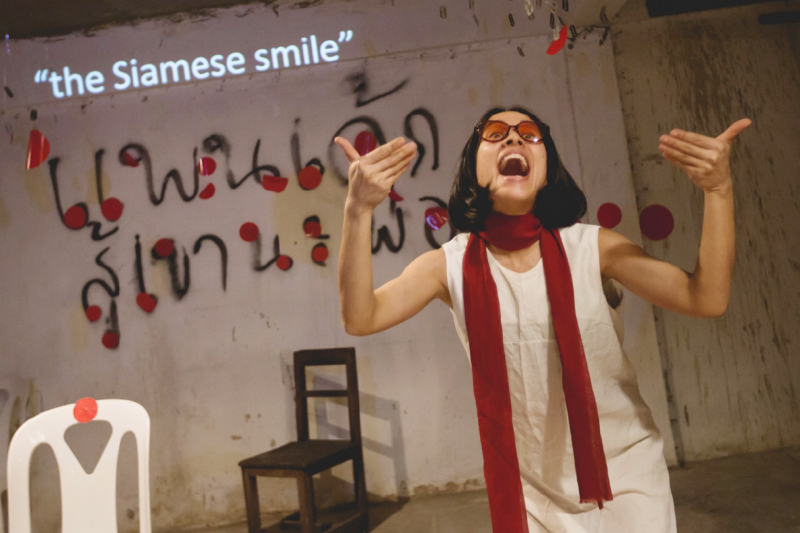
The most prolific company has been B-Floor and the phrase “a-B-Floor-work-a-month” was almost a fact. Their revival of solo performance “Bang Lamerd” was completely sold out, admittedly partly because an Army official requested them to submit a script and an official request for performance rights. A few military personnel with a video camera were present at every performance, and news of this went viral.
With core members taking turns staging, performing and producing one another’s works, B-Floor also left the audience with fond memories of “Secret Keeper” and most recently “Ceci n’est pas la politique”. It’s noteworthy that political theatre in Thailand, especially on the topic of freedom of speech, was more outspoken and prolific than during the political turmoil before May 22, 2014.
Less prolific than usual was Pichet Klunchun Dance Company who, after “The Gentlemen” and “This Piece Is Not Completed Yet” here and a few performances in Japan, took a break to prepare a large-scale work that will premiere next year.
The Bangkok Theatre Festival, with a more audience-friendly logo and poster, completely relocated its hub to the Bangkok Art and Culture Centre and became part of the BACC’s Performative Arts Festival, which ran from July to December, guaranteeing that their fourth floor studio is another venue for any dance and theatre works. And while a few major companies opted out of BTF, new companies comprising freshly graduated theatre artists indicated hope for the future. Looking at the list of nominees and winners of BTF awards, it’s evident that the participation and creative input of foreign artists, including expats, was stronger than ever.
And speaking of foreign works, the one-evening-only performance of “Hamlet” by Shakespeare’s Globe Theatre as part of its global tour was the talk of the town, thanks to the support of the British Council and the British Embassy.
The Wa project of Japan Foundation’s Asia Centre, which supports exchange between Japanese and Southeast Asian artists, has also been in full swing this year. Thanks to this project, which continues through 2020, we saw, for example, the street dance showcase and workshop “Dance Dance Asia”, Oriza Hirata’s adaptation of Kafka’s classic “La Metamorphose (version androide)”, starring Irene Jacob, Hiroshi Koike’s adaptation of the Indian epic “Mahabharata Chapter 2.5”, with Thai performer Sunon Wachirawarakarn, as well as the Japanese-Thai collaborations “Girl X” and “Strategic Loneliness”.
The Korean Cultural Centre also became more active. Its “Listen to the Cities” forum successfully connected Thai and South Korean artists and producers and the first collaboration between B-Floor and Theatre Momggol “Something Missing” met with acclaim during the BTF.
The 18 Monkeys Dance Company’s “Unfolding Kafka” festival was fully supported by Goethe Institut and featured contemporary dance and visual arts at several venues in and out of Bangkok.
This year we have also witnessed more cooperation among foreign cultural institutions. For example, “La Metamorphose (version androide)” was supported by the Goethe Institut and the French Embassy. The latter’s annual La Fete has now come to an end but it is continuing its strong support by working with local presenters and producers. The Japan Foundation also supported a work by a Japanese artist in “Unfolding Kafka”.
For me personally, the most unforgettable moment of 2015 was watching three contemporary Thai theatre works, namely “Hipster the King”, “I Am Thai” and “Virginian: The Body of Mickey Mouse” all by Democrazy Studio, at the Offene Welt festival in Ludwigshafen, Germany.
As our government prefers promoting its traditional counterpart, people outside Thailand rarely have a clear view of contemporary Thai theatre and the cumulative experience the German audience had from watching these three different works, none of which was based on traditional theatre, clearly showed them what theatre artists here are interested in and how they presented those ideas. This silver lining was possible through the support of the Goethe Institut and the festival itself, but none – no surprise here – from our Culture Ministry.
The Ministry instead rented out the Royal Albert Hall to stage khon a few months ago to commemorate the centenary of the classical Thai music performance for Queen Victoria and to continue its mission of national heritage promotion and preservation.
Sadly though, this was not a major event attended by dignitaries of both countries. Nor was it part of any festival and without any invitation from the UK, it was paid for by our tax money.
In this holiday season, I’d like to thank and send my best wishes to all artists who have shown their works on the Thai stage this year, and to all supporters who have made all of these possible. The Bangkok stage is more active than you think and these evening works in many venues have kept me busy these past 12 months.
