
Agencies meet to rescue Thai aromatic coconut industry and crack down on nominees
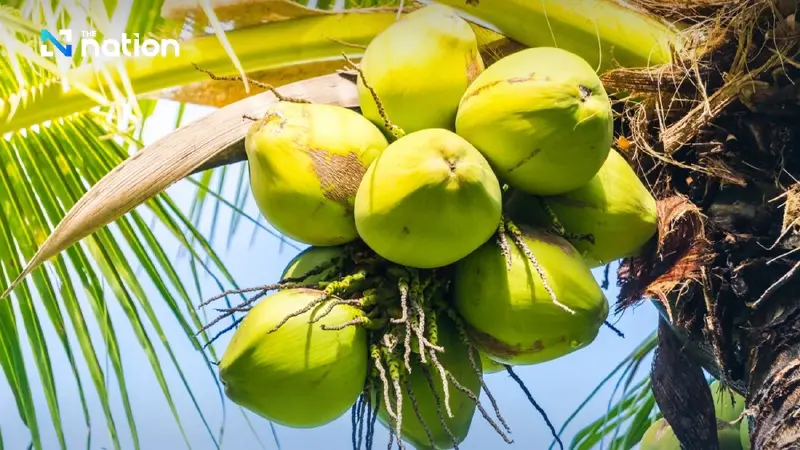


Thailand’s Chief Ombudsman has convened 16 agencies to tackle the Thai aromatic coconut crisis, targeting fake coconut water, foreign nominees and distorted farm-gate prices.
The Office of the Ombudsman has held talks with 16 agencies to draw up measures to help resolve the crisis facing Thailand’s aromatic coconut, or Nam Hom coconut, industry.
The talks focused on raising standards and setting clear definitions for genuine coconut water, improving inspection processes, cracking down on illegal coconut-water factories, blocking foreign nominee structures and reforming the price structure.

Chief Ombudsman Songsak Saicheua on Friday chaired a meeting with 16 agencies to address problems involving foreign capital using nominee structures, collusion to depress purchase prices for aromatic coconuts, and the counterfeiting and adulteration of aromatic coconut water.
The meeting sought to accelerate comprehensive corrective and preventive measures across all dimensions.
The agencies involved included the Ministry of Industry, Department of Industrial Works, Excise Department, Revenue Department, Department of Medical Sciences, Department of Health, Department of Local Administration, Department of Internal Trade, Food and Drug Administration, Office of Agricultural Economics, Thai Industrial Standards Institute, National Bureau of Agricultural Commodity and Food Standards, Office of the Consumer Protection Board, Thailand Institute of Nuclear Technology, Thailand Consumers Council, Samut Songkhram province, relevant local agencies and complainants.

Songsak said that following discussions in March 2026 and fact-finding visits to Samut Songkhram and Ratchaburi in April 2026, officials found that the problems went beyond the sharp fall in Thai aromatic coconut prices.
They also found cases of counterfeit and adulterated coconut water, as well as the expansion of foreign nominee networks.
Investigations found that foreign investors had allegedly used Thai nationals as nominees to dominate the coconut market chain, from purchasing depots to processing factories and the holding of agricultural land.
Songsak said these practices had caused serious damage to the coconut-water market and to the image of Thai coconut-water products.
To develop comprehensive measures covering the entire system, the Ombudsman therefore convened an integrated meeting with relevant agencies.
At the meeting today, June 5, 2026, participants agreed on the following management approach.

Upgrading and setting standards for genuine coconut water
At present, there is no legal measure clearly specifying proportions or ingredients for distinguishing 100% genuine coconut water from coconut water mixed with other substances in different ratios. There is also no clear legal system for testing and verification.
As a short-term measure, the meeting proposed that the Ministry of Industry consider changing the current TIS standard, which is voluntary, into a mandatory standard for the time being. This would create legal criteria for control and allow penalties to be imposed on producers of fake coconut water.
For the long term, the Ombudsman will send a letter to the Minister of Public Health asking the ministry to consider setting up a special joint committee to support the creation of permanent standards, an inspection system and a working flowchart covering the entire supply chain.
A clear structure is expected within 12-15 months.
The meeting also considered definitions of fake coconut water and classification criteria. These would divide products into those containing no coconut water at all, such as plain water or groundwater mixed with chemicals and flavouring agents to imitate coconut water, and genuine coconut water contaminated with or mixed with unauthorised substances.
Adjusting inspection procedures and closing loopholes for illegal factories
The meeting agreed to revise the standard operating procedure (SOP) for inspections and close loopholes involving illegal factories.
Inspection teams will be restructured into multidisciplinary teams, while the frequency of random inspections will be increased to every three to four months.
Inspections will cover various times of day, including at night, because information indicates that some factories secretly produce at night to avoid daytime inspections.

Transport controls and destination inspections
A control system must be established for the transport of coconut-water products so that they can be systematically traced to their final destination.
For small factories, many of which are not regulated under the Factory Act, oversight falls under local administrative organisations.
The meeting therefore proposed reviewing licensing and supervision criteria, as well as increasing legal powers for local authorities so they can order temporary production suspensions or decisively shut down illegal factories.
Fixing the price structure and blocking foreign nominees
The meeting also agreed to accelerate efforts to reform the price structure and prevent foreign nominee arrangements.
At the lowest point of the crisis, farm-gate prices fell to 3-5 baht per coconut. Undersized coconuts sold for less than 1 baht, or around 50-80 satang each.
Prices have now risen to an average of 13-15 baht per coconut, while undersized coconuts are priced at around 8-9 baht.
However, farmers believe a fair break-even price should be at least 17 baht per coconut.
They said price distortions were caused by collusion among foreign companies operating coconut-buying depots through nominee structures, as well as market share being taken by fake coconut-water producers.
If fake coconut water can be eliminated, demand for genuine coconuts in the system should rise and help stabilise prices.
Legal measures to control foreign capital
The meeting proposed that the Ministry of Commerce review regulations under the Foreign Business Act B.E. 2542 (1999).
It suggested considering whether coconut businesses and coconut processing should be added to one of the restricted business lists — List 1, 2 or 3 — to limit rights or strictly control foreign shareholding.
At present, if a foreign-linked coconut-buying depot is established solely for 100% export, there remains a loophole that weakens enforcement of the 49% foreign ownership and 51% Thai ownership threshold.
Developing Thai business capacity
The meeting also said Thailand must have a plan to strengthen the capabilities of Thai operators.
The Department of Internal Trade under the Ministry of Commerce was assigned to prepare a long-term plan to upgrade Thai-owned processing factories.
More than 200 such factories currently operate mainly as contract manufacturers, or OEMs, under foreign capital.
The plan will also develop the capacity of farmer groups, cooperatives and community enterprises so they can manage their own businesses throughout the supply chain of Thailand’s aromatic coconut industry.
