
Cooperative Promotion Department pushes central hub to curb unfair pricing
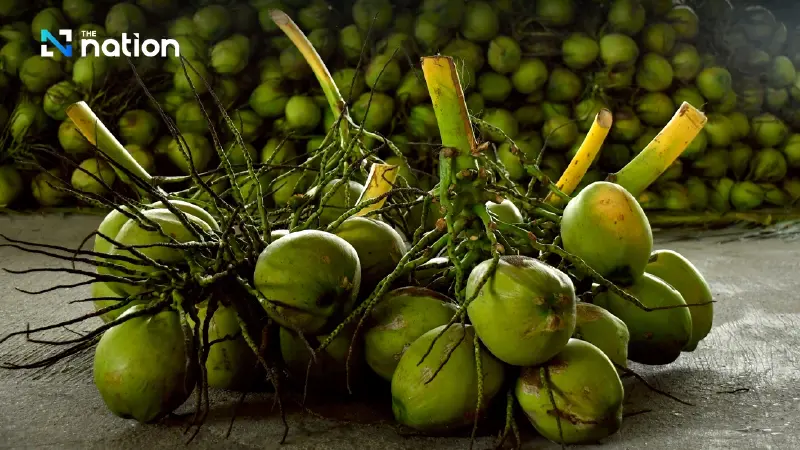


The move is designed to improve price fairness for aromatic coconut growers by widening market options and reducing dependence on dominant buyers.
- The Cooperative Promotion Department is advocating for a "central buying hub" to address falling aromatic coconut prices, which are allegedly being suppressed by Chinese buyers colluding to set unfairly low rates.
- This proposed hub would purchase produce from agricultural cooperatives, providing them with an alternative to the current system where they are forced to accept prices dictated by a few powerful buyers.
- The department's director-general supports the policy because cooperatives are strong in production but lack the marketing expertise and resources to negotiate fair prices independently.
- As an immediate measure to combat low prices, the department has already organized cooperative networks to purchase over 2.3 million coconuts from each other at above-market rates, which has helped prices to improve.
After Suphajee Suthumpun, Minister of Commerce, called a policy meeting for executives of the Ministry of Commerce and the Ministry of Agriculture and Cooperatives, led by Vinaroj Sapsongsuk, Permanent Secretary of the Ministry of Agriculture and Cooperatives, at the Ministry of Commerce on the morning of March 2, 2026, to integrate the work of the agencies, both ministries are working in the same direction and coordinating closely to prepare measures to cope with fruit from the eastern region, whose output will start reaching the market in mid-April.
At the same time, there is also an idea to solve the problem of falling aromatic coconut prices by setting up a “central buying hub” (a central produce collection, packing and trading hub set up to receive and market produce) to absorb output in place of Chinese buyers (operators of privately run produce collection, packing and export-buying depots), which have joined forces to press the price down to only 2 baht per nut, while efforts are also being accelerated to find new markets rather than relying only on China.
Niran Multhida, Director-General of the Cooperative Promotion Department, said in response to allegations that some cooperatives had joined hands with Chinese buyers by using cooperative premises as factories and whitewashing coconut-trading operations backed by grey capital so that they would appear lawful, that this was unlikely to be true in any way.
This was because cooperatives are tasked with collecting produce from members for sale to buyers, whether Thai or Chinese.
If the price is good, the cooperative sells.

“In the case of Baan Phaeo Agricultural Cooperative Ltd., which sells only to Chinese buyers, from what I asked the cooperative manager, he said it used to be a Thai-owned buying depot, but later changed hands to Chinese owners. The cooperative, therefore, still has to send produce to the same buyer, even though the price is being pressed down, because there is no other choice,” the Director-General of the Cooperative Promotion Department said.
Niran continued that, after learning that aromatic coconut prices had fallen, the Cooperative Promotion Department had moved quickly to assist by coordinating cooperative networks from across the country to join in purchasing aromatic coconuts from production sources at prices above the market.
The initiative was kicked off on February 4, 2026, at Baan Phaeo Agricultural Cooperative Ltd. in Ban Phaeo District, Samut Sakhon, where the Northeastern cooperative network, led by Kaset Wisai Agricultural Cooperative Ltd. of Roi Et Province, came in to buy 50,000 coconuts at an above-market farm-gate price of 5 baht per nut, while the coconut price in the area at that time was only 2 baht per nut.
After that, cooperative networks in various provinces jointly placed orders for coconuts to help continuously move produce out of production areas in Ratchaburi, Samut Sakhon and Samut Songkhram.
Aromatic coconuts from Songkhla have now also been added.
More than 2.3 million coconuts worth over 11.86 million baht have already been distributed through cooperative networks to destination markets, resulting in aromatic coconut prices in the area gradually improving.

The Director-General of the Cooperative Promotion Department said the idea of creating a “central buying hub” for aromatic coconuts to solve the problem of falling produce prices was a good policy and one he agreed with, because most cooperatives still lacked expertise in marketing and had to rely on the private sector or professionals to help, while cooperatives were ready to take on the role of collecting produce and supplying it to the central buying hub.
“Cooperatives are only good at producing agricultural goods. They focus on the upstream side and are not strong on the downstream side of marketing. Setting up their own buying depot is also very costly, so it is better for cooperatives to do what they are good at. Besides collecting produce and linking cooperative networks together, value-added processing is another way to solve the problem of falling prices, and in the past, the Cooperative Promotion Department has devoted budget support to help many coconut-growing cooperatives purchase marketing equipment.
For example, at Prasan Kasikit Agricultural Cooperative Ltd. in Ban Phaeo, Samut Sakhon, the department purchased a temperature-controlled storage unit for coconut blossom sap in fiscal year 2024, so that sap from coconut flowers can be stored for longer before being processed into coconut sugar, coconut syrup and other products,” Niran said.
Somkiat Praphrutkit, or “Uncle Piak” of Wat Phleng, chairman of Wat Phleng Agricultural Cooperative Ltd. in Ko San Phra Subdistrict, Wat Phleng District, Ratchaburi, whose members mainly earn their income from growing aromatic coconuts, said he agreed with the idea of creating a central buying hub to absorb output.
If the government succeeded, it would help ensure fair prices for farmers, because coconut prices today are entirely set by buyers.
“Coconut prices are set by the buyers, who decide what the price will be each day. Today, for example, deliveries are at 5 baht per nut. The cooperative acts as the intermediary between members and the buyer. If a member harvests on a particular day, that member notifies the cooperative. The cooperative then informs the buyer, after which the buyer sends in its team to cut the coconuts and grade them itself. The income is transferred to the cooperative and then forwarded to the orchard owner-member, to prevent the problem of delayed payment between the buyer and members, which has happened before.”
Somkiat continued that the cooperative currently sends an average of 20,000-30,000 coconuts a day to buyers at an average of 5-6 baht per nut, selecting only fruit of the size the market requires. Lower-grade coconuts are then processed into bottled coconut water for sale. There are no Chinese buyers here, only Thai ones. Most Chinese buyers are based around Damnoen. Asked whether that still had an impact, he said it did, because Chinese buyers determine the price and Thai buyers follow the Chinese price. Whatever price the Chinese buyers offer, Thai buyers offer the same. As for the cooperative’s income, the buyers pay an operating fee of 40 satang per nut without deducting it from members’ income, and that money is used to manage the cooperative,” the chairman of the Wat Phleng cooperative said.
Chamrun Niltao, chairman of Ban Rang Si Mok Agricultural Cooperative Ltd. in Damnoen Saduak District, Ratchaburi, said he agreed with the government’s idea of creating a central buying hub to absorb coconut output, but it would require a huge budget investment, so he was not sure whether it could actually be done.
At the same time, the market issue also remained unclear, because almost all produce today is exported to China and around the world through Chinese buyers.
“In Damnoen Saduak, there are more than 230 Chinese buyers at present. Buyers are buying mixed grades at 4 baht per nut. If you sell only the produce, it will not be worthwhile, because coconut production costs are 5-6 baht per nut. However, most coconut growers in Damnoen have their own trucks, so the buyers also pay transport costs and the wages of workers who harvest the coconuts. When everything is included, growers receive 7-8 baht per nut. It has to be accepted that most cooperative members today still depend on Chinese buyers, because they have been trading with them for 10-20 years already,” the chairman of Ban Rang Si Mok Agricultural Cooperative said in closing.
