
BYD Rebuts US Allegations of Using Thai Base to Bypass Trade Tariffs
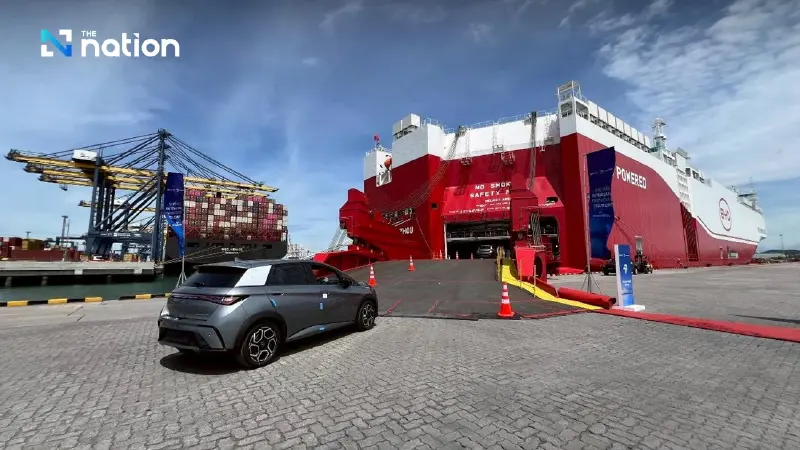


Chinese EV giant denies exporting from Rayong to America as US trade officials probe "excess capacity" and final assembly shifts across Southeast Asia
- Chinese automaker BYD has formally denied US allegations that its manufacturing facility in Thailand is being used as a "back door" to evade American trade tariffs.
- The company clarified that its Thai plant is strategically focused on the local market and exports to Europe, ASEAN, and Oceania, confirming that zero vehicles have been shipped to the United States from this facility.
- BYD's rebuttal is a response to an investigation by the US Trade Representative's Office, which is examining whether Southeast Asia is being used for the final assembly of surplus Chinese EVs to circumvent tariffs.
Chinese EV giant denies exporting from Rayong to America as US trade officials probe "excess capacity" and final assembly shifts across Southeast Asia.
Chinese automotive titan BYD has firmly rejected suggestions from Washington that its manufacturing facility in Thailand is being used as a "back door" to evade swingeing US trade tariffs.
The denial follows a probe by the Office of the United States Trade Representative (USTR) under Section 301 of the Trade Act.
The investigation is scrutinising "structural excess capacity" across several major economies, including China, the EU, and ASEAN nations.
US officials have raised concerns that Thailand could be serving as a final assembly hub for surplus Chinese electric vehicles (EVs) destined for global markets, including the United States.
Domestic Focus and Regional Exports
BYD, which inaugurated its 600-rai facility in Rayong’s WHA Industrial Estate in July 2024, clarified that its Thai operations are strategically focused on local demand and specific international regions.
Liu Xueliang, General Manager of Asia-Pacific Auto Sales, told Thansettakij that the company has not yet entered the US market.
He argued that American protectionist measures might actually benefit the region by encouraging manufacturers to redirect resources towards Asia-Pacific.
"We view this as an advantage for Thailand rather than a setback," Liu remarked.
In 2025, the Thai plant exported 10,250 units to Europe, ASEAN, and Oceania. Crucially, the company confirmed that zero vehicles were shipped to the United States.

Significant Investment in Thailand
The Rayong plant represents an investment of approximately £825 million (35,925 million baht) and boasts a maximum production capacity of 150,000 vehicles per year.
The facility handles the full manufacturing lifecycle—stamping, welding, painting, and assembly—for popular models including the Dolphin, Atto 3, and the Sealion 6 DM-i.
Ke Yubin, general manager of BYD Auto (Thailand), highlighted the company’s commitment to the local economy, noting that the plant employs 6,100 staff, of whom 92% are Thai nationals.
Global Ambitions
The controversy comes as BYD cements its position as a global powerhouse. In 2025, the firm reported total worldwide sales of 4.55 million vehicles, an increase of 7.1%.
Notably, more than 2.25 million of these were pure electric vehicles, outstripping Tesla’s reported 1.63 million units.
Last year also marked a milestone for the brand, as overseas sales outside of mainland China surpassed one million units for the first time—a staggering 150.7% increase from the previous year. Thailand remains a cornerstone of this international growth, accounting for nearly 50,000 of those sales.
