
Punk's true survivors
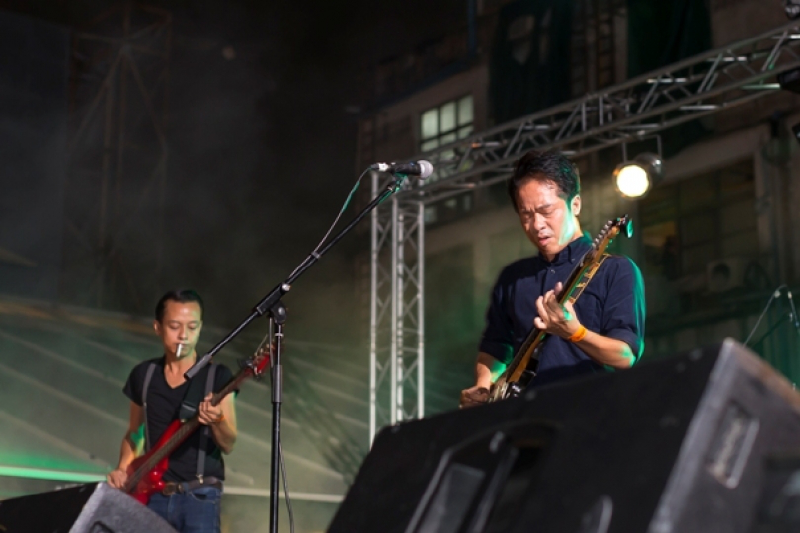


No one in rebel rock endured repression like the "bitter medicine" of Myanmar that produced Side Effect
Being a non-conformist is challenging enough anywhere in the world, but in Myanmar it could get you in loads of trouble, especially in the days before democracy began to take hold in the land then known as Burma. Somehow post-punk quartet Side Effect managed to get established enough to not only survive but help shape the music scene in Yangon.
Singer-guitarist Darko and drummer Tser Htoo formed the band in 2004, recruiting guitarist Nay Soe Myat and bassist Hein Lwin. Amid military dictatorship and tricky censorship, they blasted ahead with youthful angst and a brooding attitude, taking years to stew up an explosive debut album in 2012, “Rainy Night Dreams”.
Side Effect has performed in recent years in Denmark, Germany, Malaysia, India and Bali, Indonesia, and even in the US, at the South by Southwest Festival in Texas. Earlier this month they finally said hello to neighbouring Thailand, headlining the opening party of the Bukruk Urban Art Festival.
We had a chance to quiz Darko and Tser Htoo about the music of Myanmar before and after the era of the generals.
What kinds of music did you grow up with?
Darko: Nirvana, the Stooges, the Ramones, 999 and other ’70s punk rock. We grew up in a time of limitations – it wasn’t easy getting our hands on music from outside the country. Back when everything was controlled by the government we didn’t even have any record shops. We’d get new music as pirate copies on cassette tapes from friends. The same went with music magazines – we only had copies of the originals.
Tser Htoo: The Internet made it a little better, but the connection was always very poor, so you couldn’t download anything. And YouTube content was heavily controlled.
Tell us about the name Side Effect.
Darko: Life back then was unhappy and depressing. We were the black sheep in society and in our own families because we didn’t go along with the way of life being forced on us. There was way too much conformity. They told you what to do, what to think and, worst of all, what to be.
It was bitter medicine, older people thinking they knew best what was good for you. Maybe that’s true for some people, and but for people like us, there’s a side effect to it. We are the side effect of our own society. We represent the youth whose dreams were crushed and had no one to support them, who were unhappy with that bitter dose.
Does that describe a lot of Myanmar bands?
Darko: There weren’t many bands with original songs. Audiences were mostly okay listening to covers of Western pop and soft rock. Here in Thailand, when you say a “cover song”, that’s when you take a song and play it in your own style. But in Myanmar they give the song completely different words and a completely different meaning. You’ll hear a “Lady Gaga song”, but the words are different.
Tser Htoo: Around 2000 to 2002 some underground bands started to form – we were one of the earliest – and that really started a spark. It was so refreshing and exciting to see people our age playing their own songs and performing at small gigs. Now, with everything changed in Myanmar, there are around 20 or 30 more underground bands.
How do you survive in such a small market?
Darko: Everything comes out of our own pockets. We paid for the studio time ourselves, and along with other like-minded bands we organise free concerts in parks. We can’t charge admission because the scene is very small and we want a big audience.
The scene slowly grew bigger thanks to events like that, as we’re happy to see youth culture and underground music culture slowly growing in Yangon. Our endeavour is purely out of passion – it’s far from being a “career” that will support you and your family, but we love doing it. We all have day jobs, so music is more like our hobby.
What was it like making “underground” music in a dictatorship?
Darko: Once you got a song, you had to send the lyrics to the censorship office for approval. You didn’t send a complete song, with vocals and music, because you might need to change a few words and re-record the whole song again. Then they’d send it back with red-pen edits, asking you to change a few words, even making suggestions what the words should be. It went back and forth like this, and then, when the text was officially approved, you could go ahead with the recording. In late 2012 this process was scrapped, and shortly after that we released our first LP.
Tser Htoo: A lot of good things happened after 10 years of suffering and self-doubt. We could finally make music the way we liked without censorship, and people started to appreciate us more. Young people at home would hear about us playing outside of Myanmar and started to take interest. And now we have our music on Soundcloud to download.
Has the country’s loosening up had a personal effect on you?
Darko: Yes! I didn’t even realise at first that I’d become a bit positive. That’s why our new EP is called “Change”. It was written at the beginning of the transition, when I was so overwhelmed by the idea of change. The song isn’t about the change, though – it’s about “being the change” yourself. There’s hope now that you can do whatever you want, to be the change and follow your dream.
We don’t need to send the lyrics to be corrected anymore, but there’s still “soft censorship” – all songs have to be registered with the Myanmar Music Association. Somehow they can still give you shit if you’re too critical about the military or come across as too controversial, because some big guys are afraid to lose their control. Know your rights and don’t be scared. You have to push back if you want to see change.
Tser Htoo: Thanks to the Internet and the 3G mobile network that allows them to connect to the world, the younger generation is becoming more open-minded when it comes to music. But a lot of the country is still being left behind. I really hope to see more diversity in the music scene – whatever kinds of music there might be. And there are more than 150 different ethnic groups in our country!
Your second LP is due for release later this year and you got to record it at the Digital Factory owned by French movie director Luc Besson.
Tser Htoo: Luc Besson came to Yangon before the launch of “The Lady” [his 2011 biographical feature about Aung San Suu Kyi] and he asked to meet with local music- and film-makers. At the end of the meeting he gave us his card and offered to help anyway he could if we went to France. Three years later we were in Germany and emailed him to ask if we could record in his studio and he kindly agreed. We went to his house in Normandy and spent a whole week recording the second LP, with everything provided for us – equipment, engineers and producer.
Darko: I was surprised he remembered me at all, because I didn’t even have a card to give him. All I had was a pack of cigarettes, so I just ripped off the lid and scribbled down my contact details for him. He must have remembered me as “that punk rocker with no card”!
After effects
Find out more about the band at www.Facebook.com/5ide3ffect.
