
Teacher of the nation
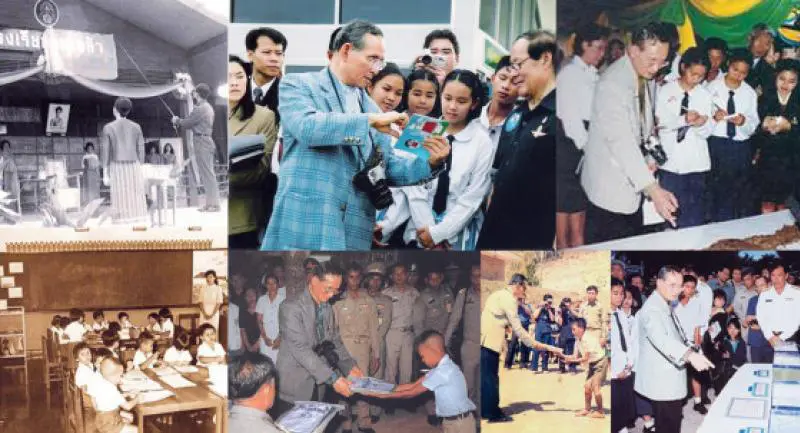


His Majesty the King made enormous contributions to education over the years, setting up distance learning by satellite, vocational training and scholarship programmes to help his less-privileged subjects
In the eyes of His Majesty King Bhumibol Adulyadej, education was crucially important because people in a democratic society needed knowledge to exercise their judgement and make good decisions.
“Without knowledge, people may be vulnerable to deception,” Grand Chamberlain Khwankeo Vajarodaya said referring to the King’s concept of education.
Khwankeo chairs the Distance Learning Foundation of Thailand (DLF), which received a Bt50 million start-up fund from the revered King.
His Majesty passed away in his 89th year on October 13 and is still remembered as the “Teacher of |the Nation” by a vast number of his people.
Chaipattana Foundation’s secretary general Dr Sumet Tantivejkul, who closely followed His Majesty and carried out work under his guidance for several decades, once publicly said that the King was truly the teacher of all people in Thailand.
“We are all his students. He has taught by example. He has taught us via his royal speeches and statements,” Sumet said, adding that even though he had earned several degrees, a doctorate among them, he still learnt a great deal from His Majesty.
“His Majesty taught us everything. From him we learnt about soil, water, forestation, to agriculture, economics, the sufficiency economy and indeed life,” Sumet said.
Sumet says that through his services to the country under His Majesty’s guidance, his knowledge continuously increased, earning him eight honorary doctorate degrees in agriculture.
And His Majesty also recognised the need for transfers of knowledge even to the youngest of his subjects, hence the DLF, which was part of the Royal Initiative “Distance Learning via Satellite”.
Launched ahead of the auspicious occasion of His Majesty’s Golden Jubilee, the initiative aimed to raise the quality of education at rural schools in Thailand, which have often faced a shortage of teachers. The gaps in educational quality between schools in remote zones and towns are distinct.
The DLF set up Distance Learning Television (DLTV) using the Wang Klai Kang Won School as its central school. DLTV broadcast its first class via seven channels to destination schools on December 5, 1995.
December 5 is significant in Thailand because it marks the King’s birthday.
By offering distance learning via satellite, the foundation has given students in rural areas the chance to learn from the best teachers.
His Majesty taught some classes himself. On October 6, 2001, he taught students at Baan Kaotao Municipality School in Tambon Nong Kae in Prachuap Khiri Khan province’s Hua Hin district.
“While I was in the United States, I opened the programme for Oregon University’s professors to see. They were very excited that the Thai King taught students himself,” Khwankeo said.
The distance learning project reached its 20th anniversary of broadcasting to the public on HM the King’s 88th birthday on December 5, 2015, with its principle of “Easy teaching, easy listening, easy writing and easy understanding”.
Distance Learning via Satellite allows teachers and students to communicate through telephone, fax and a distance conference system, with teachers trained to produce teaching media through the distance conference via satellite.
Teacher guidebooks for primary and secondary schools, following the Education Ministry’s curriculum, were distributed to host and destination schools and online lessons, or |e-learning, were applied practically for more effective learning to confer maximum benefits to students and teachers starting in 2004.
A huge number of schools in Thailand and in regional countries such as Cambodia, Laos, Myanmar, Vietnam, China and Malaysia have participated in the project. The project also collaborated with Oregon University to recruit teachers in English, mathematics and science as well as to distribute teaching materials for Thai language classes on Sunday at Wat Pa Dhammachat in the US city of Los Angeles.
Students can access live teaching through e-learning and “Video on Demand” at www.DLF.ac.th and through the application “DLTV on mobile” on iOS and Android mobile devices.
The King also established Rajaprajanugroh schools in 1963, where students’ uniforms, stationery and sports equipment were provided by the Rajaprajanugroh Foundation under His Majesty’s Royal Patronage. The foundation was set up following a typhoon that devastated Talumphuk Cape in the southern province of Nakhon Si Thammarat in 1962.
The foundation annually takes responsibility for caring for students under His Majesty’s Royal Patronage as well as for schools damaged by disasters, promoting distance learning via satellite at the 58 Rajaprajanugroh schools.
Rajaprajanugroh schools teach students the 12 royal policies: cleanliness in mind and body, self-reliance, kindness and mercy, honesty, punctuality, gratefulness, diligence, good behaviour and modesty, generosity, harmonisation and peace, knowledge about growing cash crops, and thriftiness and saving for the future.
The King also initiated the “Phra Dabos Project” in 1976 to help underprivileged people study in technical institutes providing vocational education in fields in which they could make a living.
The project evolved to become Phra Dabos School on June 1, 1989. Eight occupational fields are currently taught: mechanic, electrician, electronic technician, repairman, subsistence agriculture, furniture craftsman, welder and caretaker.
His Majesty the King went on to found the Phra Dabos Foundation on August 19, 1990.
The Thai Junior Encyclopaedia Project was carried out under the King’s direction to provide sources of knowledge for young people to further their education.
The Thai Junior Encyclopaedia began publishing books and CD-ROMs in 1973 covering subjects such as science, technology, social science and humanities.
The King’s realisation that education was the cornerstone of human capital needed to improve the country prompted him to distribute Royal Scholarships to talented but impoverished students so they could study at universities in Thailand or overseas before joining the workforce.
The Royal Scholarships included the King Bhumibol Scholarship, to which King donated Bt100,000 for bachelors degree students, while the Anandamahidol Foundation’s scholarship has distributed grants since 2006 to undergraduates pursuing medical degrees to study advanced medical techniques overseas.
The Royal Scholarships enable undergraduates to study science, engineering, agriculture, law, economics, political science, sociology, journalism and other liberal arts, allowing them to further their studies without future obligation.
The Monarch also revived the King’s Scholarship, which was initiated during the reign of King Rama V and cancelled in the reign of King Rama VII, to allow secondary school graduates to study abroad.
In response to the King’s contributions throughout the 70 years of his reign, the Education Ministry gave him the title of “Teacher of the Nation” on the special occasion of National Teacher’s Day and his 84th birthday in 2011.
