
Ancient gold ornaments unearthed at Don Yai Thong site in Phetchaburi
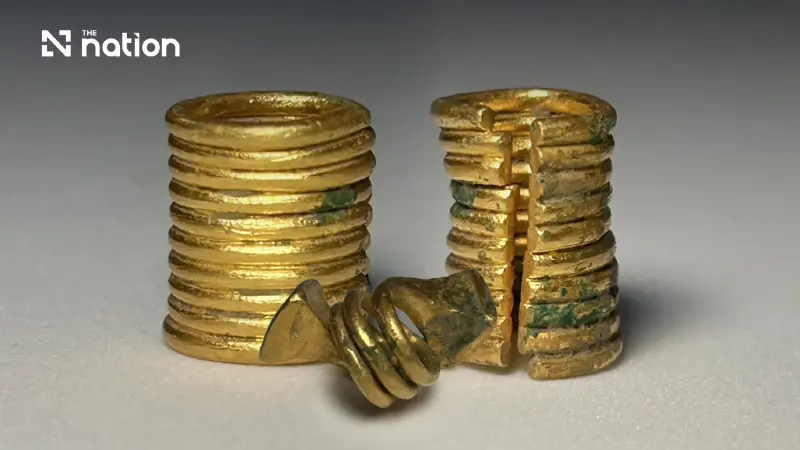


Archaeologists have discovered more ancient gold ornaments at Don Yai Thong archaeological site in Phetchaburi, inside the same skeleton where a Brahmi-inscribed seal ring was found.
Excavations at Don Yai Thong archaeological site in Phetchaburi province have generated fresh excitement after archaeologists discovered more gold ornaments while relocating the first set of skeletons.
The ornaments were found in the same skeleton where an ancient seal ring bearing Brahmi script had previously been unearthed.
The latest discovery marks another significant development in Thai archaeology, drawing strong interest from archaeologists and history enthusiasts across the country.


Phanombut Chantarachot, director-general of the Fine Arts Department, said he had received a report from the 1st Regional Office of Fine Arts in Ratchaburi that on July 17, 2026, archaeologists discovered additional gold ornaments while moving the first group of skeletons — Skeletons 1 to 4 — from the excavation pit for scientific conservation and study at the Science Centre for Conservation in Pathum Thani province.
The new items were found inside Skeleton No 4 and included a spiral-style earring, a cylindrical gold earring, and several gold beads.
All of these were found in the same skeleton where the ancient seal ring with Brahmi inscription had earlier been discovered, causing considerable excitement in the archaeological community.

Archaeologists also found that the latest gold hair ornament was larger than similar ornaments discovered previously. This may reflect the social status or important role of the skeleton’s owner in ancient times. However, all details must still undergo in-depth academic analysis.
The first group of skeletons has now been transported to the Fine Arts Department’s Science Centre for Conservation in Pathum Thani.
Archaeologists from the 1st Regional Office of Fine Arts in Ratchaburi, curators from Phra Nakhon Khiri National Museum, and conservation specialists jointly inspected the handover of the artefacts in detail before cleaning, study and conservation proceed under international standards.


The Fine Arts Department is also preparing a plan to move the second group of skeletons — Skeletons 5 to 8 — as well as a child skeleton with a large bronze vessel placed over the body.
Experts will jointly design support structures and determine careful relocation methods to preserve all archaeological evidence in the most complete condition possible.
The latest discovery of gold ornaments is another important piece of evidence that helps deepen knowledge of Thailand’s ancient history, including burial rites, beliefs, ways of life and networks of contact with outside civilisations.

In particular, the discovery of the Brahmi-inscribed seal ring suggests connections with trade and cultural networks across Asia thousands of years ago.
Don Yai Thong has now become one of Thailand’s important archaeological study areas. More discoveries are expected, potentially helping to unlock further historical clues about the development of ancient communities in the land of Suvarnabhumi.
