
Sati Store: The Mobile Cart Bringing Dhamma to City Streets
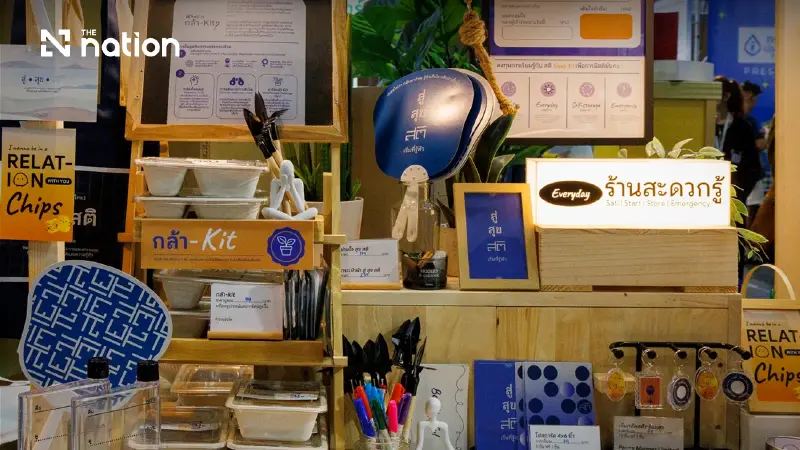


Chulalongkorn University and Suan Mokkh Bangkok introduce "Sati Store", a mobile cart blending creative design with everyday Buddhist philosophy
- Sati Store is a mobile pop-up cart in Bangkok, created by Chulalongkorn University and Suan Mokkh Bangkok, to make Buddhist philosophy (Dhamma) and mindfulness accessible in an urban setting.
- Inspired by convenience stores, the cart uses interactive activities and everyday lifestyle products to reframe mindfulness as a practical tool for daily life, not just a formal temple practice.
- It features interactive exhibits like the "Mindful Kathina Offering Tree" and "Relation-Chips" to help visitors engage with and reflect on their mental and emotional states.
- The project's success is measured by the conversations it sparks about mental well-being, aiming to make mindfulness a tangible and relatable concept for a modern, fast-paced audience.
Chulalongkorn University and Suan Mokkh Bangkok introduce "Sati Store", a mobile cart blending creative design with everyday Buddhist philosophy.
For many city dwellers, the word "Dhamma" conjures images of secluded temples, white robes, and complex Pali chants. Yet on the streets of Bangkok, a new initiative is reframing mindfulness as something as familiar and accessible as a neighbourhood street cart.
Titled Sati Store (or the "Convenience Store for Knowing"), the mobile pop-up cart offers interactive mental well-being activities alongside everyday lifestyle products.
Developed through a collaboration between Chulalongkorn University’s Faculty of Fine and Applied Arts and the Buddhadasa Indapanno Archives (Suan Mokkh Bangkok), the project aims to integrate practical mindfulness directly into fast-paced urban lives.
Dr Naputsamohn Junpiban, a lecturer in Exhibition and Experience Design at Chulalongkorn University and the project's lead designer, explains that the goal was never commercial success.

"The indicator of success isn't sales volume or visitor numbers, but the conversations that take place in front of the cart," says Dr Naputsamohn. "The fact that people of all ages can stand and exchange ideas about their mental state without feeling like they are being forced to listen to a sermon proves this innovation can transform Dhamma into something tangible."

Designing Accessibility
Supported by a Design Innovation Grant, Dr Naputsamohn initiated a co-design process involving academics, local community members, and Buddhist monks across three workshops starting in late 2025.
The research revealed a clear gap: urbanites often view formal meditation as time-consuming, while younger generations find traditional teachings dry. Concurrently, monks frequently lack modern tools to engage youth outside temple grounds.
Taking inspiration from convenience stores—symbols of speed and accessibility—Sati Store operates under the motto: "Your Daily Dose of Mindfulness—Don't Check Out. Check In."

Project advisor Phra Khru Thammarat of Wat Yanawesakwan notes that mindfulness is fundamentally a practical, universal tool applicable regardless of religious background.
"Dhamma is part of our daily lives that we use unconsciously—like being mindful when walking up stairs to avoid falling," Phra Khru Thammarat says. "When minor emotional suffering goes unaddressed, negative feelings accumulate. One provocative word can cause someone to lose their temper. Sati Store offers simple ways to cleanse those feelings daily."

Interactive Mindful Experiences
The mobile cart features several interactive exhibits designed to help visitors explore their internal state:
The Mindful Kathina Offering Tree: Adapting a traditional temple custom, visitors write their feelings on slips attached to coloured sticks. Those managing emotions well use "Collection Slips" (blue sticks), while those experiencing stress use "Emotional Recovery Slips" (orange sticks). The aggregated data is collected as a "Sati Exchange Rate" to form a social well-being database.
Shades of Sati: An activity categorising mindfulness into five distinct emotional states using color codes: Awakening (Yellow), Stable (Orange), Flowing (Blue), Fading (Red), and Returning (Green).
Mindfulness – Sati Mai Tok Krapong: Participants draw cards from a sardine-style can featuring everyday scenarios—such as receiving a critical comment from a colleague—to reflect on how they would respond mindfully rather than react impulsively.
Relation-Chips: Visitors select potato-chip-styled stickers representing personal relationships to reflect on areas needing care, gratitude, or active listening.

Sasawan Chirayus from Suan Mokkh Bangkok observes that the casual format allows visitors to engage naturally.
"People approach the cart and discuss mindfulness throughout the day without feeling lectured," she says.

Lifestyle Nudges
Alongside the interactive exhibits, Sati Store features everyday items designed to act as physical reminders ("nudges") for self-awareness:
The A5 Water Bottle: Screen-printed with the phrase "Drink, See, Know, Refill, Place", targeting office workers whose primary daily pauses occur when drinking water or using the restroom.
Mindful Happiness Bags & Pins: Monk-bag-inspired totes paired with themed pins (e.g., mindful spending or meditation) to prompt brief moments of reflection throughout the day.
Cooling Fans & Keychains: Portable fans designed to remind users to cool emotional heat and small keychains serving as comforting listening tools.
Prominent scholars have noted the practical power of these physical prompts. Visiting scholar Phra Ajarn Paisal Visalo remarked that small objects carrying direct messages can be more effective at anchoring modern minds than traditional amulets because they speak directly to daily behaviour.
Buddhist lecturer Phra Suksan Subhattho adds that the project helps counter the mental pressures of the social media age, where urbanites often suffer from comparing themselves to online ideals.
"Mindfulness practice is about reducing life conditions and daring to embrace all emotions—sadness, loneliness, or discouragement—as visiting friends," says Phra Suksan. "The key is unconditional self-acceptance."

Expanding Reach
The project was recently named a Top 3 Finalist in the Creative Wellbeing category at the Creative Economy Agency’s (CEA) Creative Excellence Awards.
The team is currently processing requests to deploy carts across hotels, hospitals, banks, and major cultural sites like Wat Pho.
Yet Dr Naputsamohn emphasises that the physical cart is merely a doorway to a broader habit.
"The ultimate Sati Store isn't in the cart or the products," Dr Naputsamohn says. "Simply allowing yourself to pause, take a deep breath, and explore how your heart feels right now means you can open your own Sati Store anywhere, every day."
