
Chula VP: Good Research Must Not End at Publication


Vice President Rungsun Rerknimitr on how a 44-year Asahi Foundation partnership turns Chulalongkorn research into national impact
- Chulalongkorn University's Vice President for Research and Innovation, Dr. Rungsun Rerknimitr, asserts that the true measure of research is its application in solving national problems and improving lives, not just its publication.
- The university promotes this philosophy through a 44-year partnership with the Asahi Glass Foundation, which has evolved to support cross-disciplinary research for tackling complex societal challenges like climate change and public health.
- To translate research into tangible impact, Chulalongkorn is building an "innovation pipeline" that includes a technology transfer office, an accelerator school, and a holding company to help commercialize new technologies.
- The university emphasizes that successful innovation should be measured by its ability to create a more inclusive and sustainable society, ensuring that benefits like improved healthcare and technology leave no one behind.
Vice President Rungsun Rerknimitr on how a 44-year Asahi Foundation partnership turns Chulalongkorn research into national impact.
For Professor Dr Rungsun Rerknimitr, vice president for Research and Innovation at Chulalongkorn University, the true measure of research success is not a published paper but a problem solved.
"Good research does not end when it is published," he told The Nation in an exclusive interview. "It must be applied to solve national problems, improve people's quality of life, and support sustainable development."
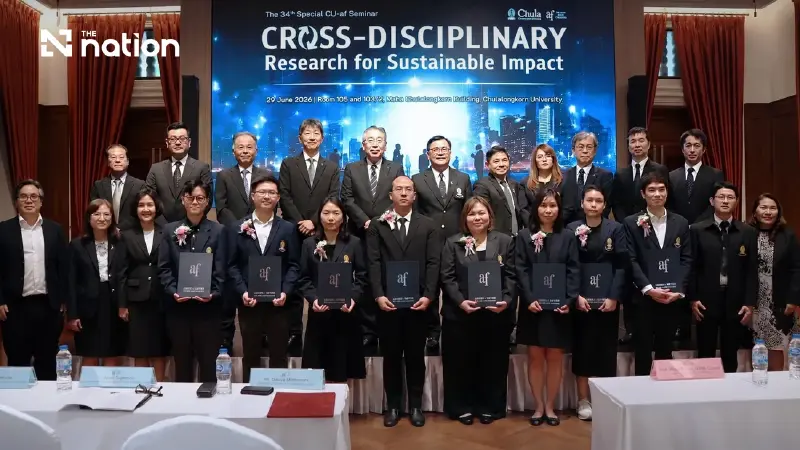
That philosophy was on full display on 29 June, when Chulalongkorn University's Office of Research Affairs, together with Japan's Asahi Glass Foundation, hosted the 34th Special CU–Asahi Special Seminar and the 2026 Asahi Glass Foundation Research Grant Award Ceremony at Maha Chulalongkorn Building.
Under the theme "Cross-Disciplinary Research for Sustainable Impact", the event brought together university leadership, foundation executives and researchers spanning fields from dentistry to architecture to veterinary science.

Professor Dr Wilert Puriwat, president of Chulalongkorn University, delivered the welcome address, while Dr Rungsun gave the opening remarks. Takuya Shimamura, President of the Asahi Glass Foundation, congratulated eight new grant recipients, and Professor Dr Hathaikarn Manuspiya of the College of Petroleum and Petrochemicals delivered a keynote on an industrial bio-waste upcycling platform.
Eleven researchers who received grants the previous year also presented findings ranging from net-zero building design to cave-pathogen surveillance and cacao supply-chain data banking.

But behind the ceremony lies a far longer story—one Dr Rungsun set out in detail in his conversation with The Nation: how a decades-old research grant scheme has evolved into a strategic ecosystem designed to turn Chulalongkorn's research into tangible national impact.
A partnership built on trust, not just funding
This year's seminar coincides with the 44th year of Asahi Glass Foundation research funding at Chulalongkorn, a relationship stretching back to 1982.
"Although seminars were not held regularly in the early years, this partnership has evolved beyond mere research grant support into a strategic collaboration that has grown alongside the university's research development, based on mutual trust and a shared vision recognising the value of research in driving societal development," Dr Rungsun said.
He said the university now hosts researchers across disciplines "who can translate knowledge into technology, public policy, community-orientated innovations, and industrial collaborations" — evidence, he argued, of Chulalongkorn's identity as "a research institution committed to creating tangible, positive impacts on society".
Crucially, the scope of Asahi Foundation support has broadened over time. What began with an emphasis on new knowledge and academic excellence in science and engineering has expanded to include medicine, architecture, social sciences, humanities, Thai studies and Asian studies.
"This reflects the understanding that solving today's complex problems requires interdisciplinary collaboration," Dr Rungsun said.

He pointed to concrete outcomes from that long-term investment: Assistant Professor Dr Suchada Chanprateep Napathorn, a 2003 grant recipient, whose biopolymer research led to industrial collaborations, and Assistant Professor Dr Ornuthai Pinyakong, a 2014 recipient, who developed microbial technology for restoring contaminated land and treating marine pollution.
"Many researchers who received support early in their careers have grown into academic leaders, formed new research teams, and expanded the impact of their work across industry, government, and communities," he added.
For Dr Rungsun, the value of the collaboration lies less in any single grant than in sustained commitment.
"Sustainable societal impact does not arise from a single research project, but rather from the development of researchers, the research ecosystem, and continuous collaboration over many decades," he said.
Breaking down academic silos
Asked why this year's theme — cross-disciplinary research — matters so urgently for Thailand, Dr Rungsun did not hesitate.
"Thailand's most pressing challenges — including climate change, an ageing society, public health, food security, clean energy, water management, biodiversity conservation, digital transformation, and growing social inequality — are no longer problems that can be solved by a single academic discipline," he said. "These are interconnected systems challenges."
He described cross-disciplinary research not as mere cooperation between faculties but as "the integration of diverse perspectives to create solutions that are scientifically sound, socially acceptable, economically viable, and environmentally sustainable".
A technological breakthrough alone, he stressed, is rarely enough; successful deployment depends on economists, legal experts, behavioural scientists and policymakers working alongside engineers and scientists.
He offered examples: low-carbon technology requiring not just engineering but also policy and market adoption; precision medicine depending on artificial intelligence, ethics and healthcare management alongside biomedical science; sustainable agriculture combining biotechnology, environmental science and local community knowledge.
"These examples illustrate that innovation today emerges at the intersections of disciplines," he said.
To that end, Chulalongkorn is "building an integrated research and innovation ecosystem that encourages researchers from different faculties to work together from the very beginning of a project," alongside partnerships with industry, government agencies, hospitals, communities and international collaborators.
"Sustainable impact extends beyond academic publications — it is measured by tangible improvements in people's lives and society," Dr Rungsun said.
From dentistry to veterinary science: research reaching local communities
The 2026 grant recipients' disciplines span dentistry, sports science, engineering, architecture, veterinary science, petroleum and petrochemicals, and Asian studies.
Asked how such varied fields translate into real-world benefit, Dr Rungsun said the common thread is impact.
"The strength of a comprehensive university like Chulalongkorn lies in the diversity of its disciplines. While the research topics may appear very different, they share a common goal: improving people's quality of life and supporting sustainable development."
He cited dentistry research advancing affordable oral healthcare, architecture developing climate-resilient urban design, and veterinary science strengthening animal health, food safety and preparedness against emerging infectious diseases.
The university, he said, encourages researchers "to work closely with communities, industry, healthcare providers, policymakers, and local governments from the outset", ensuring findings are adopted through new technologies, evidence-based policy, improved services or community-level innovation.
This same logic, he said, applies to the previous year's grant winners, whose findings — including cave-pathogen surveillance, net-zero building design and bacterial-polymer soil restoration — were presented at the seminar.
"Health and environmental challenges are inseparably interconnected and cannot be addressed using knowledge from a single discipline alone," Dr Rungsun said, pointing to the university's adoption of the One Health concept, which treats human, animal and environmental health as one interconnected system.
"Prevention is better than cure; therefore, investing in research to understand risks at their source is the most worthwhile investment for the health system, the environment, and the country's long-term development."

Data, AI and a growing innovation pipeline
Dr Rungsun also detailed how Chulalongkorn is modernising its research infrastructure to keep pace with data-driven methods highlighted at the seminar, including machine learning applications in materials science and data banking for agricultural supply chains.
"Chulalongkorn University is evolving its research framework by building a more integrated, data-driven, and collaborative research ecosystem," he said, citing investment in digital infrastructure and expanding partnerships with government, industry and international institutions.
Artificial intelligence, he said, is already reshaping the university's medical research, pointing to DeepGI, an AI platform supporting colorectal cancer screening through colonoscopy, and D-Mind, an AI-assisted system for depression screening and mental health assessment.
In materials science, the university is working with a major international consortium to build a centralised materials data platform "that enables data sharing, machine learning, and accelerated discovery of next-generation materials".
In agriculture, Chulalongkorn is collaborating with government and private-sector partners on data platforms to strengthen supply chains, improve traceability, and support evidence-based decisions.
Turning laboratory research into industry
The seminar's keynote, delivered by Professor Dr Hathaikarn Manuspiya on an industrial bio-waste upcycling platform, prompted Dr Rungsun to outline how Chulalongkorn helps such innovations reach commercial scale.
"The key challenge is not only creating innovative technologies, but also translating them into solutions that industry can adopt at scale," he said.
He described a three-part ecosystem built for that purpose: CUiHUB, the university's technology transfer office, which helps researchers protect intellectual property and connect with industrial partners; a planned Accelerator School to equip researchers and IP owners with entrepreneurial and investment-readiness skills; and CU Enterprise (CUE), the university's holding company, which offers a matching-fund mechanism alongside private investors and government agencies.
"This helps de-risk early-stage technologies and accelerates their journey from laboratory research to market adoption," he said.

Research that leaves no one behind
Beyond hard science, the seminar also featured research into the recruitment ecosystem for people with autism in Thailand — a reminder, Dr Rungsun said, that innovation must be measured by more than economic value.
"Innovation should be measured not only by economic value but also by its ability to improve people's lives and create a more inclusive society. Economic growth and social inclusion should go hand in hand," he said.
He said similar research approaches are applied to ageing populations, mental health, education, disability and equitable access to healthcare, drawing on researchers from medicine, engineering, social sciences, law, business and the humanities to ensure new technologies are designed with ethical and cultural considerations in mind.
"The most successful innovations are those that leave no one behind and contribute to a more sustainable and inclusive future for Thailand," he said.
What comes next
The seminar closed with a networking dinner at the Surawong Room, Baan Suriyasai Restaurant, where Dr Wilert, Dr Rungsun and Shimamura met with executives from both institutions.
Asked what emerged from those discussions, Dr Rungsun said the two sides are looking to move beyond individual research grants toward shared strategic platforms.
Chulalongkorn, he said, is now developing platforms to support "the entire innovation pipeline — from fundamental research and proof-of-concept to prototyping, technology validation, and commercialisation", with priority areas including advanced therapy medicinal products, medical devices, and future food innovation, sectors in which he believes Thailand has strong potential to become a regional leader.
"We hope that the next phase of collaboration with the Asahi Glass Foundation will not only continue to support excellent research, but also help build international networks, nurture young researchers, and accelerate the translation of scientific discoveries into innovations that benefit both Thailand and the global community," Dr Rungsun said.
