
Medeze, Chula team up to strengthen Thailand’s biotech supply chain
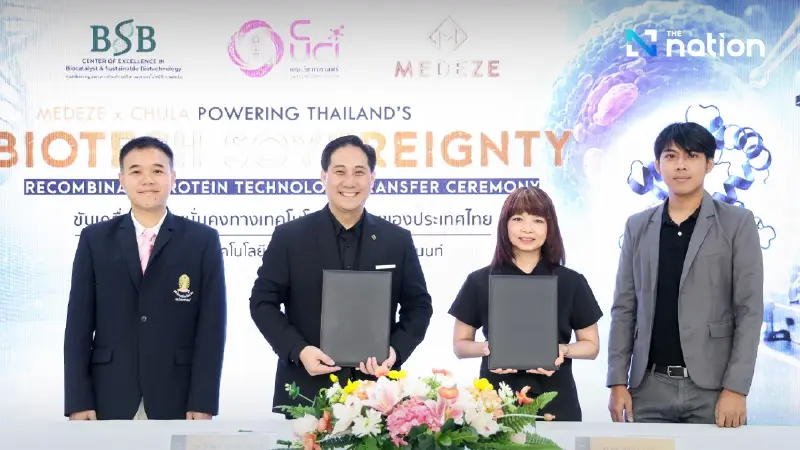


Medeze and Chulalongkorn University are developing recombinant protein production to strengthen Thailand’s biotech and ATMP industry.
Medeze Group and Chulalongkorn University’s Department of Biochemistry have launched a joint research project to develop recombinant protein production in Thailand, in a move aimed at strengthening the country’s biotechnology supply chain and supporting its ambition to become a regional medical hub.
The collaboration seeks to turn university research into the commercial production of recombinant proteins, a key biological raw material used in modern medicine, vaccines, personalised medicine and advanced cell-based therapies.
The project comes as Thailand is placing greater emphasis on advanced therapy medicinal products, or ATMPs, after the Ministry of Public Health recently issued a ministerial regulation classifying stem cell and cell-based therapies as medicines under Thai law.
According to Medeze, local production of recombinant proteins could help reduce reliance on expensive imports, strengthen biotechnology security and support treatments that meet international standards. The company also believes the move could attract more foreign patients seeking high-quality healthcare in Thailand, boosting both the medical and tourism sectors.

Recombinant proteins key to advanced therapies
Dr Veerapol Khemarungsan, chief executive officer of Medeze Group, described recombinant proteins as essential to medical treatment because they can help reduce complications and support the growth of cells used in advanced therapies.
They are vital for cultivating stem cells, natural killer cells, hair follicle cells and other emerging cell types, as they help cells grow properly and support better treatment outcomes, he explained.
Producing recombinant proteins domestically would strengthen Thailand’s biotechnology security, Veerapol added, compared with the past when most knowledge and production capability were based overseas.
He noted that the standard operating procedures provided by Chulalongkorn University had already helped reduce experimental import costs by around 50%. If Medeze reaches large-scale manufacturing and demand increases, costs could eventually fall by 70-80%, he added.
Building a full biotechnology supply chain
Veerapol explained that Medeze already had midstream and downstream operations and was now working to develop upstream production through a plant for cell culture media.
If Medeze can build upstream capability, the company would be able to connect the entire supply chain and support existing market demand for protein production, he noted.
Interleukin-2 was the first protein the company synthesised because it is widely used and Medeze already understands its specifications and expected applications in cell testing.
Cell culture media may require more than 20 types of protein, meaning the company will need to produce many different proteins over time, he explained.
Once Medeze establishes large-scale standard operating procedures and manages sterility requirements, the company plans to discuss the next steps with the Food and Drug Administration (FDA) to develop a laboratory capable of extracting proteins in line with international standards.
Veerapol expects the project to move towards commercial production within three to five years, subject to approval from relevant agencies.

Reducing reliance on imported raw materials
Professor Alisa Vangnai of Chulalongkorn University’s Department of Biochemistry explained that the collaboration began with the goal of producing recombinant proteins in Thailand for use in the medical industry.
Chulalongkorn University already had relevant technology, she noted, but it had not previously been applied in the medical industry at this level.
“This became the starting point that allowed us to develop the project and achieve initial success,” she said.
Alisa described Thailand’s medical sector as having strong growth potential and the ability to become an important medical base for the region and the world. However, the country still lacks key raw materials and continues to import almost all of them, she noted.
This dependence has created a major bottleneck because imported raw materials come with high production costs, transport expenses and other fees, while Thailand has limited control over supply.
“For the industry to be sustainable, we must be able to produce these raw materials ourselves,” she said.
Recombinant proteins are among the most important raw materials for modern medicine, especially in applications requiring high purity, proven function and scientific verification, she added.
ATMPs seen as a new health-economy driver
Veerapol urged Thailand to accelerate the development of ATMP technology as the country, like many others, moves deeper into a super-aged society.
Demand for advanced therapies is expected to grow as older people seek to stay healthy, maintain quality of life and receive treatment for diseases linked to physical degeneration, he explained.
“Using a person’s own cells to restore the body, strengthen immunity and support cancer-related treatment is already a global trend,” he said.
Veerapol also pointed to strong growth potential in Thailand’s ATMP and cell therapy market, supported by policies from both the previous and current governments.
Medeze has progressed about 70-80% through an ATMP sandbox supported under the previous administration. The current government, he added, now wants Thailand to become an ATMP hub by developing high-value medical products that can generate revenue for the country.
If Thailand can produce products of international quality at lower cost while maintaining strong medical services, the country could attract more foreign patients and boost the health economy, he said.

Bridging universities and industry
Veerapol also highlighted the gap between the commercial sector, industry and universities. Although Thailand has tried many projects to connect companies and universities, many have not yet reached the commercial stage.
This project could open a new door and serve as a sandbox model for other Thai companies to work with universities, he noted.
“This project opens a new door,” he said. “It can become a sandbox and a model for many other companies in Thailand to approach universities, share their needs and see how highly skilled academics can help answer those needs.”
He described the project as an important step because it marks the first time deep-tech, research-based knowledge would be transferred into large-scale manufacturing in line with global megatrends.
Looking ahead, Veerapol expects Thailand to become ASEAN’s ATMP leader within the next five to 10 years if government policy and industry development continue in the same direction.
