
Thailand seizes THB24bn as scam and nominee crackdown widens
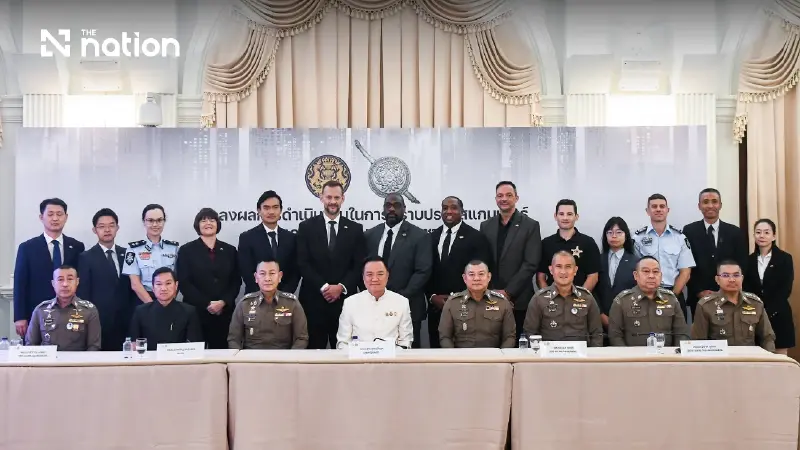


Thailand says online scam cases fell 69.2% after a nine-month crackdown targeting call-centre gangs, mule accounts and foreign nominees
Thailand has seized or frozen more than 24 billion baht in money and assets and arrested more than 29,000 suspects linked to scammer networks, as the government intensifies its campaign against online fraud and foreign nominee operations.

Prime Minister and Interior Minister Anutin Charnvirakul led a briefing at Government House on Monday to report the results of a nine-month national crackdown on online scam gangs, call-centre networks and transnational nominee structures.
The government said reported online crime cases had fallen by 69.2%, while financial losses had dropped by 87.3%. Authorities also said they had seized assets worth 24 billion baht, blocked around 300,000 dangerous or suspicious phone numbers, shut down 122,840 fraudulent websites and identified or arrested more than 70 high-level gang leaders.
Police have also arrested more than 30,000 people linked to scammer networks, while operations against nominee businesses have expanded from Koh Phangan to Phuket, Phang Nga and Krabi.
The crackdown forms part of a national agenda ordered by the government, with the Royal Thai Police serving as the main agency in suppressing technology crime, scammer networks and foreign nominee structures.
Pol Lt Gen Trairong Phiwphan, deputy inspector-general of the Royal Thai Police and police spokesman, said the operation was being carried out under the government’s urgent security policy. The campaign is being integrated with the Interior Ministry and other agencies under the wider policy framework of relieving hardship, improving public welfare, protecting public peace, eradicating drugs and defeating criminal gangs.

Joining the briefing were National Police Chief Pol Gen Kitrat Phanphet, deputy national police chiefs Pol Gen Thana Chuwong and Pol Gen Samran Nualma, and assistant national police chief Pol Lt Gen Jirabhop Bhuridej.
Anutin said the fight against technology crime, scammer networks and transnational crime was one of the government’s key missions, and had been declared a national agenda requiring urgent and decisive action.
He said the results over the past nine months were satisfactory, with both the number of cases and the value of losses falling sharply. He said this showed that the government’s prevention, interception and coordination mechanisms were working more effectively to protect the public.
The prime minister also said the suppression of transnational crime and foreign nominee networks had produced clear results, especially against illegal businesses that exploited Thai people.
He instructed authorities to continue the campaign nationwide, saying Thailand remained friendly and welcoming to tourists, but would not tolerate transnational criminals or groups exploiting Thai nationals.
Pol Gen Kittirat said the Royal Thai Police had accelerated its work on both online crime and transnational criminal networks in line with the government’s policy and the prime minister’s instructions.

On cybercrime, the Royal Thai Police’s Technology Crime Suppression Centre has served as the main operational mechanism, particularly against call-centre gangs and scammer networks. Pol Gen Thana has been assigned to lead the Anti-Online Scam Operation Centre, or ACSC, which works with domestic and international partners to cut scammer networks at every level.
The ACSC has spent the past nine months investigating offenders, expanding cases from lower-level operatives to wider networks, tracing and freezing assets, and using real-time coordination to prevent people from becoming victims.
Police said the Warroom ACSC, working with banks and other agencies, had helped 862 victims in real time by intervening before losses could escalate, warning potential victims and helping them file complaints.
Authorities have suspended 23,341 criminal phone numbers and 291,498 suspicious or spam numbers, helping reduce fraudulent phone activity by 77.94% per month.
Police also seized SimBox devices used for fraudulent calls and text messages, as well as false base station equipment used to send scam messages. They inspected border-area signal towers, carried out 10 cross-border internet “unplug” operations to stop scammers from misusing Thai internet services, and blocked more than 122,840 fraudulent URLs. Facebook accounted for the largest number of blocked URLs, at 108,517.
Police said public-awareness campaigns had also been carried out online and nationwide to strengthen cybercrime awareness, including training model police instructors to help educate the public.
On financial disruption, authorities have closed 351,884 mule accounts used by criminals. Money and suspicious assets frozen through complaints submitted via the Thai Police Online system amounted to more than 3.6 billion baht, or about 24% of total reported losses.
Police said tougher measures against mule accounts had reduced overall mule-account numbers by 83.67%. Individual mule accounts fell by 75.27%, corporate mule accounts dropped by 87.62%, and related transaction volumes declined by 81.39%.
Investigators have arrested 29,233 suspects linked to scammer networks, averaging 121 arrests per day. Authorities have also arrested or issued warrants for more than 70 gang leaders and 26 Thai and foreign state officials, as well as private-sector personnel allegedly connected to the networks.
The crackdown also led to the repatriation of 1,862 Thai nationals from neighbouring countries, with 67.9% brought back from Cambodia and 32.1% from Laos.
Police also arrested 2,489 Thais accused of illegally crossing natural border routes, with more than 1,031 linked to existing case records. Authorities pushed out 2,647 foreigners who had entered Thailand illegally in connection with cases involving KKPark and Minletpan.
Police have identified more than 60 suspected scammer clusters in Cambodia, Laos and Myanmar. They have also coordinated with military units and neighbouring countries to dismantle scammer bases along the border, including in O’Smach, Thmor Da, Poipet, Tboung Khmum, KKPark, Shwe Kokko, Minletpan, Tachileik and Bokeo.
Authorities also cited major operations against networks allegedly involved in recruiting people into scam operations and smuggling people across borders.
Among the key cases were operations targeting scammer-related sites and warehouses near the border, the “Uprooting Transnational Scammers” operation, and asset seizures worth more than 10 billion baht linked to the Yimleak-Ben Smith network. Police also issued warrants for Ben Smith and his wife in an alleged cross-border investment fraud case that caused losses of more than 1 billion baht.
Authorities also referred to the transfer of She Zhijiang, described in the report as a major figure in Chinese grey-capital networks, to face prosecution in China, as well as joint scammer investigations with the FBI Strike Force.
The Royal Thai Police said laws, measures, orders and related regulations had also been updated to improve the handling of scammer networks.
The second part of the campaign targets foreign nominee networks, particularly in major tourist provinces.
Pol Gen Samran, director of the Royal Thai Police’s centre for suppressing transnational criminals and illegal foreign entry, said the nominee crackdown was being carried out in three phases to reclaim economic sovereignty and prevent illegal business structures.
Authorities have seized back 172 plots of land covering 130 rai, one ngan and 25.8 square wah, with land and buildings valued at around 1.67 billion baht.
In May, the first two phases focused on Koh Phangan in Surat Thani. Authorities surveyed 3,754 registered companies on the island and found that foreigners held shares in 2,381 of them. Of these, 243 companies were assessed as being at risk of nominee arrangements.
Police have already taken legal action in 105 nominee cases on Koh Phangan. Of these, 88 are under investigation, three are with prosecutors, and 14 have resulted in court convictions.
The third phase began on June 20 and targeted the Andaman coast, covering Phuket, Phang Nga and Krabi.
In Phuket, authorities found 31,970 registered companies, including 11,773 with foreign shareholders. Of these, 632 were assessed as being at risk of nominee arrangements.
In Phang Nga, 1,685 registered companies were surveyed, including 346 with foreign shareholders, with 174 companies assessed as being at risk. In Krabi, authorities found 3,587 registered companies, 749 of which had foreign shareholders, while 401 were assessed as nominee-risk companies.
Across the four provinces, including Surat Thani, more than 1,450 companies were found to be at risk of nominee arrangements.
Across all three phases, courts approved 107 warrants against 96 people, comprising 29 Thais and 67 foreigners. Police have arrested 65 suspects under 73 warrants, including 24 Thais and 41 foreign nationals. The foreign suspects include nationals of Israel, France, Russia, Poland, Switzerland, South Africa and the United Kingdom, among others.
Police said the goal of the foreign nominee crackdown was to regulate investment and tourism in Surat Thani, Phuket, Krabi and Phang Nga, protect lawful business operations, and prevent foreign capital groups from using Thai nominees to exploit local communities.
Authorities said any companies or land plots suspected of nominee arrangements would continue to be investigated and prosecuted under the law.
