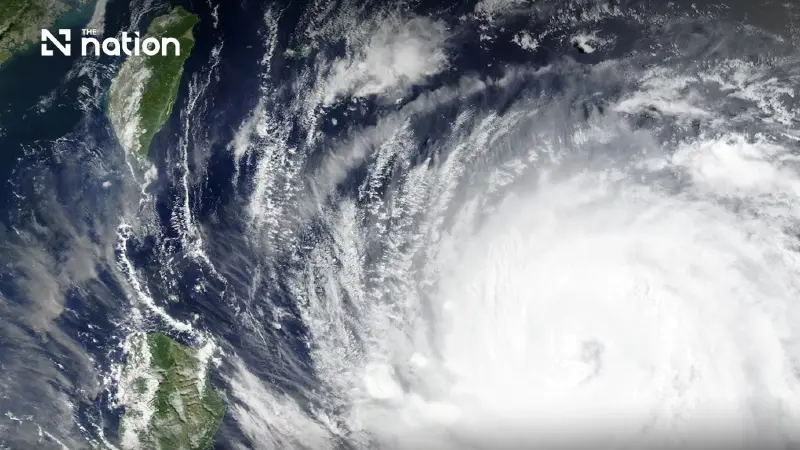
Typhoon Bavi brings violent winds to Japan’s Sakishima Islands as Taiwan evacuates more than 14,000 people and cancels all domestic flights
In Japan's southwestern islands, Typhoon Bavi disrupted travel by causing the cancellation of hundreds of flights and ferry services, and led to power outages for hundreds of buildings.
Although not making a direct landfall, the storm's wide circulation prompted Taiwan to close its financial markets, suspend work, and evacuate more than 2,000 people from high-risk areas.
The typhoon is forecast to make landfall on China's eastern coast, where coastal communities have begun preparations by securing fishing boats ahead of its arrival.
Japan’s southwestern islands and Taiwan have moved into emergency preparations for Typhoon Bavi, with the powerful storm disrupting flights and ferry services, cutting electricity supplies and raising fears of destructive winds, torrential rain, flooding and landslides across the region.
Bavi was expected to pass extremely close to the Sakishima Islands, a remote island chain in Okinawa Prefecture near Taiwan, early on Saturday, July 11, according to Japanese meteorological authorities.
Maximum sustained winds near the centre of the typhoon had reached about 162 kilometres per hour as it approached the islands. Japanese authorities warned residents to remain alert throughout Friday and Saturday for violent gusts, landslides, flash flooding and storm surges.
The storm was described in local reports as potentially the most severe to threaten the area in about 30 years, prompting residents of Ishigaki Island to make final preparations before weather conditions deteriorated further.
Ishigaki prepares for destructive winds
Heavy rain was already sweeping across Ishigaki on Friday as residents secured windows and placed wind-resistant netting around homes and businesses.
At supermarkets, shoppers stocked up on food and other supplies, with shelves of instant noodles emptied as people prepared for possible power cuts and a prolonged period indoors.
Some residents expressed concern that their preparations might not be sufficient for a storm of Bavi’s strength. One shop owner placed protective netting around his bicycle-rental business, while others reinforced windows with tape to reduce the risk of breakage.
Public beaches and coastal parks appeared to have been closed, while the local ferry terminal suspended services. Ferry sailings scheduled for both Friday and Saturday were cancelled, leaving some tourists unable to continue their journeys to nearby islands.
One visitor from Ibaraki Prefecture, northeast of Tokyo, was forced to extend his stay on Ishigaki after ferry services were halted. He said he had previously experienced typhoons passing nearby but had not faced a storm expected to strike so directly.
Nearly 900 buildings across Okinawa Prefecture were without electricity by 3pm Japan time on Friday, adding to concerns that further outages could occur as the storm moved closer.
Airlines grounded hundreds of flights as the typhoon disrupted travel across Japan and the wider region.
Japan Airlines cancelled more than 100 flights scheduled for Friday and Saturday, affecting nearly 20,000 passengers.
All Nippon Airways cancelled more than 160 flights through Sunday, disrupting the journeys of about 20,000 passengers.
The cancellations affected routes serving Okinawa and the southwestern islands, where airports and transport operators faced increasingly dangerous conditions.
The disruption extended beyond Japan. Taiwanese airlines cancelled all flights scheduled to depart from Taiwan Taoyuan International Airport, outside Taipei, on Saturday.
Cathay Pacific also cancelled weekend services between Hong Kong and Taiwan, as well as some flights to the eastern Chinese coastal cities of Hangzhou, Ningbo and Fuzhou.
Taiwan shuts markets and evacuates residents
Although Bavi was not expected to make a direct landfall in Taiwan, its broad circulation was forecast to bring extremely heavy rain, strong winds and flash floods to much of the island.
Some locations could receive up to one metre of accumulated rainfall from late Friday, according to forecasts.
Taiwan closed its financial markets for the day, while work was suspended across extensive areas in the north and east.
More than 2,000 people were evacuated, primarily from mountainous areas along the eastern coast, where the risk of landslides and flooding was particularly high.
Nearly 29,000 military personnel were placed on standby to support evacuations, emergency operations and relief work if conditions worsened.
The Taipei city government established distribution points where residents could collect sandbags. In flood-prone neighbourhoods, people placed the bags across entrances to homes and businesses in an attempt to prevent water from flowing inside.
President Lai Ching-te said Bavi had weakened slightly and had been downgraded to a moderate typhoon under Taiwan’s classification system. However, he warned that its large storm radius meant it could still bring strong winds and intense rainfall to many areas.
Chipmaker delays sales announcement
The disruption also affected Taiwan’s technology sector.
Taiwan Semiconductor Manufacturing Co, the world’s largest contract chipmaker, postponed the scheduled release of its June sales figures from Friday until Monday because of the typhoon-related shutdown.
Taiwan is a major centre of global semiconductor production, meaning severe weather can disrupt transport, staffing and business operations even when large manufacturing facilities remain protected.
Philippines reports deaths after monsoon rains
The storm’s wider influence was also felt in the Philippines, where Bavi strengthened a southwest monsoon system that brought heavy rain.
Ten people were killed in a landslide on the southern island of Mindanao, according to a disaster-management official.
The deaths illustrated the storm’s regional reach, with its circulation intensifying rainfall far from its centre even before it approached Japan and Taiwan.
Bavi expected to move towards China
After passing close to Japan’s Sakishima Islands and affecting Taiwan, Bavi was forecast to continue westwards towards China.
The typhoon was expected to make landfall near Wenzhou, a city of about 10 million people on China’s eastern coast, late on Saturday or early Sunday.
Fishing communities around Wenzhou had begun preparations before the storm’s arrival. Boats from nearby villages returned to harbour, while some vessels were hauled ashore for repairs and protection.
Residents and maritime workers were preparing for high winds, heavy rainfall and rough seas as the storm approached the Chinese coastline.
Bavi’s path across the region has prompted extensive precautions in Japan, Taiwan and China, with authorities emphasising that even areas outside the storm’s direct track could face dangerous rainfall, flooding and transport disruption.
Latest: Taiwan evacuations rise as flight cancellations mount
Taiwan expanded its emergency measures on Saturday as Typhoon Bavi passed northeast of the island, evacuating more than 14,000 people and cancelling 1,191 flights.
All 274 domestic flights were grounded, while 917 international services were cancelled. Nearly all cities and counties declared a typhoon holiday, closing government offices and schools that would otherwise have opened over the weekend.
The high-speed railway linking northern and southern Taiwan remained in operation, although services were reduced.
Most evacuees were moved from mountainous communities in northern and eastern Taiwan, where authorities warned of flooding and landslides. Forecasts indicated that some areas could receive almost one metre of rain despite the storm gradually weakening and not being expected to make landfall on the island.
In Taipei, gusty winds and rain continued, although some residents remained outdoors. Sandbag distribution points had been established in advance, particularly in neighbourhoods considered vulnerable to flooding.
Bavi meanwhile battered Japan’s Sakishima Islands with sustained winds of about 144 kilometres per hour and gusts forecast to reach 198kph. Flights and ferries serving Ishigaki remained suspended as strong winds sent debris across largely deserted streets.
The storm was forecast to continue towards China’s eastern coast and make landfall near Wenzhou early on Sunday.