
Latest Wongwian Yai update: building stable as 11 sensors track movement after tunnel leak
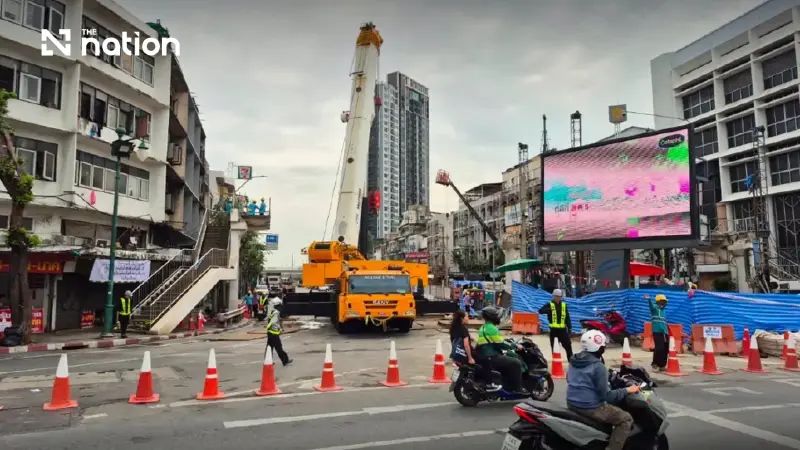


Structural movement at buildings affected by the road subsidence near Wongwian Yai remained stable early on July 11, as authorities expanded digital monitoring and completed the removal of a heavy pedestrian bridge from the weakened area
- Engineering inspections show the building is stable, with displacement and angle readings remaining unchanged despite a nearby tunnel leak and road subsidence.
- A network of eleven intelligent level and tilt sensors has been installed at nine locations on and around the building to continuously monitor for any movement.
- The sensors are designed to detect minute changes in settlement or inclination, providing immediate warnings to allow for a rapid response from emergency teams.
- As a precautionary measure to maintain stability, a heavy concrete pedestrian footbridge was removed to reduce the load on the weakened ground.
The Department of Disaster Prevention and Mitigation, or DDPM, said the latest engineering inspection by Thailand’s national Urban Search and Rescue team showed that the displacement reading remained unchanged at 8.3.

The update was delivered at 6am by DDPM director-general Theerapat Kachamat, who has been overseeing the department’s support operation at the site of a water leak inside the southern Purple Line underground railway tunnel. The published update reported the figure as 8.3 but did not specify its unit of measurement.
The incident affected the road surface and nearby commercial buildings around Wongwian Yai intersection, prompting authorities to deploy structural engineers, rescue personnel and specialist monitoring equipment.

Readings remain stable
The latest result followed continuous monitoring that began after one of the commercial buildings appeared to tilt following the tunnel leak and road subsidence.
Theerapat said on the evening of July 9 that the building appeared, when viewed with the naked eye, to have leaned further. Instrument readings, however, showed that its angle remained at approximately 79–80 degrees, unchanged from measurements taken earlier that evening.

Although no significant additional movement was detected at that stage, officials continued to watch existing cracks and fractures in the structure and surrounding road surface.
USAR Thailand personnel used engineering instruments and digital monitoring equipment capable of triggering an alarm if the building moved beyond the recorded position. The affected building was undergoing renovation and was unoccupied, while businesses in nearby properties were advised to exercise caution and await any formal evacuation instructions from the Bangkok Metropolitan Administration.

Eleven sensors installed at nine locations
The DDPM has since strengthened the monitoring system in collaboration with the Engineering Institute of Thailand and the Department of Civil Engineering at Kasetsart University.
Eleven intelligent level and tilt sensors were installed at nine strategic locations around the main subsiding building and neighbouring commercial structures.
The devices are intended to detect small changes in settlement or inclination and transmit early warnings if the buildings move further, including shifts measured at millimetre level. The system is designed to improve safety for rescue teams, engineers and people in surrounding areas.
The expanded network supplements two Rescue Guardian monitoring devices previously installed within the approximately 30-metre zone where cracks had been found.

Those devices monitor changes in the angle and position of the buildings through a camera-controlled system and sound an immediate alarm if structural movement is detected. Engineers attached to USAR Thailand are supporting the operation to ensure that the monitoring and emergency response follow structural-safety standards.
The use of continuous sensors provides officials with faster information than periodic visual inspections alone and allows teams to withdraw or intervene quickly if the readings change.
Footbridge removed before dawn
Engineering teams and contractors also completed the removal of two large concrete sections of a pedestrian footbridge from the affected area.
The bridge represented a substantial load above the weakened road surface and was considered a potential source of further danger if the ground continued to settle.
Removal work began during the night. Crews successfully lifted the first section at 4.30am before moving directly to the second.
Light rain continued during the operation but did not prevent the teams from completing the work. Both concrete sections were fully removed before dawn, reducing the accumulated weight on the vulnerable surface.
USAR team remains on standby
The DDPM deployed 20 USAR Thailand personnel to work alongside Bangkok’s fire and rescue teams after the incident.
An incident command post was established inside Wongwian Taksin, supported by specialist rescue equipment, generators and lighting equipment for overnight work. Volunteers and rescue foundations were also placed on standby to assist with emergencies or medical transfers if required.
Authorities have continued to restrict access around the work zone because heavy machinery and engineering teams remain active.
The DDPM said it would continue reporting developments as officials monitor the buildings, road surface and tunnel-leak response.
The stable readings do not mean monitoring has ended. The buildings and surrounding ground remain under close observation, with the sensor network intended to provide immediate warning if displacement, settlement or tilting begins to increase.
