
Purple Line tunnel leak prompts scrutiny of ground improvement
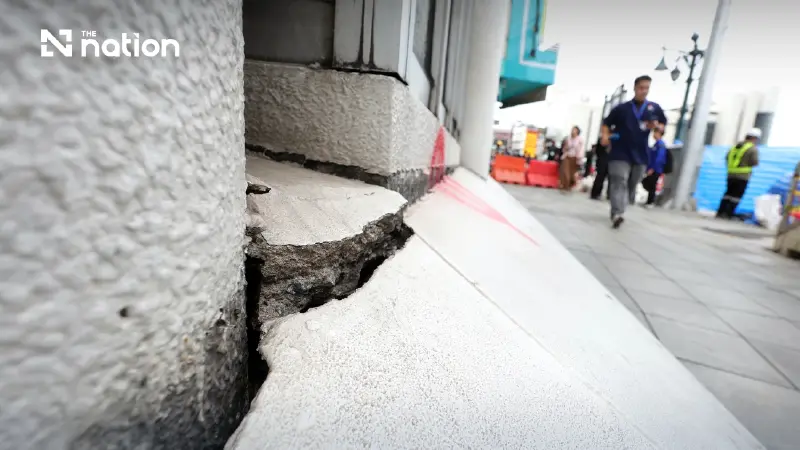


Professor Amorn Pimanmas urges hourly monitoring as soil reinforcement, groundwater pressure reduction and grouting continue at four leak points.
- A water leak at the MRT Purple Line tunnel construction site has caused ground subsidence and cracks in nearby buildings.
- The effectiveness of the initial "ground improvement" process, a technique meant to strengthen soil with cement injections to prevent leaks, is being questioned as the potential cause of the failure.
- The primary concern is that the leak is washing away soil, which could lead to further road subsidence and damage the foundations of surrounding structures.
- Remedial measures are underway, including injecting additional cement into the soil to stop the water flow and pumping out groundwater to relieve pressure for repairs.

Prof Amorn Pimanmas, president of the Thailand Structural Engineers Association, inspected the site where water had leaked into the construction area of the southern section of the MRT Purple Line project at Wongwian Yai intersection, resulting in subsidence and cracks in nearby buildings and structures.
After the inspection, he told reporters that an initial assessment found that buildings close to the construction site had indeed been affected and developed cracks, particularly near the construction shaft, where work was underway on the underground tunnel’s lowest point.
Underground rail tunnel construction normally requires a sump pit to collect water from track washing or drainage inside the tunnel before it is pumped out.
A review of the construction plans showed that engineering principles required ground improvement, involving injections of cement or chemicals to strengthen the soil, before excavation or underground construction began, to prevent water and soil from flowing into the tunnel.
Amorn said he had been informed, based on preliminary information, that construction at the location had already been completed.


This raised a question over whether the ground improvement had sufficiently covered the affected area.
If the work was carried out correctly in accordance with the design, the likelihood of water seeping into the tunnel would be reduced.
This was a key issue requiring further examination.
Amorn said the measures now underway included injecting additional cement into the soil layers to strengthen them and reduce the flow of water into the tunnel.
He said the concern was not only the leaking water, but also the possibility that it could carry soil into the tunnel.
If soil were washed away, it would cause the road surface to subside and affect the foundations of surrounding buildings, particularly older buildings, most of which use short piles and are at risk of settlement when their supporting soil is lost.
The Thailand Structural Engineers Association began measuring building settlement levels the previous day to establish reference values and planned to repeat the measurements the following day.
The readings would be used to compare day-to-day settlement rates and assess their relationship with cracks inside the buildings, helping determine the effectiveness of the remedial measures being implemented.

Another key measure being carried out by the agencies was to reduce groundwater pressure by drilling deep groundwater wells and pumping out water so that grouting at all four leak points could be carried out effectively.
Amorn also proposed that the agencies prepare contingency plans in case the current measures proved ineffective, including backup measures and other technologies such as injecting water to create pressure and prevent soil from flowing, or using ground-freezing technology to solidify the soil.
He said experts should assess these alternatives as appropriate.
He stressed that the most important priority was continuous monitoring of the volume of water entering the tunnel, whether pumping operations could keep pace, the settlement levels of the road and surrounding buildings, and any cracks.
Measurements should be taken hourly, he said, as surveying equipment and levelling instruments could be used continuously.

