
Houthi blockade threat opens new front in Iran war
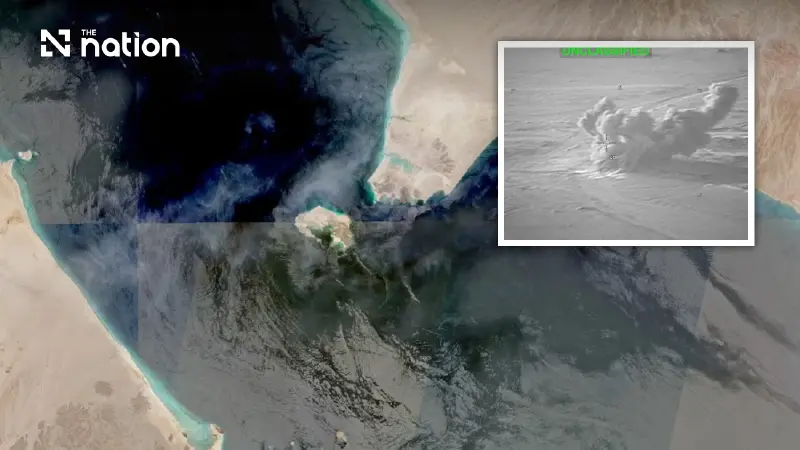


A Houthi threat to blockade Saudi shipping raises fresh risks to oil supplies as US-Iran strikes continue despite ceasefire efforts
- Yemen’s Iran-aligned Houthi movement has threatened a naval blockade against Saudi Arabia, which is seen as opening a new front in the broader US-Iran conflict.
- The blockade targets the Bab el-Mandeb Strait, a vital maritime passage for global energy supplies, potentially removing up to 7% of the world's oil from the market.
- Saudi Arabia's coalition has responded with a warning of military force and has started protecting vessels in the strait, escalating regional tensions.
Yemen’s Iran-aligned Houthi movement has threatened to impose a naval blockade on Saudi Arabia, raising the prospect of a new front in the widening US-Iran war and adding fresh danger to global energy supplies and maritime trade.
The Houthis announced that what they described as a maritime embargo would take effect immediately in response to an alleged Saudi siege of Yemen.
Saudi Arabia’s coalition in Yemen responded by warning that it would use force against the group. It also began introducing measures to protect vessels travelling through the Bab el-Mandeb Strait, a vital passage linking the Red Sea with the Gulf of Aden.
The waterway has become increasingly important for Saudi oil exports because the Strait of Hormuz has been effectively closed by the conflict.

A complete shutdown of Bab el-Mandeb could prevent much of Saudi Arabia’s oil from leaving the region and remove the equivalent of about 7% of global supply from international markets. The war has already disrupted oil shipments amounting to roughly 10% of worldwide supply.
Oil prices initially rose after the Houthi announcement before giving up those gains as traders continued to hope that diplomatic efforts might produce a breakthrough. Insurance costs for cargo travelling through the Red Sea also increased as the threat to commercial vessels intensified.
US military deaths deepen pressure on Trump

The escalation followed one of the deadliest periods of the conflict for American forces.
The Pentagon identified two US soldiers killed when Iran attacked an American base in Jordan on Friday. Unidentified remains were also recovered and could belong to a third soldier listed as missing.
A fourth service member was killed in northern Iraq during a controlled operation to destroy unexploded ordnance from a downed Iranian attack drone.
US President Donald Trump defended the latest strikes against Iran as retaliation for the deaths of American troops.
Trump declared that Iran would pay many times over whenever it killed an American soldier and said the directive had been passed to Defence Secretary Pete Hegseth, Joint Chiefs of Staff chairman Daniel Caine and other military commanders.

US Central Command confirmed that another wave of attacks on Iran had begun on Monday afternoon in the United States.
Explosions were subsequently reported in several Iranian cities, including Tabriz, Chabahar, Konarak, Bandar Mahshahr and Bandar Imam Khomeini. Iranian state media reported that one person was killed and several others wounded southwest of Tabriz.
Iran reports attacks across the region

Iran’s Islamic Revolutionary Guard Corps claimed responsibility for attacks on US military assets across the Middle East.
It said ballistic missiles had been fired at American aircraft at Aqaba airport in Jordan, as well as military facilities in Kuwait and positions in Syria.
Warning sirens sounded across Bahrain on Monday, while Kuwait’s military reported early on Tuesday that its air defences were again intercepting Iranian drones.
The Revolutionary Guards also reported explosions involving two oil tankers attempting to pass through the Strait of Hormuz using what it called an unsafe route.
The force did not identify the vessels or provide information about possible casualties. Reuters was unable to verify the account independently.
Separately, the United Kingdom Maritime Trade Operations agency reported that an unidentified projectile had struck a vessel off Oman’s coast near the Strait of Hormuz.
Kuwait said one of its desalination facilities had been hit for the second consecutive day, highlighting the growing danger to critical civilian infrastructure as the conflict spreads across the region.
Mediators explore temporary ceasefire

Despite the continuing attacks, there were signs that Washington and Tehran remained open to diplomacy.
Iran’s Foreign Ministry confirmed that mediators had presented proposals to Tehran but did not disclose their contents.
A senior Iranian official said one proposal involved a 10-day ceasefire intended to rescue the interim agreement reached the previous month and create a path towards a broader settlement.
The war began on February 28 with joint US-Israeli attacks on Iran. The subsequent cycle of strikes has severely weakened the fragile interim arrangement.
Two Pakistani government sources said Iranian Interior Minister Eskandar Momeni had asked Islamabad to resume its role as a mediator. Momeni later travelled to the Pakistani capital for further discussions.
The diplomatic push has so far failed to stop either side from launching new attacks, while the Houthi threat has widened fears that two of the world’s most important maritime corridors could be disrupted at the same time.
Thousands of people have been killed during the broader conflict, most of them in Iran and Lebanon. Parts of southern Lebanon remain occupied by Israeli forces following attacks on Israel by Hezbollah, which said it was acting in support of Tehran.
Lebanese President Joseph Aoun is due to meet Trump at the White House on Tuesday to present a plan for disarming Hezbollah and securing an Israeli withdrawal.
In Gaza, where Israeli forces remain deployed following two years of war, Hamas announced that senior negotiator Khalil al-Hayya had been appointed as the group’s overall leader. The choice could indicate a tougher position towards international demands that Hamas disarm.
Source: Reuters
