
US and Iran intensify military exchanges amid regional escalation
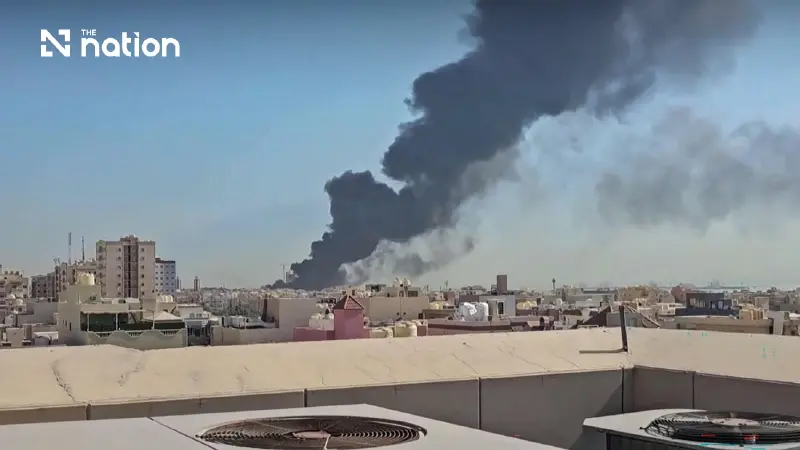


Washington completed an eighth night of strikes as Iran attacked US military targets and Gulf states, deepening fears of renewed full-scale conflict.
- The United States has conducted eight consecutive nights of military operations against Iran, striking coastal and air-defense installations.
- Iran has retaliated with drone and missile attacks on US military assets and allied targets in Kuwait, Bahrain, and Jordan.
- The recent escalation was fueled by an Iranian attack in Jordan that killed two American service members, bringing the total US military deaths in the conflict to 17.
- The conflict has expanded to maritime confrontation in the Strait of Hormuz, with the US imposing a naval blockade and Iran targeting commercial vessels.
Fresh Iranian attacks were reported in Kuwait, Bahrain and Jordan on Sunday as the United States concluded an eighth consecutive night of military operations against Iran.
The latest escalation came as an interim ceasefire signed a month earlier continued to unravel.
Growing confrontation over control of the Strait of Hormuz, which carries about one-fifth of global oil trade, has heightened the danger of full-scale hostilities resuming.
The renewed US action followed an Iranian attack in Jordan on Friday that killed two American service personnel and left another missing.
US Central Command later reported that “unidentified remains” had been recovered from the attack site and that “an examination process to verify the remains is ongoing”.
Another US service member died on Saturday in northern Iraq, where the United States maintains military bases.
The death occurred during the controlled detonation of unexploded ordnance on a downed Iranian attack drone.
The latest announcements raised the number of US military personnel killed since the war began to 17, with more than 420 wounded. US defence secretary Pete Hegseth responded on social media: “Their sacrifice only stiffens our resolve.”

CENTCOM reported that Saturday’s operation began at 6pm EDT, or 2200 GMT, and struck Iranian military coastal-surveillance and air-defence installations.
It said the operation was intended to weaken Iran’s ability to threaten commercial shipping in the Strait of Hormuz and punish Islamic Revolutionary Guard Corps forces over the attack in Jordan.
Washington had begun sending additional assets, including fighter aircraft, to the Middle East even before Iran’s attacks on Saturday, according to a US official.
Israeli officials also reported preparations to receive more US refuelling aircraft amid the possibility of a wider American operation against Iran.
Inside Iran, attacks were reported near Sirik in the south and Shadegan, close to the Iraqi border, while an explosion was later reported in the south-western city of Abadan.
The Atomic Energy Organisation of Iran also condemned an alleged US strike on a nuclear power plant being built at Darkhovin, Mehr News Agency reported.
The International Atomic Energy Agency said it was examining reports of the overnight attack, noting that construction of the plant remained at a very early stage.

Iranian state television reported that Tehran retaliated with a drone attack on US military assets and equipment at Al-Adiri Camp and Ali Al Salem Air Base in Kuwait.
Both bases had already been targeted during Iranian attacks on American facilities and US allies in the Gulf over the previous week.
Kuwait’s government reported that a desalination plant was struck for a second consecutive day, causing a fire.
It described the incident as a direct attack on vital civilian infrastructure.
The country’s armed forces also reported that they had again intercepted Iranian missiles following a sustained assault on Saturday.
Bahrain’s air defences intercepted another Iranian attack on Sunday, according to state television.
Sirens were also activated in Jordan, where the military reported shooting down three Iranian missiles.
Israel’s military said missiles had been launched from Iran towards Aqaba, the Jordanian city on Israel’s border.
Jordan subsequently summoned Iran’s chargé d’affaires to protest against the recent attacks.
The confrontation has also extended to commercial shipping.
The United States says it is imposing a naval blockade on Iranian ports, while Iran says it targets vessels that disregard its navigation rules in the Strait of Hormuz.
The Islamic Revolutionary Guard Corps reported that four vessels, backed by the United States, had ignored its warnings and attempted to use what it called an “unsafe route” through the strait.
Two vessels abandoned the attempt, while the remaining two were involved in an “accident”, it said without giving further details.
The war began on February 28 when the United States and Israel attacked Iran, seeking to disable its nuclear and missile programmes and weaken its regional proxies.
Thousands of people, most of them in Iran and Lebanon, have since been killed, while energy supplies have been severely disrupted and concerns about global inflation have increased.
Iran’s Health Ministry reported on Saturday that US strikes over the preceding three weeks had killed 50 people and wounded more than 500.
In Lebanon, fighting between Israel and the Iran-aligned militant group Hezbollah has also resumed.
Meanwhile, US Secretary of State Marco Rubio met Lebanese President Joseph Aoun on Sunday to discuss a US-backed framework agreement signed in June.
Aoun is due to meet US President Donald Trump on Tuesday and present a plan to disarm Hezbollah and secure Israel’s withdrawal from southern Lebanon.
Source: Reuters
