
Maris holds meeting to prepare plan for assisting Thai nationals in Cambodia


The Ministry of Transport coordinates with seven Thai airlines to accommodate Thai nationals returning home amid the ongoing situation in Cambodia.
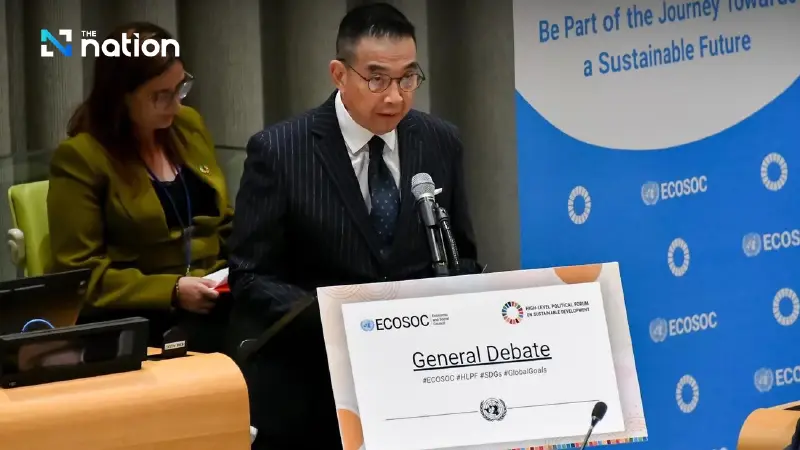
Maris Sangiampongsa, Thailand's Foreign Minister, currently in the United States for the 2025 High-Level Political Forum on Sustainable Development (HLPF2025) at the United Nations Headquarters in New York, held a video call with the Ministry of Foreign Affairs’ meeting room.
He chaired a meeting on the urgent plan to assist Thai citizens in Cambodia, confirming that he has been closely monitoring the situation between Thailand and Cambodia and giving continuous directives despite being abroad.
During his participation in the forum, Maris had the opportunity to meet high-level foreign representatives, including the UN Secretary-General, the Deputy Prime Minister and Minister of Foreign Affairs of Pakistan, who is the current President of the UN Security Council for July, and the Minister of Social Development and Human Security of Panama, who will be the UNSC President in August.

Both Pakistan and Panama expressed their support for Thailand’s approach to resolving the issue through bilateral mechanisms, and if violations of the Ottawa Convention occur, they should be addressed. Maris also met Japan's Deputy Foreign Minister, as Japan will chair the Ottawa Convention State Parties meeting in December 2025.
The Ottawa Convention, formally known as the Convention on the Prohibition of the Use, Stockpiling, Production and Transfer of Anti-Personnel Mines and on Their Destruction, is an international treaty that aims to eliminate anti-personnel landmines. The treaty was adopted in 1997 and entered into force in 1999.
Maris reiterated to the international community Thailand's position on Cambodia’s insincere actions. He stressed Thailand's commitment to peacefully resolving the issue within a bilateral framework, respecting sovereignty, and adhering to international law.
He also emphasized that Thailand has consistently kept the door open for sincere dialogue, in contrast to Cambodia’s provocative stance and interference in Thailand's internal affairs. Cambodia’s military actions, particularly the ongoing attacks in Thai territory on July 24, targeting civilian areas such as hospitals, have resulted in injuries and fatalities.

The Thai government is prepared to consider escalating protective measures if Cambodia continues its unlawful military aggression, violating Thailand’s sovereignty and international law.
Maris also instructed the Ministry of Foreign Affairs to prepare an evacuation plan for Thai citizens in Cambodia. Following a meeting with the Ministry of Transport, relevant agencies, and commercial airlines, it was decided to increase flight capacity between Phnom Penh and Bangkok to accommodate Thais wishing to return home.
He expressed his concern for Thai nationals in Cambodia and urged them to stay informed through the following contact points:
- The Royal Thai Embassy in Phnom Penh (Emergency Hotline: (+855) 77 888 114)
- The Thai Consulate General in Siem Reap (Phone: (+855) 86 608 999)
- The Consular Affairs Call Centre (Phone: (+66) 2 572 8442, available 24/7)
Maris also thanked the Ministry of Transport, airline representatives, and all involved agencies for their cooperation in this matter.
Meanwhile, Deputy Prime Minister and Minister of Transport, Suriya Jungrungreangkit, has assigned Kritchanon Aiyapanya, the Ministerial Assistant and Spokesperson for the Ministry of Transport, along with Air Chief Marshal Manat Chavanaprayoon, Director of the Civil Aviation Authority of Thailand (CAAT), to meet with the Ministry of Foreign Affairs.
They discussed plans to accommodate Thai nationals in Cambodia wishing to return to Thailand due to the ongoing instability along the Thai-Cambodian border.
All seven Thai airlines are fully prepared to cooperate, with four airlines already operating flights between Bangkok and Cambodia.
These include Thai Airways, which offers 16 flights per week with 180 seats per flight; Thai AirAsia, operating 28 flights per week with 180 seats per flight; Bangkok Airways, providing 40 flights per week with 180 or 70 seats per flight; and Thai VietJet, with 16 flights per week offering 180 seats per flight.
Additionally, three more airlines—Thai Lion Air, Thai AirAsia X, and Nok Air—are ready to support and ensure the smooth transportation of Thai citizens back to Thailand.
