
Thailand confirms Cambodian use of PMN-2 landmines, cites serious Ottawa Convention violation


Thailand confirms Cambodian troops’ use of BMN-2 landmines, calls it a serious violation of the Ottawa Convention and the ceasefire agreement. Evidence to be submitted to the Ottawa Convention Committee on Friday and reaffirms “Ban Nong Chan” as 100% Thai territory, accuses Cambodia of using “human shield” to escalate border tensions.
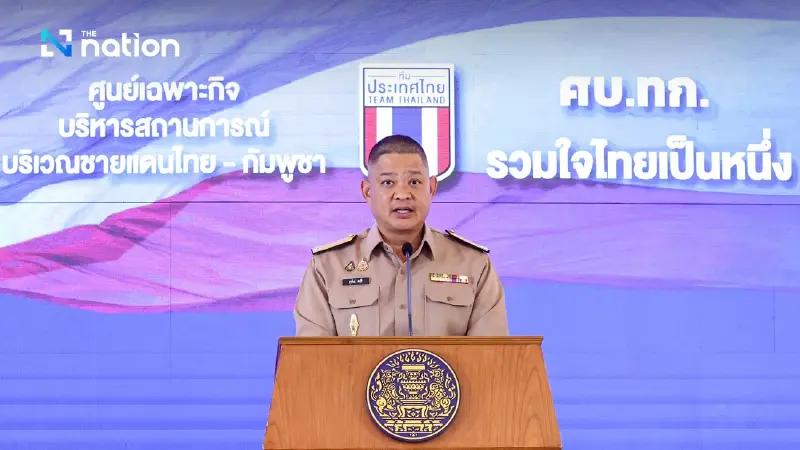
Rear Admiral Surasan Kongsiri, Deputy Spokesperson for the Royal Thai Armed Forces, reported on the outcomes of the Ad Hoc Centre for the Thailand-Cambodia Border Situation meeting on Wednesday (August 20), addressing four key security issues.
Border Situation: No significant incidents have been reported along the general border. The overall situation remains normal and stable.
Discovery of Cambodian Phone: The Thai Navy’s bomb disposal unit discovered crucial evidence, confirming the illegal use of PMN-2 landmines by Cambodian troops near Phu Makua.
On August 19, 2025, the Humanitarian Mine Action Unit of the Royal Thai Navy uncovered a Cambodian soldier’s mobile phone left behind in the area.
Upon inspection, the phone contained video clips and photographs clearly showing Cambodian soldiers holding PMN-2 anti-personnel mines. The phone also recorded audio in Khmer, believed to be a demonstration of how to use the landmines before illegally planting them along the Thai border.

The evidence, including precise timestamps and clear location data embedded in the phone’s photos and videos, serves as a critical piece of proof, confirming the violation of international agreements and the illegal use of landmines.
The Thai Armed Forces have forwarded this evidence to the Ministry of Foreign Affairs to support the claim of Cambodia’s breach of agreements. This evidence will be presented at the upcoming Ottawa Convention Committee Meeting on August 22.

The third issue discussed was the Interim Observer Team (IOT)’s operations in the region from August 18-20, 2025, in line with the General Border Committee (GBC) Agreement signed by Thailand and Cambodia on August 7, 2025, in Malaysia.
On August 18, the IOT visited the 22nd Military District Command in Ubon Ratchathani Province to receive a briefing on the situation. The team also met with high-ranking officials from the 12th Military District and the 2nd Army Area, where the Deputy Commander of the 2nd Army Area provided clarification on the ongoing issues.
On August 19, the IOT visited Chong AN Ma in Ubon Ratchathani, where Cambodian forces had cut through Thailand’s barbed wire, which was placed to prevent encroachment on Thai territory. The team then observed the Phu Makua area, where they were briefed on Cambodian rocket fire from BM-21 launchers into Thai territory, resulting in casualties and damage to civilian property.
The team also visited the Phu Ma Keua area at Krisana Base, where Thai soldiers had previously stepped on landmines, and additional unexploded ordnance was discovered during their inspection.
On the final day, August 20, the IOT visited the location where 18 Cambodian prisoners of war were being held, by the Geneva Conventions, as well as Phanom Dong Rak Hospital, which had been affected by BM-21 rocket attacks.
They also visited Chong Jup Tamok, where a Thai patrol unit from Company 2610 had stepped on landmines.
After completing their inspections, the Thai military will hold a debriefing session on August 21, and a liaison office will be set up at the Royal Thai Armed Forces Command to coordinate with the IOT Team.
The IOT will take the information gathered back to their respective military branches. The IOT will use the office of the Malaysian Defence Attaché in Thailand for coordination purposes.
Final Issue: the Disputed Area of Ban Nong Chan, Sa Kaeo Province. Surasan Kongsiri said about the sensitive issue regarding Ban Nong Chan in Sa Kaeo Province, which has long been a point of contention in Thai-Cambodian relations.
This area was once a temporary refugee camp for Cambodians fleeing the Khmer Rouge genocide in 1975, following a request by UNHCR and based on humanitarian principles. Thailand allowed hundreds of thousands of refugees to seek shelter within its borders.
However, after the war ended, most refugees returned to Cambodia, but some chose to remain, establishing settlements that encroached on Thai territory, clearly violating the 2000 Memorandum of Understanding (MOU) between the two countries.
The Ad Hoc Centre for the Thailand-Cambodia Border Situation reaffirmed that Ban Nong Chan is 100% Thai territory. It believes Cambodia is using its population as a "human barrier" to provoke and create tensions along the border.
Thailand has tried to resolve this issue through bilateral mechanisms, such as the Joint Boundary Commission (JBC), for over 10 years. However, Cambodia has shown no genuine intent to address the issue.
This encroachment not only violates Thailand’s sovereignty but also negatively impacts Thai citizens who once lived and worked in the area, forcing them to evacuate.
Surasan emphasised that Thailand's installation of barbed wire along the border, such as at Chong AN Ma and Ban Nong Chan, is a measure to protect the sovereignty and security of Thai citizens, as well as to prevent the illegal placement of landmines from Cambodia.
This action is in line with the GBC Agreement, which prohibits the construction of military infrastructure beyond each side’s territory. He reaffirmed that the area is fully Thai, and the installation of barbed wire does not violate any agreements.
