
Thailand’s Department of Foreign Trade to meet Myanmar’s Ambassador over tightening border measures
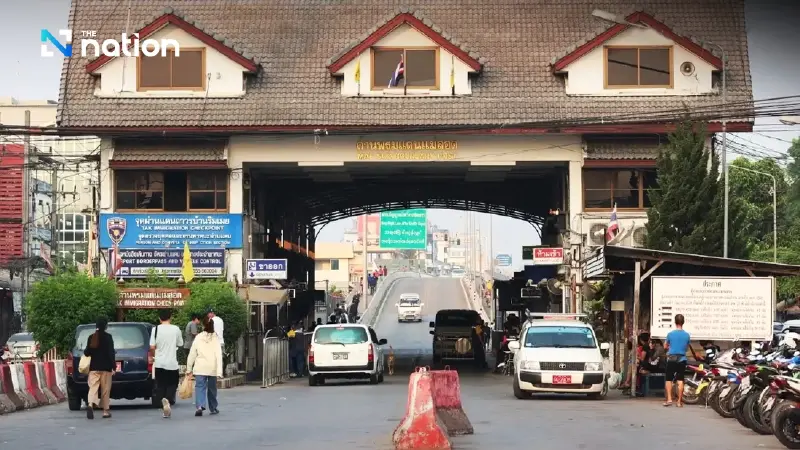


Thailand’s Department of Foreign Trade plans talks with Myanmar’s Ambassador to ease the closure of the Mae Sot-Myawaddy border, which has caused 400 trucks to back up.
Thailand’s Department of Foreign Trade (DFT) is preparing to invite Myanmar’s Ambassador to Thailand for talks to ease the closure of the Mae Sot-Myawaddy border, which has caused a backlog of more than 400 trucks.

Arada Fuangtong, Director-General of the Department of Foreign Trade, revealed that Myanmar had closed the Mae Sot-Myawaddy border at the Thai-Myanmar Friendship Bridge 2 from August 18, 2025, in an effort to curb the illegal import of goods and goods entering without an import licence. Following this, the DFT and the Department of International Trade Promotion invited Myanmar’s Trade Attaché to Thailand to discuss the situation on August 19, 2025, as per the instructions of Commerce Minister Jatuporn Buruspat.
Myanmar explained that since early August, it had tightened its inspection of illegal imports and goods entering without licences. This was due to the loss of revenue and increasing trade deficits, prompting the authorities to enforce stricter measures. As a result, a large number of trucks, mostly carrying goods from other countries, have been waiting at the border to enter Myanmar.
“We have received reports from the Office of the International Trade Promotion in Yangon, Myanmar, that around 400 trucks are stuck at the border. Most of these trucks are carrying goods from other countries, as well as goods from Thailand. Myanmar has suggested redirecting shipments via Ranong Port to reach the island of Koh Song instead,” said Arada.

She added that the department would present the findings from the discussions with Myanmar’s Trade Attaché to the Minister of Commerce, who will then invite Myanmar’s Ambassador to Thailand for further talks to negotiate a relaxation of the measures.
According to the Office of International Trade Promotion in Yangon, the Thai-Myanmar border trade has been under pressure from Myanmar’s increasingly strict import licence checks. These measures were escalated in mid-2025, heavily impacting the Mae Sot Customs House, which accounts for nearly 40% of Thai-Myanmar border trade, and the Ranong Customs House, which represents nearly 20%. Other customs offices have not been as heavily affected.
If the situation continues, it could lead to a shift in transport routes, directly affecting export businesses. Goods such as fuel, beverages, and consumer products could be affected if they are unable to be exported without the necessary import licences. Additionally, local businesses and the border market in Mae Sot and surrounding areas could suffer due to public concerns about uncertainty and the avoidance of cross-border travel for shopping. Logistics operators will also be impacted by the shift to sea routes.
For the first half of this year (January to June), the value of Thai-Myanmar border trade was 105.149 billion baht, down 24.91% from the same period in 2024. Thai exports amounted to 63.572 billion baht, a decrease of 16.36%, while imports were valued at 41.578 billion baht, a 35.07% decline. Thailand recorded a trade surplus of 21.994 billion baht.
At the individual customs offices, Mae Sot Customs in Tak Province saw the highest trade value at 45.378 billion baht, down 9.71%, followed by Sangkhla Buri Customs in Kanchanaburi at 32.406 billion baht, a 33.27% decrease, Ranong Customs at 18.199 billion baht, down 12.23%, Mae Sai Customs in Chiang Rai at 8.066 billion baht, a 47.13% drop, and Prachuap Khiri Khan Customs at 300 million baht, down 93.94%. However, Mae Hong Son Customs saw a 266.35% increase, with a trade value of 698 million baht, while Mae Sariang Customs in Chiang Mai rose by 35%, reaching 104 million baht.
