
Kajiki downgraded to tropical depression as rains drench Vietnam
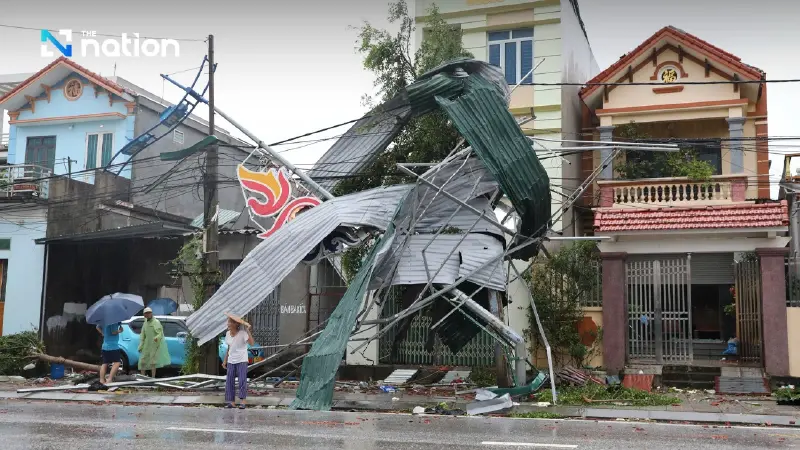


Tropical storm Kajiki, known in Vietnam as Storm No. 5, lost strength on Tuesday after crossing into central Laos, but the system continues to dump torrential rain across parts of Vietnam and neighbouring countries.
The National Centre for Hydro-Meteorological Forecasting said the storm entered Laos early Tuesday morning, carrying sustained winds of 50–61 km/h and gusts up to 88 km/h. Although downgraded to a tropical depression, it left behind widespread damage after battering northern and north-central Vietnam on Monday.
Strong winds and surging seas
Coastal monitoring stations recorded destructive conditions before Kajiki weakened. Winds at Bach Long Vi in Hai Phong and Co To in Quang Ninh reached force 9–10 on the Beaufort scale, while Hon Ngu Island in Nghe An reported force 8 with gusts up to 11. Along the shoreline from Quang Ninh to Thanh Hoa, winds averaged force 6–8, and in Nghe An and Ha Tinh, gusts rose as high as force 15.
Storm surges topped 1.6 metres at Hon Ngu, more than a metre at Sam Son in Thanh Hoa, and half a metre at Vung Ang in Ha Tinh.

Torrential rainfall and forecast risks
Heavy downpours drenched large swathes of Vietnam, with some parts of Thanh Hoa, Quang Tri and the Red River Delta recording more than 600mm. Meteorologists expect continued rainfall of 50–100mm across most areas on Tuesday, with localised totals above 200mm.
Laos is forecast to receive between 100–250mm of rain through Wednesday, with some locations potentially exceeding 500mm. Officials have warned of serious risks of landslides, flash floods and sudden inundations in both mountainous and low-lying areas.
Tornado strikes Ninh Binh
One of the storm’s most dramatic impacts came on Monday evening when a sudden tornado tore through Ninh Binh province. The whirlwind ripped across a two-kilometre stretch of National Highway 21, toppling houses and infrastructure.
Authorities said more than 200 homes were damaged in Ly Thuong Kiet Ward alone, while 25 households in Kim Bang Ward lost roofs and fences. An 88-year-old woman was killed when her house collapsed.


Large-scale mobilisation
Vietnam’s Ministry of National Defence deployed a massive relief effort, mobilising over 346,000 personnel and 8,200 vehicles, including five aircraft. Nearly 44,000 people were evacuated from five provinces, while more than 23,000 fishing vessels carrying some 77,000 crew members sought safe harbour. Only 32 boats with 225 workers remained at sea, but authorities confirmed they were operating in safe zones.
The General Staff of the People’s Army ordered all local commands to stay on high alert and prepare rapid responses for floods and landslides. Air Force units were tasked with keeping aircraft ready for search-and-rescue missions, while Viettel, the military telecom provider, was directed to maintain communications in disaster-hit regions.
Despite its downgrade, Kajiki continues to pose serious flood and landslide threats as its remnants move further inland.
Viet Nam News
Asia News Network
