
Deputy AG set to review new case on Hun Sen accused of ordering Thai killings
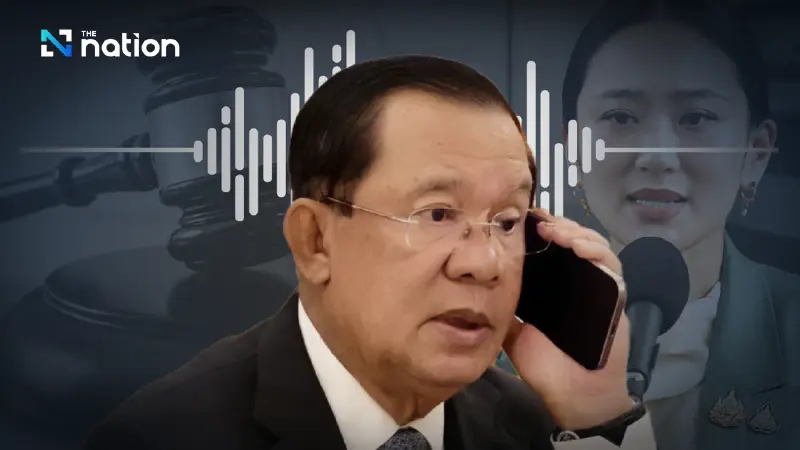


Deputy attorney-general Watcharin Panurat to finalise probe into Hun Sen audio clip, seen as security threat, and submit case file to attorney-general for prosecution order.
Watcharin Panurat, deputy attorney-general at the Office of Investigation, said on Tuesday (September 30) that progress had been made in the case concerning the leaked audio clip of a conversation between former Cambodian prime minister Hun Sen and former Thai prime minister Paetongtarn Shinawatra.
He explained that the attorney-general had assigned the commander of the Cyber Crime Investigation Bureau 1 to serve as lead investigator, with prosecutors from the Office of Investigation joining the inquiry. Watcharin himself has been appointed head of the prosecutorial team overseeing the case.
Investigators have already questioned several witnesses, including the complainant, Paetongtarn, and others who confirmed that Hun Sen had used his Facebook account.
On the question of whether the conversation actually took place, he said the matter was already settled: both the testimony of the former Thai prime minister and a Constitutional Court ruling in her ethics case confirmed that the conversation matched the audio clip in circulation. That ruling ultimately led to her removal from office for ethical violations under constitutional law.
However, he clarified that the current case is distinct from the Constitutional Court’s ruling. This investigation concerns whether Hun Sen’s release of the audio clip caused public disorder or unrest within Thailand to a degree that might constitute sedition under Section 116 of the Penal Code, or offences under the Computer Crime Act.
As the alleged offences occurred outside the kingdom, Watcharin said the case would be treated as an extraterritorial offence. The investigation is expected to conclude within two weeks, after which the findings will be submitted to the attorney-general, who alone has the authority to decide whether to prosecute.
Asked about past incidents in which Cambodian forces fired artillery into Thailand, resulting in civilian deaths, injuries, and property damage, the Deputy Attorney-General said state security officials and legal authorities had already met to discuss the matter. Several agencies shared the view that charges could be brought against Cambodian leaders, including Hun Sen, for offences such as murder, terrorism, causing harm to civilians, and destruction of property.
He noted that both private citizens and state agencies had suffered losses, and formal complaints had been filed with police investigators in several affected provinces. Discussions had already been held with the commander of Provincial Police Region 3, who has jurisdiction over Surin, Si Sa Ket, Ubon Ratchathani, and Buri Ram, to coordinate the collection of case files for submission to the attorney-general.
Watcharin explained that once police investigators complete their witness interviews and forward the case files to the Office of Investigation, prosecutors will compile their legal opinions and submit them to the Attorney-General for consideration as an extraterritorial offence. If the attorney-general determines that the case meets the criteria, it will proceed under the provisions of Thai law on offences committed outside the kingdom.
“In a case of this seriousness, police investigators will be the lead authority, but prosecutors from the Office of Investigation will join the inquiry. A joint working group will be established, and once the investigation is complete, the matter will be forwarded to the attorney-general, who alone has the authority to order prosecution,” Watcharin said.
Responding to questions on how suspects could be brought to trial if prosecution is ordered, Watcharin acknowledged that some individuals might currently enjoy certain privileges or immunities. However, he stressed that the immediate priority is gathering evidence.
“The question of apprehending the accused depends on the situation at the time a prosecution order is issued. By then, they may no longer have immunity, or action could be pursued through international criminal cooperation mechanisms. That remains a matter for the future,” he said.
He added that since both state agencies and members of the public had suffered loss of life, injury, and property damage, an investigation must proceed to ensure justice for the victims. “So far, no formal action has been taken, which is why collecting evidence through joint police and prosecutorial efforts is crucial. Only then can the case move forward,” he noted.
