
Thai Army explains stance as Cambodia refuses border evacuation plan
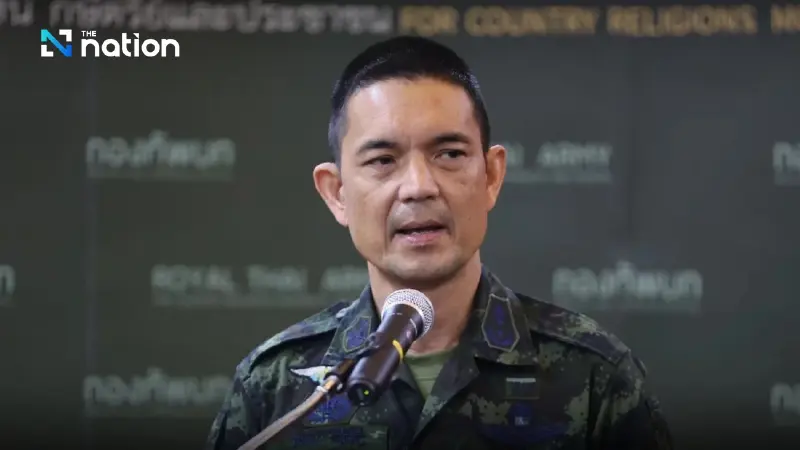


Thai Army details six-point response after Cambodia ignores border evacuation plan, reaffirming peaceful and bilateral resolution efforts.
The Royal Thai Army says its decision to delay the regional border committee meeting with Cambodia aims to ensure tangible progress, not to ignore prior agreements.
The First Army Area has sent a letter to its Cambodian counterpart to confirm its readiness to attend the Regional Border Committee (RBC) meeting with Cambodia’s 5th Military Region, scheduled for October 10–12 in Poipet, Banteay Meanchey province.
The letter, however, made clear that Thailand’s participation would proceed only if Cambodia prepared and submitted a plan to evacuate Cambodian civilians living in three disputed border areas, Ban Nong Chan, Ban Nong Ya Kaeo in Khok Sung district, and Ban Ta Phraya in Ta Phraya district of Sa Kaeo province. Cambodia was asked to submit the evacuation plan to the First Army Area by October 7, before Thailand would confirm attendance at the meeting.
Cambodia has since declined to draw up the evacuation plan, prompting a public statement from Lt Gen Maly Socheata, spokeswoman for the Cambodian Ministry of National Defence, addressing several related issues.
In response, Royal Thai Army spokesman Maj Gen Winthai Suvaree issued a clarification:
1. Cambodia’s remark that the RBC meeting between Cambodia’s 5th Military Region and Thailand’s First Army Area was in line with the resolution of the General Border Committee (GBC) adopted at the first special meeting on August 22, 2025.
The Royal Thai Army spokesman said the First Army Area had no intention of refusing to hold the meeting or disregarding the GBC’s resolution. The Thai side only wanted each meeting to produce effective and tangible results that would lead to concrete solutions, not mere verbal commitments that serve only to delay progress without any practical implementation, as has often happened in the past.
2. Cambodia’s statement regarding the Chok Chey and Prey Chan areas, reaffirming that it would proceed in accordance with the agreement reached at the GBC meeting on September 10, 2025, which assigned the Joint Boundary Commission (JBC) as the main mechanism for discussions and finding solutions on the matter.
The Royal Thai Army spokesman explained that in the case of Ban Nong Chan and Ban Nong Ya Kaeo, there are two forms of encroachment.
The first involves areas claimed by both sides, which, under bilateral agreements, fall within the jurisdiction of the JBC.
However, the second type involves clear encroachment into Thailand’s recognised sovereign territory, an urgent matter that the Thai side must address immediately.
3. Cambodia’s statement that the RBC serves only as a coordinating body to ease tensions and resolve local issues peacefully, without any authority to make decisions on boundary demarcation.
The spokesman said that Thailand’s RBC continues to serve as a coordination mechanism.
However, in cases of the second type of encroachment, those extending into Thai territory outside disputed zones, responsibility lies primarily with local administrative authorities and the police, who will take action under Thailand’s normal legal framework.
4. Cambodia’s report that surveys found some areas where Thai citizens had utilised land under Cambodian sovereignty, reflecting the complexity of the issue and the need to adhere to the principles previously agreed upon by both countries.
Winthai said Cambodia could also address this issue through the existing local coordination mechanisms between the two sides. According to available information, the land use in question appears to involve small-scale agricultural activities, which should be relatively easy to resolve, unlike cases of border encroachment involving permanent buildings or structures.
5. Cambodia’s statement that it would wait for the JBC to review the cases of Chok Chey and Prey Chan, as well as other areas where Thai citizens have built structures or engaged in activities crossing parts of the border, while urging that the JBC meeting be convened as soon as possible to find a joint solution.
The Royal Thai Army spokesman said the JBC plays a vital role in determining boundary lines in geographically complex areas, particularly mountainous or forested terrain, where modern technology can be used to verify watershed divides.
However, in the case of Ban Nong Chan and Ban Nong Ya Kaeo, the terrain is flat, allowing a straight line to be drawn between the boundary markers that both sides have already surveyed and confirmed. This provides a practical working reference for field operations while awaiting formal demarcation.
6. Cambodia’s call for both sides to strictly comply with the agreements made during previous GBC meetings.
Winthai reaffirmed that Thailand has always remained committed to adhering to all agreements and resolutions adopted at international and bilateral meetings. He said Thailand continues to make every effort to ensure these mechanisms lead to truly effective and lasting solutions.
The Royal Thai Army reiterated its firm commitment to resolving all border issues peacefully through existing bilateral mechanisms, promoting constructive dialogue and cooperation.
“If the Cambodian side recognises the facts as clarified, it will see that Thailand’s proposed approach is appropriate, consistent with international principles, and in line with the bilateral frameworks both countries have long respected,” the spokesman said.
He added that this approach would not only strengthen stability along the Thai–Cambodian border but also improve the livelihoods of people on both sides in the long term.
“If both nations can reach a mutual agreement on this issue, it is believed that other outstanding border matters can also be resolved peacefully in the future,” he concluded.
