
Military reuses ‘soft-hand strategy’ from student protests at Nong Chan
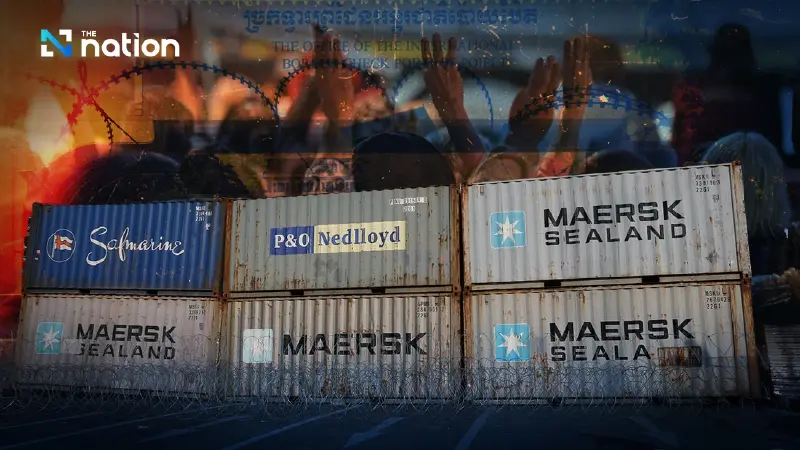


The military has drawn lessons from the 2020–2021 student protests against Gen Prayut Chan-o-cha, applying similar crowd-control tactics at Ban Nong Chan, where 60 shipping containers have been lined up to form a 360-metre barrier along the border.
One key reason the armed forces’ top commanders opted to impose martial law in response to Cambodian incursions into three areas of Sa Kaeo province, Ban Nong Chan, Ban Nong Ya Kaeo in Khok Sung district, and Ta Phraya district, covering over 200 Cambodian households, was to ensure full legal protection for officers during operations.
The measure is intended to prevent potential lawsuits for damages or criminal liability, streamline legal procedures during arrests and deportations, and allow swift removal of trespassers. In contrast, enforcement under the Forest Act and Immigration Act exposes officers to possible prosecution and compensation claims.
The military leaders have drawn lessons from past political crackdowns by both the armed forces and the Royal Thai Police, many of which led to years of litigation. Some cases have been dismissed, while others remain unresolved after prolonged court proceedings.
However, the commanders are well aware that martial law is an extreme measure, and that Cambodia might exploit tensions along the Sa Kaeo border to provoke violence and then use any resulting civilian casualties to portray Thailand negatively on the international stage.
To prevent such outcomes, the Army Operations Centre has been tasked with developing operational plans, standard procedures, and rules of engagement that comply with international human rights law and Thai law, emphasising that all actions must be carried out with restraint and proportionality.
The operation represents a joint effort involving the Burapha Task Force, the First Army Area, police units, the Sa Kaeo governor, and other local agencies, integrating both military and civilian forces in coordinated enforcement actions.
The plan also draws on lessons learned from the 2020–2021 school student-led protests — known as the “three-finger movement”,which called for the resignation of then-Prime Minister Prayut Chan-o-cha, dissolution of Parliament, an end to harassment of activists, and constitutional reform, extending to sensitive calls for monarchy reform.
Although the government at that time invoked the Emergency Decree, enforcement proved difficult since most demonstrators were students and young people, necessitating a soft-hand approach.
Protesters often used symbolic acts and marched to sensitive royal premises, including the Temple of the Emerald Buddha, Sanam Luang, and the Privy Purse Bureau.
Despite police attempts to block their advance with buses, barriers, and metal fences, demonstrators set them on fire, forcing authorities to respond with water cannons and tear gas.
In the aftermath, the police joined hands with the 1st Infantry Division, King’s Guard, then under the command of Lt Gen Worayos Lueangsuwan, now the First Army Area Commander, to reinforce royal premises.
They adopted new defensive measures, sealing key routes with shipping containers and concertina wire, which proved more effective than earlier barriers in preventing clashes or property damage.
These measures also minimised direct confrontations between officers, protesters, and royalist counter-groups, preventing the situation from escalating into violence, ultimately leading to the peaceful dispersal of demonstrations.
At present, 60 shipping containers, each measuring six metres in length, have been positioned at Ban Nong Chan, forming a 360-metre-long defensive line. The containers are expected to serve as barriers during the removal of Cambodian settlers, preventing them from re-entering or reclaiming the area. Unlike barbed wire fences, the containers are difficult to destroy and will be used in conjunction with ten Geno water cannon trucks.
Each Geno vehicle can hold 12,000 litres of water and is equipped with a roof-mounted nozzle capable of spraying up to 65 metres in any direction. The water stream can also be mixed with coloured dye, allowing authorities to easily identify individuals who are sprayed during crowd-control operations.
The Geno model deployed at the border is also fitted with a Long Range Acoustic Device (LRAD), a high-frequency sound system used to disperse crowds or issue warnings to trespassers attempting to enter restricted zones. In addition, the vehicles are equipped with tear gas, fire-suppressing foam, and armoured, bullet-resistant tyres.
Protective metal grilles cover all windows, while a front-mounted steel barrier allows the vehicle to clear obstacles during operations. CCTV cameras have been installed around each vehicle to record incidents from all angles, ensuring video evidence is available should any confrontation occur.
Since assuming his post as First Army Area Commander, Lt Gen Worayos has made several inspection visits to Ban Nong Chan and Ban Nong Ya Kaeo, overseeing joint military, police, and administrative drills to strengthen coordination in protecting Thailand’s sovereignty along the Sa Kaeo border.
On October 10, 2025, Thai authorities are scheduled to begin mine-clearing operations in Ban Nong Chan and Ban Nong Ya Kaeo in accordance with the Thai-Cambodian General Border Committee (GBC) agreement. Cambodia, meanwhile, plans to send a delegation of observers under the IOT mechanism, accompanied by civilians, including women, children, and the elderly — to the same areas.
Analysts believe the Thai side is waiting for a tactical advantage before initiating a full reclaiming operation, while Cambodia appears poised to exploit the situation to gain diplomatic leverage on the international stage. The coming days, therefore, will be crucial in determining which side blinks first.
