
Wan Noor asks IPU chief to back Thailand’s anti-scammer motion
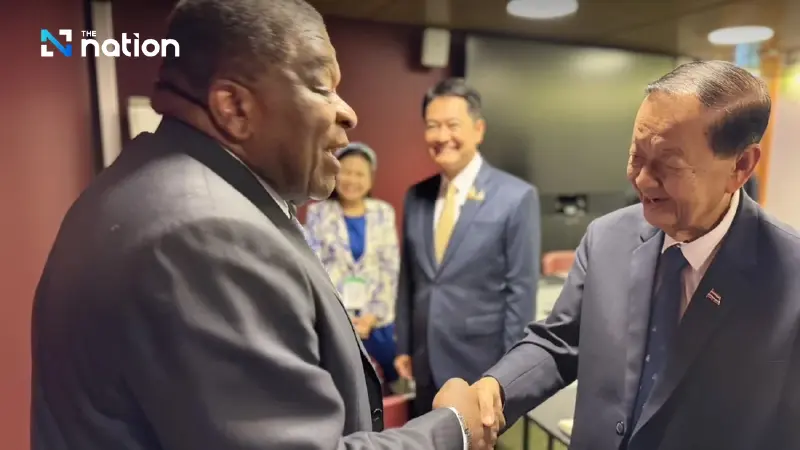


House Speaker Wan Muhamad Noor Matha asked the IPU chief to support Thailand’s anti-scammer motion as Cambodia complained of negative Thai media coverage and sought talks.
House Speaker Wan Muhamad Noor Matha, in his capacity as head of the Thai parliamentary delegation, held an informal meeting with Martin Chungong, Secretary-General of the Inter-Parliamentary Union (IPU), on Monday evening (20 October)at Room S11 of the Centre International de Conférences Genève (CICG) Geneva, Switzerland, during the 151st IPU Assembly.
The discussion, conducted in a friendly and cordial atmosphere, reflected the long-standing working relationship between Wan Muhamad Noor and Chungong.
During the meeting, Chungong informed Wan Muhamad Noor that he had been approached by the Cambodian parliamentary delegation on 19 October. The Cambodian representatives had expressed concern over what they viewed as negative reporting in the Thai media towards Cambodia, despite Phnom Penh having made no public criticism of the Thai government.

According to Chungong, the Cambodian side felt that Thai media coverage had created a hostile public perception and wished to know how both countries could address the issue. They also stressed that media language and communication could serve as a bridge for peace and mutual understanding, rather than fuelling tensions.
He went on to suggest that Thailand and Cambodia should meet for a dialogue to rebuild trust and find constructive solutions. He proposed using Room S11, the very room where the meeting took place, as the venue for such talks, noting that it had previously hosted sensitive international discussions, including those between North and South Korea, and between Armenia and Azerbaijan over territorial disputes.
“I hope both delegations can meet before the conclusion of this IPU Assembly,” Chungong said, pledging to facilitate and coordinate the dialogue personally.
Thailand reaffirms support for peaceful dialogue
In response, Wan Muhamad Noor reiterated the stance he had expressed earlier during his address to the General Debate, that Thailand supports dialogue and peaceful engagement to foster lasting peace.

On Cambodia’s concern about the Thai media, he explained that Thailand upholds media freedom and does not control the press. “Our responsibility is to tell the truth,” he said. “The media then reports according to the facts. Cambodia may have a different system that allows for greater control of media narratives.”
The Thai Speaker also noted that both countries already have bilateral mechanisms for addressing disputes, including meetings under the General Border Committee (GBC) framework, which have produced preliminary understandings. More recently, the foreign ministers of Thailand and Cambodia met in Malaysia, with observers from China and the United States, where both sides agreed to implement the 28 July ceasefire in a concrete and verifiable manner.
Parliamentary-only framework
Wan Muhamad Noor welcomed the IPU’s initiative for a parliamentary dialogue but stressed that such discussions must remain within the scope of parliamentary cooperation and must not interfere with the executive functions of either government, particularly ongoing ceasefire arrangements or other official negotiations.
Chungong agreed, assuring that any meeting between Thai and Cambodian parliamentarians under the IPU would not affect governmental processes. “The goal,” he said, “is simply to encourage conversation between legislators, not to create a parallel diplomatic channel.”
He added that he would send formal invitations to both delegations, expressing confidence that representatives from Thailand and Cambodia could meet before the close of the 151st IPU Assembly.
Thailand seeks IPU backing for cybercrime motion
Before concluding, Wan Muhamad Noor also requested Chungong’s support for Thailand’s draft resolution on combating cross-border cybercrime and scam networks, which the Thai delegation has submitted as an emergency item for inclusion in the Assembly’s agenda on October 21.
