
Thai Military Dismisses Cambodian Claims as Fabricated, Confirms AI-Generated Images Among Fake News


Armed forces denounce hospital bombing allegations whilst 165 Cambodian casualties reported; Thai citizens remain stranded in Poipet
- Thailand's military has rejected Cambodian allegations of strikes on civilian targets, such as a hospital and a school, calling the claims fabricated.
- Thai officials presented evidence that photos were staged, citing an image of an unexploded artillery shell that lacked the expected impact damage and a bomb crater that was too small for the alleged weapon.
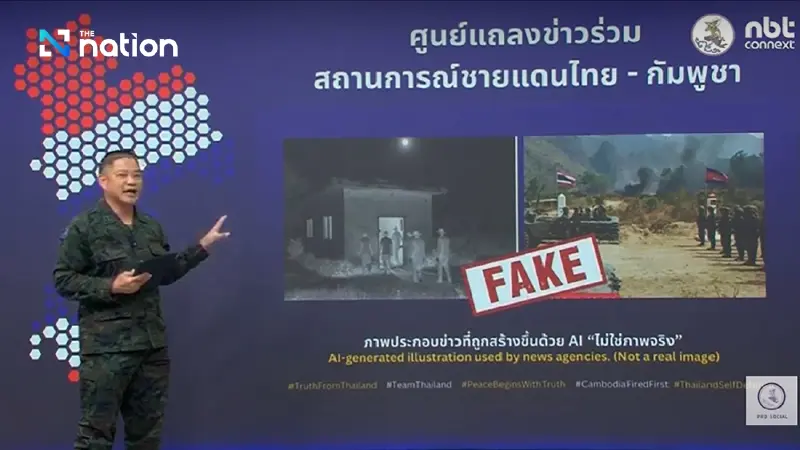
- The military has explicitly confirmed that AI-generated images are being circulated as part of the fake news, appealing to the public to be critical of social media content.
- Examples of identified AI-generated fakes include an implausible image of operatives in cowboy hats and a staged-looking confrontation between soldiers.
Armed forces denounce hospital bombing allegations whilst 165 Cambodian casualties reported; Thai citizens remain stranded in Poipet.
Thailand's military has categorically rejected Cambodian allegations of artillery strikes on civilian targets, presenting evidence that photographs circulating on social media have been fabricated and, in some instances, generated using artificial intelligence.
During a press briefing at the Joint Press Centre on Friday morning, Rear Admiral Surasant Kongsiri displayed several images purportedly showing unexploded Thai artillery shells near a Cambodian hospital.
The spokesman pointed out critical inconsistencies that exposed the photographs as staged.
"If this were genuinely an artillery shell that had been fired, the condition of the projectile would show distortion and deformation," Rear Admiral Surasant explained. "Artillery shells fired at high velocity would be damaged upon impact with hard surfaces if they failed to detonate. However, this shell appears completely intact, with no corresponding damage to the surrounding ground."

Air Force Refutes Bombing Allegations
Air Marshal Jackkrit Thammavichai addressed media questions about Cambodian reports claiming F-16 strikes had caused extensive damage near a school in the Preah Vihear area.
Recent footage broadcast by Cambodian state media showed what appeared to be a large crater, which Phnom Penh attributed to Thai air strikes.
"I want to emphasise that the destructive power of a 500-pound bomb would be far greater than the hole they've excavated," Air Marshal Jackkrit stated. "If a 500-pound bomb had struck that location, this entire briefing room would have melted. A 2,000-pound bomb would create a crater the size of a football pitch. The claim that this small hole represents a 500-pound bomb impact site is an attempt that appears rather transparent but ultimately unconvincing."
The air force representative stressed that all military targets are selected to minimise civilian casualties.
"Every target we select aims to degrade Cambodian military capabilities whilst avoiding civilian impact entirely or keeping it to an absolute minimum," he said. "Targets near communities are engaged using precision-guided munitions to ensure minimum collateral damage."
He categorically denied that Thai forces had struck civilian infrastructure, including schools and residential areas, asserting that such targets are systematically avoided in mission planning.

AI-Generated Images Circulating
The military also identified several AI-generated images circulating on social media platforms.
One purported to show Black Hawk Quartet (BHQ) operatives infiltrating Thai territory, whilst another depicted Thai and Cambodian soldiers in a face-to-face confrontation.
"Citizens can easily identify these as fabricated," Rear Admiral Surasant noted. "The individuals in the infiltration image are wearing Western-style cowboy hats—highly unlikely for operatives in Southeast Asia. The image of soldiers confronting each other face-to-face is equally implausible given current operational conditions."
The spokesman appealed to the public to exercise critical judgement when consuming news and social media content during the crisis.
"Fake news is proliferating extensively during this period. We must be extremely careful in verifying information before sharing it."

Border Situation Update
Thai forces have made progress in securing strategic positions along the frontier.
According to deputy spokesperson of the Royal Thai Army Colonel Richa Suksuwan, green markers on operational maps indicate areas under full Thai control, including a Cambodian military base near Samraite and the Chong Chom, Chong Ploe, and Chong Rayee passes, though heavy Cambodian resistance continues in these locations.
Orange markers denote partially controlled areas, including Chong An Ma and Chong Khana, where Prasat Khana temple is located. Thai forces are working to consolidate control in these zones.
Red markers show ongoing fierce fighting, notably at Prasat Ta Kwai temple, where difficult terrain has prevented Thai infantry from securing the position despite destroying numerous surrounding Cambodian military installations.
At Ban Khlong Phaeng Saeng in Ta Phraya district, Thai forces briefly raised the national flag on 9th December but were forced to withdraw after intense Cambodian counter-attacks using BM-21 multiple rocket launchers.

Meanwhile, deputy spokesperson of the Royal Thai Navy Captain Nara Khunthothom explained that the Royal Thai Navy requested air support from F-16 fighters to strike the "Three Houses" target in Chanthaburi province, described as containing trenches, military positions, and underground concrete bunkers that posed threats to Thai forces.
Intelligence reports indicate Cambodia has reinforced positions at Chong Dan and Ban Phak in Chanthaburi province and at Ban Nong Reeb in Trat province.

Casualty Figures
Thai military casualties remain at nine killed in action, with approximately 190 wounded.
The military estimates Cambodian losses at a minimum of 165 personnel killed, along with nine armoured vehicles and tanks destroyed, 68 drones downed, one anti-drone system eliminated, three communications towers destroyed, and multiple BM-21 rocket systems neutralised.

Humanitarian Concerns
Thai citizens remain stranded in Poipet, unable to return home despite coordination efforts between Thai and Cambodian authorities.
The Ministry of Foreign Affairs has been negotiating with Phnom Penh to open crossing points, but bureaucratic delays have prevented repatriation.
Deputy Ministry spokesperson Maratee Andamo addressed the issue during the briefing: "We acknowledge that the current tense situation has affected coordination to some extent, but this is not an insurmountable obstacle. We are requesting full cooperation from Cambodia to allow Thai citizens to return home."
She assured concerned relatives that documentation issues would not prevent returns.
"The Ministry of Foreign Affairs, our embassy, and consulates can issue emergency travel documents immediately. This is not a barrier whatsoever," Maratee stated.
The ministry has been coordinating at all levels, including provincial governors and Cambodian counterparts, and is exploring alternative routes for citizens to return, including by air or overland through third countries.

Support Operations Continue
Despite political upheaval in Bangkok following Prime Minister Anutin Charnvirakul's dissolution of parliament on Wednesday, military operations continue unaffected.
"Regardless of the parliamentary dissolution, military operations are unaffected," Air Marshal Jackkrit said. "The Armed Forces Organisation Act of 2008 provides clear operating procedures independent of political developments. The Supreme Commander retains full authority to control and command military operations."
Government agencies continue supporting border operations. The Provincial Electricity Authority has been restoring power infrastructure in combat zones, while "Sky Doctor" medical evacuation units operated by Phramongkutklao Hospital are airlifting casualties using Royal Thai Army aircraft.
Private sector foundations are also assisting with casualty evacuation to rear medical facilities.
The military has appealed for blood donations through the Thai Red Cross and local hospitals, noting that whilst current supplies remain adequate, maintaining reserves is essential given ongoing combat operations.

Previously, the Joint Press Centre Director Air Chief Marshal Prapas Sornchaidee announced that Thai forces remain committed to seven core operational principles regardless of domestic political circumstances, emphasising that protecting national sovereignty remains the paramount mission.
The centre will provide its next situation update at 16:00 local time on Thursday.
