
Second Army finds Cambodian kamikaze drones mirror Ukraine war models
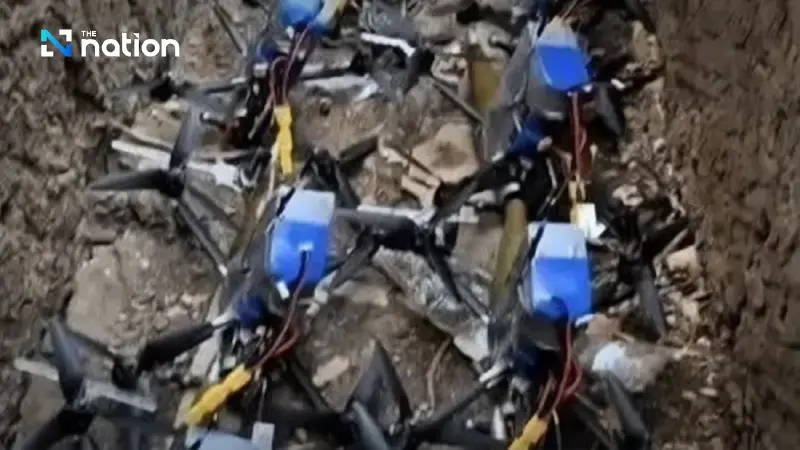


Second Army Area says Cambodian kamikaze FPV drones resemble models used in the Russia-Ukraine war, with fibre-optic controls that evade jamming and signs of possible foreign operators.
- The Thai Second Army reported that kamikaze drones used by Cambodian forces in border clashes are structurally and tactically similar to FPV strike drones from the Russia-Ukraine war.
- Evidence suggests experienced foreign operators were involved, citing advanced flight tactics, the use of jam-proof fibre-optic controls, and English voice commands common among pilots in the Ukraine conflict.
A report from the Second Army Area said on Friday, December 12 that during five days of fighting along the Thai-Cambodian border, Cambodian forces repeatedly used drones to attack Thai positions.
Investigators later detected that the drone operators were not Cambodian, prompting the army to compile and analyse the available information, concluding that the drones Cambodia deployed against Thailand resemble those used in the Russia-Ukraine war.
Advances in modern warfare have turned drones into weapons that can fundamentally reshape combat, particularly first-person view (FPV) strike drones — often described as kamikaze drones — that have been widely used in the Russia-Ukraine conflict.
These systems have become a key model that many countries have adapted, including Cambodia in recent border clashes with Thailand.

An analysis of the drones’ structure, equipment and the operational terrain — based on wreckage seized inside Thai territory — was cited as showing links in tactical concepts, and offering an explanation for how Cambodia has been able to employ such drones despite no clear history of prior training.
In the Russia-Ukraine war, FPV drones are often seen as low-cost weapons capable of causing significant damage. Their basic structure typically includes a carbon-fibre frame, four motors and an FPV camera linked to real-time control goggles, allowing an operator to guide the drone into a target with high precision.
They can also carry small warheads or improvised munitions adapted from artillery rounds, machine-gun ammunition or rocket-propelled grenade (RPG) warheads, at relatively low cost but with high tactical impact.
Mass production in field-style workshop settings has enabled both Ukrainian and Russian forces to deploy drones in swarms against frontline positions, an approach that has been studied and copied worldwide.
The Second Army Area report said that when the Thai military compared the wreckage recovered in the Chong Bok and Chong An Ma areas with FPV drones used in the Russia-Ukraine war, it found clear similarities.
These included a five-inch frame, LiPo batteries with XT60 connectors, carbon-fibre construction, and warhead mounting using straps and cable ties. Internal components also suggested a strike drone designed to crash into its target, rather than a reconnaissance platform.
Signal detection, the report added, also indicated drone activity coming from the Cambodian side during the same time window as the clashes, which it said confirmed the attacks were systematic and controlled by operators with genuine FPV expertise.
The report went on to say it was unlikely that complete drone systems had been moved from the Eastern European battlefield to Southeast Asia, given transport constraints and international controls on military equipment.
It argued it was more plausible that knowledge, techniques, personnel and assembly templates were transferred to Cambodia — a pattern it said is common in 21st-century proxy warfare.
FPV drone assembly know-how and pilot training can be passed on quickly, it added, and specialists could enter a country under civilian cover, such as drone athletes, technicians or private consultants, bringing portable control equipment without attracting attention.
One piece of evidence cited in support of this hypothesis was the discovery of English voice commands, including the word “finished” — which it said is not normally used by Cambodian troops but is a phrase commonly heard in FPV pilot communications in the Russia-Ukraine war.

The report said the accuracy of the strikes, target selection and flight behaviour all indicated the operator had prior experience and was unlikely to be a Cambodian soldier using drones for the first time. It said such capability requires advanced training and may reflect support from individuals outside Cambodia or those with real battlefield exposure.
Another key feature highlighted was the use of fibre-optic control links, which the report said cannot be disrupted by Thai jamming systems.
Fibre-optic controls can provide highly stable command in mountainous terrain, but require significant skill to operate, it added — suggesting systematic preparation and training rather than the basic-level capabilities associated with Cambodian forces in the past.
It also argued that the choice of attack areas, including Chong Bok and Chong An Ma, reflected a clear assessment of terrain. Elevated Cambodian positions, such as Hill 745 and Hill 677, were described as providing wide visibility over Thai areas, enabling safer drone launches and giving a tactical advantage.
Drones flying from higher to lower ground are easier to control, the report said, while valleys, waterways and dense forest could help conceal fibre-optic lines, making detection more difficult. This, it said, pointed to a deep understanding of terrain and modern drone warfare tactics.
The operational impact on Thai forces, the report added, includes terrain-related disadvantages, jamming systems that are ineffective against fibre-optic drones, and psychological pressure created by attacks where the point of origin is hard to identify.
It said this has forced adjustments in defensive tactics, including improved detection, interception and force deployment in contested areas.
The assessment concluded that Cambodia does not have an overarching technological advantage over Thailand in military terms, but has benefited from a combination of terrain selection and the application — and likely transfer — of techniques and personnel linked to the Russia-Ukraine war.
It said this should serve as a lesson for Thailand as it develops capabilities for a new dimension of drone warfare.
