
Hun Sen must allow Thais to return home or face abduction charges, ex-military legal chief warns
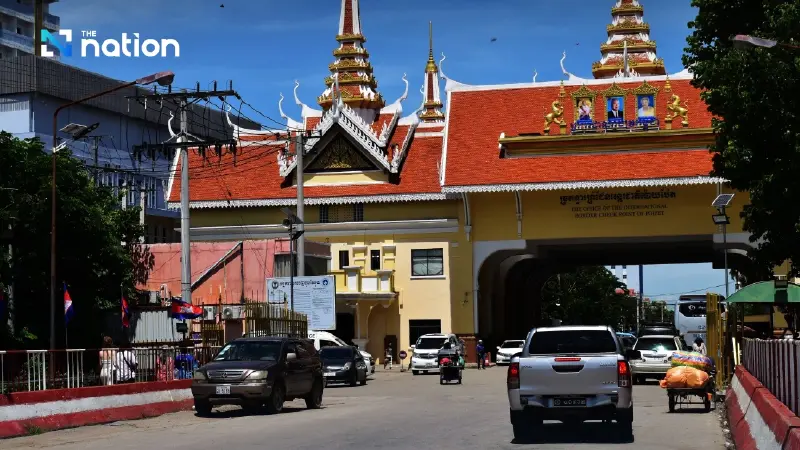


A former Defence Ministry legal chief warns Hun Sen to let stranded Thais cross at Poipet, or risk claims Cambodia is holding civilians hostage.
A former legal chief at the Defence Ministry on Sunday warned Cambodian Senate President Hun Sen to allow stranded Thai nationals to return home, or risk accusations of breaching the Geneva Conventions by holding civilians hostage.
Gen Krissana Bowornratanarak, a former adviser to the Defence Secretariat and former chief of the Judge Advocate General’s Department, said Hun Sen—whom he described as Cambodia’s supreme leader—could face such accusations because Cambodia is a party to the relevant conventions.
In his article, Krissana referred to reports that Hun Sen had ordered officials to prevent Thai nationals from crossing at the Poipet border checkpoint into Thailand, leaving many stranded in Cambodia.

Krissana said preventing Thai nationals from returning home without proper legal grounds could be construed as taking civilians hostage.
“Besides violating human rights—specifically the freedom to travel back to one’s own country—this also appears to violate international humanitarian law (the Geneva Convention relative to the Protection of Civilian Persons in Time of War of August 12, 1949, and the Additional Protocols to the Geneva Conventions of August 12, 1949, relating to the protection of victims of international armed conflicts, 1977 (Protocol I) of June 8, 1977),” Krissana wrote.

“It may be deemed the detention of Thai nationals, who are civilians, as hostages, or unlawful detention. In summary:
“During an armed conflict (hostilities) between Thailand and Cambodia, these Thai nationals must not be restricted from travelling back to Thailand. They are entitled to protection and must be allowed to leave Cambodia, unless there is clear evidence that they are suspects who have committed, or were involved in, acts hostile to Cambodia’s security. In other words, these Thai nationals are civilians, not combatants or members of the armed forces, and have no involvement in the fighting.”
Those involved in taking civilians hostage or unlawfully detaining them could be regarded as war criminals, Krissana wrote, adding that Cambodia is a party to the Geneva Conventions and Additional Protocol I.

“As for Additional Protocol I, Cambodia acceded on January 14, 1998, and it entered into force for Cambodia on July 14, 1998,” he said.
“In conclusion, the Geneva Conventions and the Additional Protocols are binding international law that Cambodia must comply with. Cambodia must therefore allow the thousands of Thai nationals at the Poipet checkpoint to return to Thailand without delay, so as not to violate international law and human rights,” the former judge advocate general concluded.
