
Thai historian urges govt to reject ICJ ruling, retake Preah Vihear
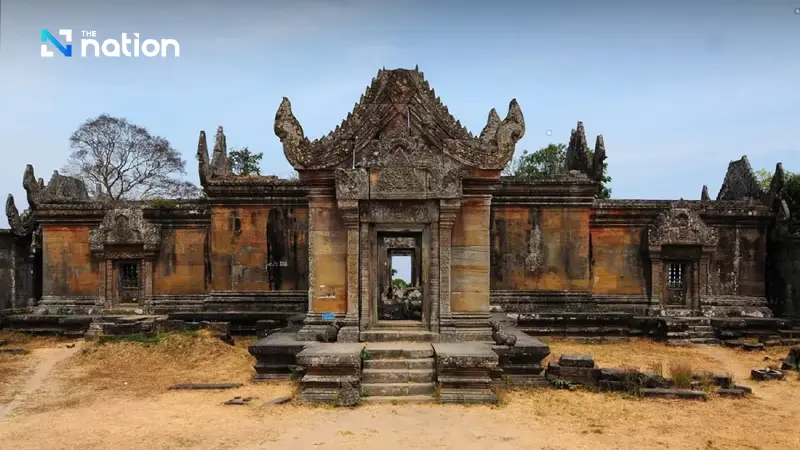


Historian Thepmontree Limpayom urges the government to cite “new evidence” to reject the ICJ ruling and reclaim Preah Vihear from Cambodia.
A freelance academic and historian on Monday called on the government to cite “new evidence” to reject the International Court of Justice’s (ICJ) ruling on Preah Vihear and reclaim the historic site from Cambodia.
The controversial proposal was posted by Thepmontree Limpayom on his Facebook page.
He said the “new evidence” lay in the 1904 Franco–Siamese Treaty, which stated that the border would follow the watershed line of the mountain range. He also claimed that Cambodia had conceded that the watershed line on the Preah Vihear mountaintop lies at the cliff edge, meaning the site is on the Thai side, not Cambodia’s.
Thepmontree said Thailand could also rely on the formal diplomatic reservation it submitted to the UN Secretary-General on July 6, 1962, following the ICJ’s 1962 ruling.
After losing the case, Thailand complied with the court’s order to withdraw from the area, but did so while lodging a reservation with the UN Secretary-General.
“Rights to recover”
Thailand stated that it “desires to make an express reservation regarding whatever rights Thailand has, or may have in the future, to recover the Temple … by having recourse to any existing or subsequently applicable legal process.”
Objection to the map used by the court
Thailand also maintained that the “Annex I Map” cited by the ICJ was technically flawed because it did not follow the natural watershed line agreed in the 1904 treaty.

With this reservation, Thepmontree argued, Thailand should take the following steps to retake Preah Vihear:
- Use military force to retake Preah Vihear and all surrounding areas, in line with the 1904 Siam–France Convention.
- Pass a Cabinet resolution instructing the Ministry of Foreign Affairs to write to the UN Secretary-General, stating that Thailand, as a UN member state, is invoking the reservation of rights it previously lodged and does not accept the ICJ’s ruling in the Preah Vihear case, arguing that the judgment was unfair and conflicted with treaty provisions and geographical realities.
- Establish a negotiation team to invoke Thailand’s reservation of rights and notify the UN Secretary-General, citing historical evidence and current evidence from the Cambodian side acknowledging that the watershed line in the Preah Vihear area lies along the cliff edge, as reflected in the management plan submitted to the World Heritage Committee and in topographic surveys using LiDAR technology.
- Argue that the ICJ judgments in 1962 and 2003 focused on sovereignty and Thailand’s withdrawal of police and military personnel from the area around the site. He said that if Thailand has new evidence and maintains that the boundary under the 1904 treaty follows the watershed—and that the boundary demarcation commission placed it at the cliff edge, the highest point more than 600 metres above sea level—then Preah Vihear belongs to Thailand. He claimed Thailand therefore has the right to restore its exercise of sovereignty and station police and military personnel to protect its territory, while arguing the ICJ did not rule on the boundary line or the border itself.
- Claim Cambodia exploited misunderstandings of the judgment by issuing a royal decree on the Preah Vihear area in 2007, which Thailand protested twice, and by referring to Thailand’s notification to the UN Secretary-General in MOFA letter 0803/453, dated June 20, 2008. He said Thailand therefore has sovereignty over Preah Vihear and all territory on the Phanom Dong Rak mountain range.
- Instruct the Second Army Area to establish a base at Preah Vihear and notify the World Heritage Committee and the World Heritage Centre in Paris that Cambodia had used the site to stockpile weapons and troops and had encroached on Thai territory, urging the committee to remove Preah Vihear from the World Heritage List, potentially by first placing it on the List of World Heritage in Danger.
- Inform Cambodia, through the Ministry of Foreign Affairs, that Thailand does not want Cambodia to exercise sovereignty over Preah Vihear any longer—now or in the future.
