
ASEAN Breaks the Ice with Myanmar, But Scepticism Runs Deep
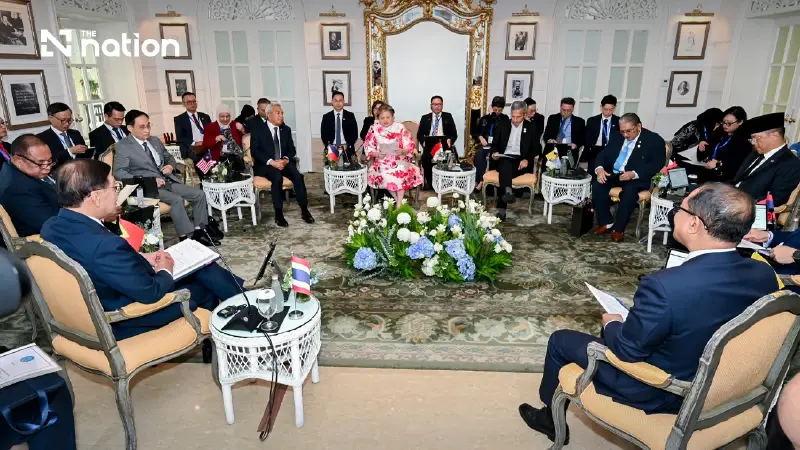


Bangkok talks mark ASEAN's first ministerial meeting with Myanmar since 2021, but critics question whether goodwill can survive without deadlines or enforcement
- ASEAN held its first face-to-face ministerial meeting with Myanmar's junta-appointed foreign minister since the 2021 coup, marking a renewal of direct engagement.
- Despite the meeting, deep skepticism persists as ASEAN officials could not provide firm answers on timelines, enforcement mechanisms, or accountability for achieving progress.
- Critics question the strategy of re-engaging without preconditions and adhering to a five-point peace plan that Myanmar's own parliamentarians have dismissed as irrelevant.
- The main tangible outcome was an agreement for an ASEAN-led humanitarian mission, but broader goals like political dialogue and reducing violence remain benchmarks without deadlines.
Bangkok talks mark ASEAN's first ministerial meeting with Myanmar since 2021, but critics question whether goodwill can survive without deadlines or enforcement.
For the first time since the 2021 coup upended Myanmar's place in the region, ASEAN's foreign ministers sat down face to face with their Myanmar counterpart on Sunday. The meeting, hosted by Thailand in Bangkok, was billed by its architects as a modest but meaningful step forward. Journalists in the room were far less convinced.

Within minutes of the two chief negotiators taking their seats – Maria Theresa Parreño Lazaro, the Philippines' special envoy of the ASEAN Chair on Myanmar, and Sihasak Phuangketkeow, Thailand's deputy prime minister and foreign minister – the press conference turned pointed.
Reporters pressed the pair on whether ASEAN was clinging to a five-point peace plan that Myanmar's own parliamentarians have publicly dismissed as irrelevant, whether inviting Myanmar's junta-appointed foreign minister back to the table set a dangerous precedent, and whether any of the "concrete and demonstrable progress" ASEAN says it wants will ever be measured against an actual timeline.
None of those questions received a firm answer. That gap — between ASEAN's language of cautious optimism and its inability to say when, or how, progress will be judged — is likely to define how this latest overture to Myanmar is read across the region.

A first meeting, five years in the making
Sunday's engagement was, in diplomatic terms, unusually layered. It comprised two distinct sessions: an informal meeting of ASEAN foreign ministers with Myanmar's foreign minister, U Tin Maung Swe, and a separate "Extended Informal Consultation on Myanmar" involving ASEAN members only.
Nine of the bloc's ten members attended in Bangkok, all at the foreign minister level, barring Malaysia, which sent its secretary-general for senior officials. Cambodia was the sole no-show, declining to send any representative.
Lazaro, who has held the special envoy brief since the Philippines took over as ASEAN chair, called the session historic in scale, if not in substance.

"This is the first time that we have met in person with the Foreign Minister of Myanmar since the events in 2021," she told reporters, describing a "comprehensive briefing" from Myanmar's side covering the peace process, the transfer of Aung San Suu Kyi to designated residence, and cooperation against cross-border scam operations, trafficking and drug trafficking.

Sihasak, whose government brokered the encounter, was careful to frame it as an evolution in tactics rather than a change in position.
"Thailand supports the approach of calibrated engagement," he said. "All of us reaffirm our commitment to the Five-Point Consensus (5PC), but the key issue here is what is the strategy to implement it."
He added a pointed caveat aimed at Naypyidaw as much as at ASEAN's own capitals: "This calibrated engagement is a two-way street... the Myanmar side has to reach out as well to address the concerns of ASEAN and the concerns of the international community."

The concrete deliverable: a humanitarian mission
If the meeting produced one tangible outcome, it was Lazaro's announcement that she intends to travel to Myanmar on a humanitarian mission in the second half of this year, working alongside the AHA Centre, humanitarian actors and ASEAN development partners to expand access to affected communities.
Both she and Sihasak presented this as evidence that engagement, however slow, is yielding movement.

"This is already a movement," Lazaro said of Myanmar's apparent openness to granting permits for humanitarian access to previously restricted areas. "It can't be done in one stroke."
Beyond the humanitarian mission, ASEAN's asks remained the same four benchmarks reiterated throughout the press conference: expanded humanitarian access, a further reduction in violence against civilians, inclusive political dialogue involving all stakeholders, and a more conducive political environment, including further release of political prisoners.
Sihasak said Thailand was also working to facilitate dialogue between Naypyidaw and ethnic armed groups along the Thai border, though he offered no further detail beyond confirming talks were "in the works".

Old doubts persist beneath the diplomacy
The scepticism voiced by journalists tracked three separate fault lines, and neither official fully dispelled them.
The first concerned the five-point consensus itself. Asked how ASEAN could keep citing a framework that Myanmar's own parliament has rejected as "no longer relevant", Lazaro did not dispute the rejection but held the line regardless: "Whether they reject it or not, I stand [firm], and I think ASEAN stands behind the five-point consensus."
Sihasak's answer leaned instead on strategy over principle, arguing Thailand was less interested in "just repeating" the consensus than in working out how to implement it.
The second concerned precedent — whether allowing Myanmar's foreign minister back into the room, after Naypyidaw had rebuffed ASEAN's request to allow the special envoy to meet Aung San Suu Kyi directly, rewarded non-compliance.
Lazaro rejected the framing outright, calling the meeting itself the sign of movement, not a concession: "This is the first time we're meeting... since 2021 when this started in Brunei."
The third, and perhaps sharpest, concerned accountability: with no dates attached to any of the benchmarks ASEAN has set, how will anyone know whether Myanmar has actually delivered? Here both officials essentially conceded the point.
"It's evolving. We cannot set dates," Lazaro admitted, adding that "sometimes the process is more important than... the conclusion."
Sihasak pointed to this year's ASEAN Summit as the de facto checkpoint: "We will review and look at whether there's been substantial progress," he said, but stopped short of describing any formal mechanism for that review.
Aung San Suu Kyi and the legitimacy question
Questions about Aung San Suu Kyi's welfare and the legitimacy of Myanmar's recent election drew some of the meeting's more delicate exchanges.
Lazaro relayed Myanmar's assurance that the Nobel laureate remains "in good health" and is being cared for by relatives but acknowledged ASEAN had pressed, without success so far, for the special envoy to be allowed to verify this in person.
On the election that installed Myanmar's current government, Lazaro was candid about a split within the bloc.
"There are certain countries who have already expressed a possible recalibration of their relations with Myanmar as a result of the recent elections," she said, while noting that "some ASEAN member states" still consider the vote's legitimacy unresolved, tying the disagreement back once more to unmet five-point consensus benchmarks.

What comes next
For all the caveats, both officials sought to end the session on a note of open-endedness rather than failure.
"We are ready to help," Sihasak said. "We are ready to assist in order that we would like Myanmar not to be [absent] from the ASEAN family."
Lazaro echoed the sentiment, calling the day's talks "an impetus for further engagement" toward a solution she stressed must ultimately be "Myanmar-owned and Myanmar-led".
Whether Sunday's meeting marks the start of a genuine thaw or simply resets the clock on a five-year stalemate is likely to be tested well before the year is out.
Myanmar's foreign minister is expected to feature in discussions at the upcoming ASEAN Foreign Ministers' Meeting and Post-Ministerial Conferences, due within days, and ASEAN leaders have effectively pencilled in this year's summit as the moment to judge whether Naypyidaw has moved beyond gestures and into the "concrete and demonstrable progress" that both Lazaro and Sihasak say they are still waiting to see.
