
Thailand Directs Pressure on Myanmar Junta, Demanding Direct Envoy Access to Detained Aung San Suu Kyi
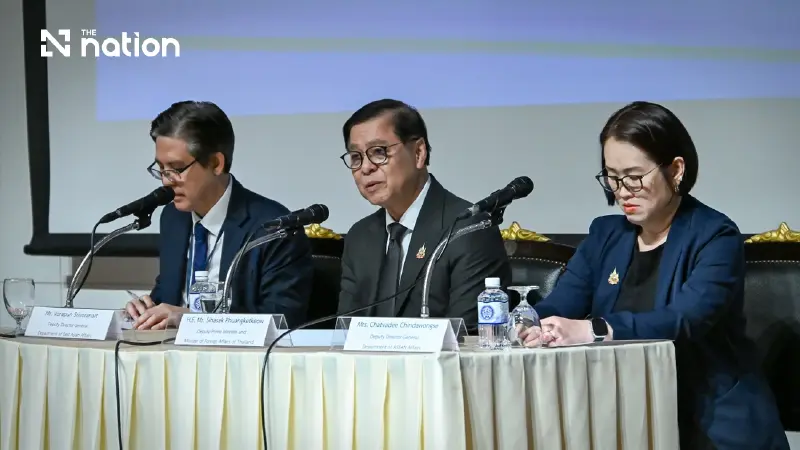


Foreign Minister Sihasak Phuangketkeow tells foreign ambassadors that assurances over Aung San Suu Kyi’s welfare must be backed by a face-to-face envoy visit
- Thailand is formally demanding that Myanmar's military junta grant the ASEAN Special Envoy a direct, face-to-face meeting with detained leader Aung San Suu Kyi.
- The Thai Foreign Minister has dismissed the junta's verbal assurances about Suu Kyi's welfare, stating that physical verification by an envoy is required by the international community.
- This demand is being used as a critical benchmark for the junta's cooperation and is part of a new ASEAN framework of "Four Indicators of Progress" to hold the regime accountable.
- Access to Suu Kyi is explicitly listed as a measure of progress towards a "conducive political environment," alongside the release of other political prisoners.
Foreign Minister Sihasak Phuangketkeow tells foreign ambassadors that assurances over Aung San Suu Kyi’s welfare must be backed by a face-to-face envoy visit.
Thailand is spearheading a diplomatic push within Southeast Asia by demanding that the military regime in Myanmar grant the ASEAN Special Envoy direct, face-to-face access to the detained pro-democracy leader, Daw Aung San Suu Kyi.
Briefing the international diplomatic corps in Bangkok on Wednesday, Foreign Minister Sihasak Phuangketkeow explicitly challenged the junta's basic welfare assurances.
He informed foreign ambassadors that while the military regime had provided verbal guarantees that the 81-year-old Nobel laureate was being well cared for within a designated residence and retained access to medical facilities, the international community required physical verification.

Sihasak confirmed he has formally requested that the ASEAN Special Envoy—the Philippines' Foreign Secretary, Maria Theresa Lazaro—be permitted to meet face-to-face with Suu Kyi.
The meeting is being sought during a planned humanitarian visit ahead of the high-stakes ASEAN Summit in November, framing independent access as a critical benchmark for the junta's cooperation.

Measuring Progress: The Four Yardsticks
The ambassadorial briefing followed a series of pivotal, high-level diplomatic meetings hosted by Thailand, including the first face-to-face talks between ASEAN foreign ministers and the junta-appointed minister, U Tin Maung Swe, since the 2021 coup.
Sihasak outlined the bloc's newly established "Four Indicators of Progress", a conditional checklist designed to hold Naypyidaw accountable under Thailand's policy of "calibrated reengagement".
The four metrics presented to the ambassadors comprise:
Humanitarian Space: A verifiable expansion of aid corridors, channelled directly through the ASEAN Coordinating Centre for Humanitarian Assistance on disaster management (AHA Centre).
Reduction of Violence: A demonstrable drop in hostilities, specifically targeting the cessation of military strikes impacting civilian populations.
Inclusive Dialogue: The maintenance of a credible, multi-stakeholder peace process that includes opposition groups.
Conducive Political Environment: Concrete steps towards national reconciliation, explicitly measured by the release of political prisoners and positive developments regarding Suu Kyi.

The Pattaya Corridor: "Talks for Talks"
The diplomatic corps was also briefed on a delicate parallel track running in the coastal city of Pattaya. Thai officials recently hosted distinct, back-to-back meetings with the junta’s National Solidarity and Peacemaking Negotiation Committee (NSPNC) and six key Ethnic Armed Organisations (EAOs).
Sihasak clarified that Thailand is positioning itself strictly as a "facilitator" rather than a mediator, leveraging its geography to provide a neutral ground. While the warring factions did not sit face-to-face during this round, Thai diplomats acted as a physical go-between.
The current phase is being handled as "talks for talks"—a process focused on establishing the logistics, protocols, and locations for future substantive peace negotiations.

The Dual-Track Strategy
The foreign minister concluded by detailing Thailand’s "Dual-Track Approach", explaining how the kingdom balances regional obligations with immediate domestic security.
The strategy separates the ASEAN Track, which strictly adheres to the regional Five-Point Consensus to address Myanmar’s internal political crisis, from a vital Bilateral Track.
The latter allows Bangkok to protect its own borders by directly addressing cross-border crime networks—specifically targeting illegal narcotics trafficking, transboundary haze pollution, and the lucrative network of online scam centres operating along the frontier.
While conceding that structural change in Myanmar will not happen overnight, Sihasak stressed that these developments represent the most significant diplomatic movement in five years.
The final determination regarding Myanmar’s political status and its potential re-entry into high-level ASEAN forums will be debated by regional leaders at the November summit.
