
Thailand to Lodge Formal Protest over UN Rapporteur’s Cambodia Report
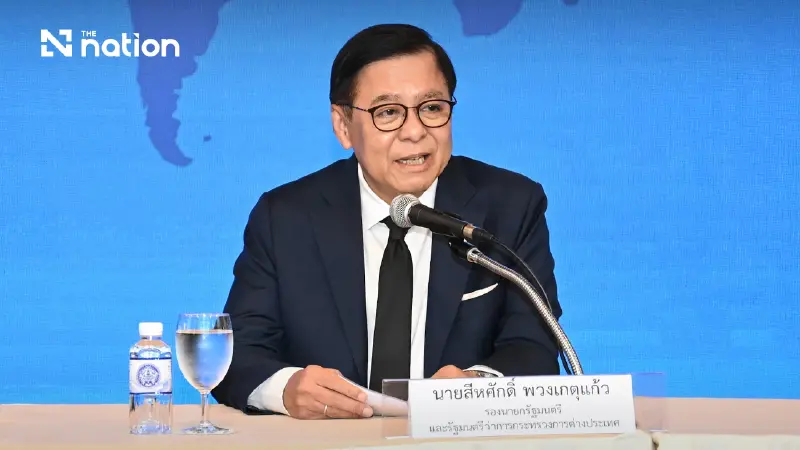


Foreign Minister Sihasak Phuangketkeow confirms formal letters will be dispatched to UN Human Rights Council over "unverified" border report
- Thailand is lodging a formal protest with the UN Human Rights Council (UNHRC) and the Office of the High Commissioner for Human Rights (OHCHR) over a UN rapporteur's report concerning Cambodia.
- The Thai government asserts the report contains "unverified" and inaccurate data, specifically disputing claims about 650,000 displaced Cambodians and the forced deportation of migrant workers.
- Thailand's foreign minister criticised the rapporteur for publicising the findings before the official UN review process, where member states can contest the information.
- Bangkok also accuses Phnom Penh of using the report for political propaganda, which violates a bilateral agreement to refrain from public attacks.
Foreign Minister Sihasak Phuangketkeow confirms formal letters will be dispatched to UN Human Rights Council over "unverified" border report.
Thailand will lodge formal protest letters with the United Nations Human Rights Council (UNHRC) and the Office of the High Commissioner for Human Rights (OHCHR) in Geneva, following claims made by a UN special rapporteur regarding the human rights situation in Cambodia that referenced Thailand.
Minister of Foreign Affairs Sihasak Phuangketkeow confirmed the action during a press conference at the Ministry of Foreign Affairs on Monday, stating that allegations made by Tom Andrews, the UN Special Rapporteur on the situation of human rights in Cambodia, contained inaccurate data and lacked neutrality.

Formal Letters and UN Processes
Outlining Bangkok's direct response, Sihasak—who previously served as president of the UNHRC—emphasised that the Thai government will officially submit protest documentation to both the president of the UNHRC and the OHCHR in Geneva.
Sihasak clarified that the statement delivered by Andrews at a press conference in Phnom Penh was an individual rapporteur's assessment under his mandate, rather than an endorsed, official United Nations report.
"The report has not yet gone through the official UN Human Rights Council review process in Geneva, where member states—including Thailand—will have the opportunity to debate, raise observations, and contest specific points," Sihasak explained.
He criticised the decision to hold a public press conference before submitting the findings to the Council, adding that independent experts must maintain strict impartiality and verify facts directly with affected nations rather than presenting one-sided claims.

Rebuttal of Displaced Persons and Migrant Worker Claims
The foreign minister firmly disputed key statistics presented in Andrews’ report. Addressing allegations that 650,000 Cambodian civilians were internally displaced as a result of border conflicts, Sihasak noted that the figure was inaccurate.
He stated that the count appeared to include Cambodians residing in villages that encroached onto Thai territory during civil conflict more than 50 years ago. Consequently, these individuals do not fall under the definition of internally displaced persons (IDPs).
Sihasak further highlighted that the report overlooked Thailand's own losses, including civilian casualties and military strikes that damaged Thai schools and hospitals. He stressed that Thailand was not the party that initiated the border clashes.
Regarding Cambodian migrant workers, the minister refuted claims that Thai authorities had forcibly deported them.
He stated that it was the Cambodian government that had urged its citizens to return home, subsequently leaving returning workers without employment and creating an internal burden for Phnom Penh.

Politicisation and Transnational Scams
Bangkok expressed deep concern that Phnom Penh was selectively using parts of the rapporteur’s statement for political propaganda. Sihasak noted that this selective amplification breached bilateral agreements forged between the two nations' leaders during the ASEAN Summit in Cebu, where both sides agreed to refrain from launching verbal or public attacks on international stages to foster mutual trust.
Additionally, Sihasak pointed out that while the Cambodian government highlighted sections critical of Thailand, it ignored significant portions of Andrews' report addressing political freedoms, freedom of expression, and transnational crime.
In response, Thailand intends to use its position as a UNHRC member during the upcoming session to formally push for discussions and potential resolutions addressing transnational cyber scams, human trafficking, and forced labour operating in the region.
"Thailand wants to bring the issue of online scam networks and transnational crime to the serious attention of the Council in its next session, calling on all parties to step up enforcement," Sihasak concluded.
