
Bangkok Plans $29m Pedestrian Bridge to Link Historic River Districts
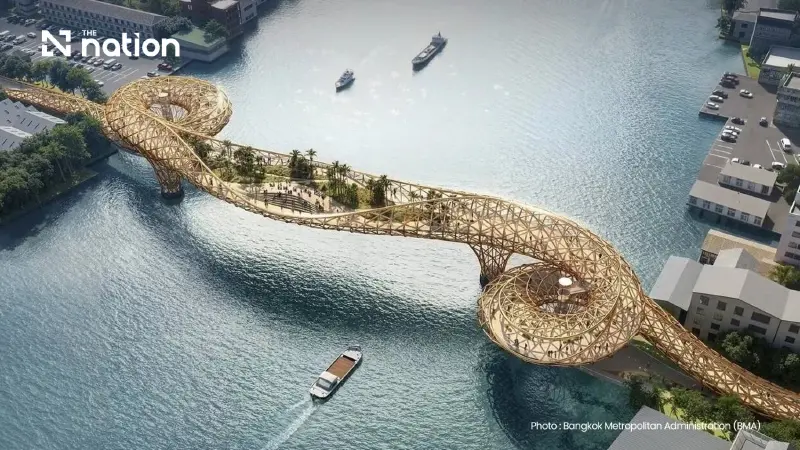


New Chao Phraya River footbridge to connect historic Songwat and Khlong San, boosting green mobility and multi-modal transit links by 2030
- Bangkok plans to build a pedestrian and bicycle bridge across the Chao Phraya River, connecting the historic districts of Songwat and Khlong San.
- The project has an estimated budget of over 1 billion baht (approx. $29 million) and is scheduled for completion by 2030.
- A primary goal is to boost green mobility by creating an interchange for the city's "wheel-rail-river" transport network, linking walkways to MRT train stations.
- The bridge is intended to be a landmark that reduces the economic divide between the Phra Nakhon and Thonburi sides of the city without requiring land expropriation.
A new Chao Phraya River footbridge to connect historic Songwat and Khlong San, boosting green mobility and multi-modal transit links by 2030.
The Bangkok Metropolitan Administration (BMA) has unveiled plans to construct a landmark pedestrian and bicycle bridge across the Chao Phraya River, aiming to link the capital’s historic districts of Songwat and Khlong San while expanding green transit options for residents and tourists alike.
Led by Bangkok Governor Chadchart Sittipunt, the project carries an estimated construction budget exceeding 1 billion baht (approx. $29 million) and is slated for completion by 2030.
As reported by Krungthep Turakij’s sustainability journalist Wirassanan Tuengtin, the footbridge is envisioned as a world-class urban landmark that will foster a sustainable pedestrian ecosystem and bridge the economic divide between the city's Phra Nakhon and Thonburi sides.
Connecting 'Wheel, Rail and River'
Historically, crossing the Chao Phraya River has presented significant hurdles for non-motorised commuters. Existing routes are dominated by heavy vehicular traffic, while ferry services operate within restricted hours, leaving pedestrians and cyclists with limited, often unsafe options.
The new structure aims to solve these bottlenecks by functioning as an interchange for Bangkok's multi-modal "wheel-rail-river" transport network.
On the Phra Nakhon side, the bridge will connect footpaths to the vibrant Yaowarat (Chinatown) district and the MRT Silver Line at Wat Mangkon Station. On the Thonburi bank, it will link directly with the MRT Southern Purple Line (Tao Poon–Rat Burana extension), which is currently under construction.

Governor Chadchart stressed that the project aligns with his administration’s policy of developing human-centric infrastructure alongside major road networks.
"I want the city to have a landmark—a bridge across the Chao Phraya River specifically for pedestrians and cyclists, as there are already plenty of bridges for cars," Chadchart said. "This will create a context for the surrounding community economy and help reduce disparities between the Phra Nakhon and Thonburi sides, which were often overlooked in the past."

No Land Expropriation
According to technical details from the BMA’s Department of Public Works, the 300-metre-long river span will sit between the existing Phra Pok Klao and Phra Chao Tak Sin Maharaj bridges.
The structure will feature a width ranging between 7 and 10 metres, anchored on the Phra Nakhon side at Sawasdee Pier on Songwat Road and extending across to Chiang Mai Road in Khlong San District. The overall network footprint will cover approximately 1 kilometre.
Crucially, project planners confirmed the development will proceed without additional land expropriation, minimising disruption to long-standing riverside communities. To support grassroots trade, the design explores incorporating rooftop spaces on connecting buildings for community shops and street food vendors.
Preparatory work is already under way. Following a 25 million baht consultancy contract awarded to Chulalongkorn University’s Academic Services Centre under contract SNY.2/2025, detailed designs and an Environmental Impact Assessment (EIA) are expected to conclude in late 2025. Physical construction is scheduled to begin in 2028 following final budget approvals.

Building 'Social Infrastructure'
Urban experts have welcomed the project as a shift away from car-centric planning towards a more inclusive city model.
Pichai Wongwaisayawan, Dean of the Faculty of Architecture at Bangkok University, described the crossing as vital "social infrastructure" that links people, cultures and transit modes rather than merely offering a physical pathway.
"The true value of this bridge lies not in the structure itself, but in its ability to connect all transport systems together—be it trains, boats, walkways, or bicycles," Pichai noted.
He added that while tropical weather considerations, shade, Universal Design, and 24-hour lighting are essential technical requirements, the ultimate success of the project will depend on how well it integrates into a wider network.
"Bangkok today does not lack landmarks; it lacks an interconnected network of public spaces," Pichai said. "If this bridge serves merely as a destination, it will succeed to a certain degree. But if it marks the beginning of a network of riverfront walkways connecting communities and public transit, it will become a lasting urban legacy."
