
The Park Connector: How Bangkok Is Building a Living Climate Buffer Between Lumpini and Benjakitti
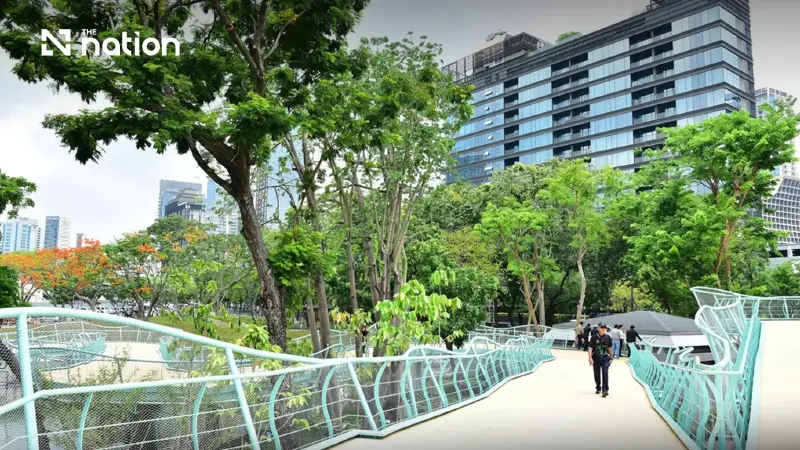


Bangkok is stitching together its largest urban parks with smart infrastructure — a 1.6-kilometre green corridor that doubles as a blueprint for the climate-adaptive city
- Bangkok is constructing a 1.6-kilometre elevated and ground-level walkway, called the "Green Connection," to link Lumpini Park and Benjakitti Park.
- The corridor is designed as a climate-adaptive infrastructure, part of the city's "Blue & Green Network," to combat urban heat, sinking land, and rising sea levels.
- As a "living buffer," it incorporates features like misting systems, vertical gardens, and improved water management, treating green space as essential infrastructure rather than just an amenity.
- The project aims to be a "strategic wellness asset" by integrating universal design, accessibility ramps, and connections to public transit to encourage pedestrian use.
Bangkok is stitching together its largest urban parks with smart infrastructure — a 1.6-kilometre green corridor that doubles as a blueprint for the climate-adaptive city.
Until recently, the route between Lumpini Park and Benjakitti Park — two of Bangkok's largest green lungs — was an unremarkable stretch of Witthayu Road: congested, sun-exposed, and hostile to pedestrians. The capital had two significant parks and no meaningful way to move between them on foot.
That gap is now being addressed through one of the most considered pieces of public realm design in the city's modern history.
The 1.6-kilometre "Green Connection" is a linear elevated and ground-level walkway that bridges the Witthayu central business district with the lakeside expanse of Benjakitti Forest Park, which, at 450 rai (roughly 72 hectares), is the largest green space in inner Bangkok.
The corridor incorporates universal design principles — including sport-grade surfacing, high-performance accessibility ramps, vertical gardens, and smart CCTV infrastructure — to create what city planners describe as a continuous "strategic wellness asset".

The broader context for this corridor is the Bangkok Metropolitan Administration's Blue & Green Network, an urban regeneration programme spearheaded in partnership with landscape architects including Kotchakorn Voraakhom of LANDPROCESS, whose firm designed the Chong Nonsi Canal Park and the Chulalongkorn Centenary Park.
Kotchakorn has noted publicly that Bangkok, built on the soft alluvial soils of the Chao Phraya delta, sinks at approximately two centimetres per year.
The IPCC projects sea levels to rise by 33 centimetres by 2050. In that context, parks are not amenities — they are infrastructure.

The Green Connection also functions as a "digital detox" corridor – an informal branding that emerged organically from the park's morning users, who range from office workers on guided corporate wellness programmes to government-sponsored free exercise classes.
Research by the Stockholm Environment Institute (SEI), based on early 2025 fieldwork at Bangkok's pocket parks, found that park use varies dramatically by neighbourhood, design, and aesthetic — but that parks drawing hundreds of visitors at peak times share a consistent quality: meaningful integration with their surrounding communities and transit networks.

The Lumpini-Benjakitti corridor addresses this by integrating MINE Smart Ferry ports along the canal edge, adding misting systems to combat Bangkok's rising urban heat — which Kotchakorn has described as the result of "urban growth making Lumpini an unhealthy lung" — and embedding pocket gardens along its length.
Renovation of Lumpini Park itself, covering 360 rai, was expected to be substantially complete by 2025 and encompasses historical preservation, recreational design, and a Green Bridge connecting it to Benjakitti.

Bangkok's broader park initiative is not without critics. SEI researchers noted that the Chong Nonsi Canal Park — the pilot project for the Blue & Green Network — faced practical limitations after construction: smaller non-native tree species replaced large native ones, concrete coverage increased, and water quality improvements were slower than projected.
The lesson the BMA appears to be applying to subsequent projects, including the Green Mile Upgrade, is that function must take precedence over form — and that climate resilience requires water management as much as greenery.
